











• bitcoinBitcoin(BTC)$85,198.000.49%
  • ethereumEthereum(ETH)$2,696.230.64%
  • tetherTether(USDT)$1.000.00%
  • binancecoinBNB(BNB)$787.101.58%
  • rippleXRP(XRP)$1.501.07%
  • usd-coinUSDC(USDC)$1.000.00%
  • solanaSolana(SOL)$121.632.02%
  • tronTRON(TRX)$0.335642-0.11%
  • Figure HelocFigure Heloc(FIGR_HELOC)$1.072.33%
  • zcashZcash(ZEC)$1,323.062.29%
  • HyperliquidHyperliquid(HYPE)$89.961.87%
  • dogecoinDogecoin(DOGE)$0.0934530.74%
  • chainlinkChainlink(LINK)$14.111.97%
  • moneroMonero(XMR)$548.67-0.16%
  • whitebitWhiteBIT Coin(WBT)$84.770.48%
  • USDSUSDS(USDS)$1.000.00%
  • cardanoCardano(ADA)$0.244539-0.03%
  • RainRain(RAIN)$0.01217821.13%
  • leo-tokenLEO Token(LEO)$8.99-0.05%
  • stellarStellar(XLM)$0.2156420.30%
  • bitcoin-cashBitcoin Cash(BCH)$317.771.96%
  • nearNEAR Protocol(NEAR)$4.865.02%
  • uniswapUniswap(UNI)$8.99-1.45%
  • litecoinLitecoin(LTC)$71.042.11%
  • CantonCanton(CC)$0.1247843.07%
  • suiSui(SUI)$1.201.57%
  • Ethena USDeEthena USDe(USDE)$1.000.00%
  • avalanche-2Avalanche(AVAX)$11.00-1.33%
  • daiDai(DAI)$1.00-0.01%
  • hedera-hashgraphHedera(HBAR)$0.101502-0.08%
  • USD1USD1(USD1)$1.000.01%
  • the-open-networkGram (prev. Toncoin)(GRAM)$1.521.10%
  • quant-networkQuant(QNT)$256.942.95%
  • BittensorBittensor(TAO)$304.385.03%
  • crypto-com-chainCronos(CRO)$0.0683263.83%
  • shiba-inuShiba Inu(SHIB)$0.0000060.02%
  • tether-goldTether Gold(XAUT)$4,141.600.09%
  • BitwayBitway(BTW)$1.20-17.26%
  • Global DollarGlobal Dollar(USDG)$1.000.01%
  • Pump.funPump.fun(PUMP)$0.00628010.30%
  • paypal-usdPayPal USD(PYUSD)$1.000.00%
  • aaveAave(AAVE)$178.78-0.64%
  • okbOKB(OKB)$121.010.82%
  • Ripple USDRipple USD(RLUSD)$1.000.01%
  • Circle USYCCircle USYC(USYC)$1.140.00%
  • OndoOndo(ONDO)$0.4930041.10%
  • EthenaEthena(ENA)$0.2355321.74%
  • MemeCoreMemeCore(M)$1.041.51%
  • Ondo US Dollar YieldOndo US Dollar Yield(USDY)$1.150.00%
  • BlackRock USD Institutional Digital Liquidity FundBlackRock USD Institutional Digital Liquidity Fund(BUIDL)$1.000.00%
TradePoint.io
  • Main
  • AI & Technology
  • Stock Charts
  • Market & News
  • Business
  • Finance Tips
  • Trade Tube
  • Blog
  • Shop
No Result
View All Result
TradePoint.io
No Result
View All Result

What Is Infill In 3D Printing And Is It Necessary?

October 4, 2026
in AI & Technology
Reading Time: 4 mins read
A A
What Is Infill In 3D Printing And Is It Necessary?
ShareShareShareShareShare

Your 3D prints probably don’t need to be rock solid, but what goes inside them still matters.


Reflexpixel/Getty Images

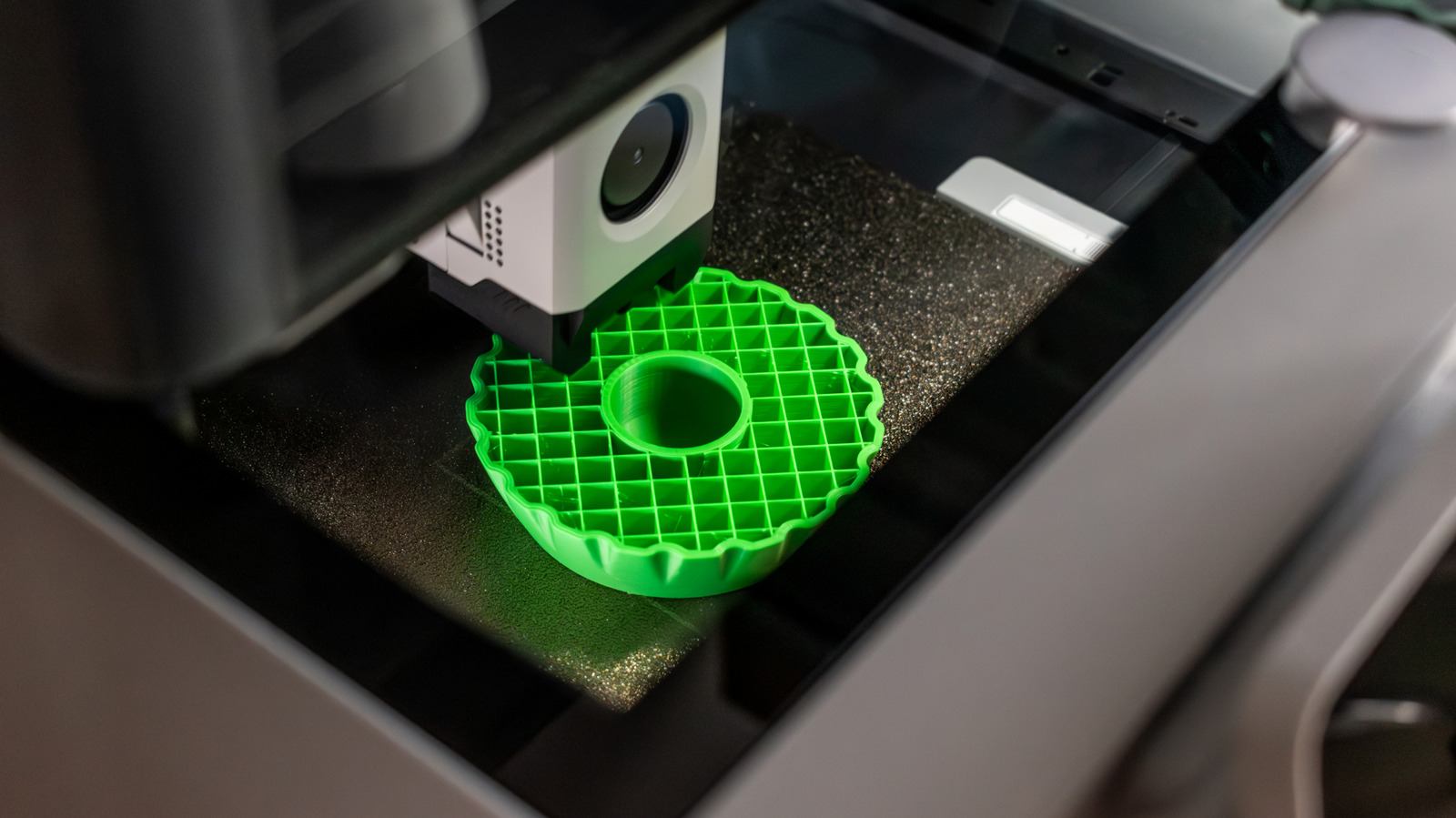
You may have noticed a weird web of lines inside 3D-printed models. That’s infill. Typically, the interior of a model is not solid plastic in FDM or FFF 3D printing. Rather, the slicer (software that prepares files for 3D printing) generates an internal structure that supports the layers above it and provides some extra rigidity to the final product without wasting a whole spool of filament.

YOU MAY ALSO LIKE

Fighting AI Slop in Science Papers – Unite.AI

What Are Amplifiers For And How Important Are They To Your Sound System’s Quality?

Infill isn’t part of every 3D-printing process. For instance, resin printers tend to create solid models unless they are intentionally hollowed out. However, on the filament printers most beginners will be using, infill is one of those settings that can subtly alter the length of a print, the amount of material used and the strength of the finished part.

Infill density changes more than how much plastic is inside
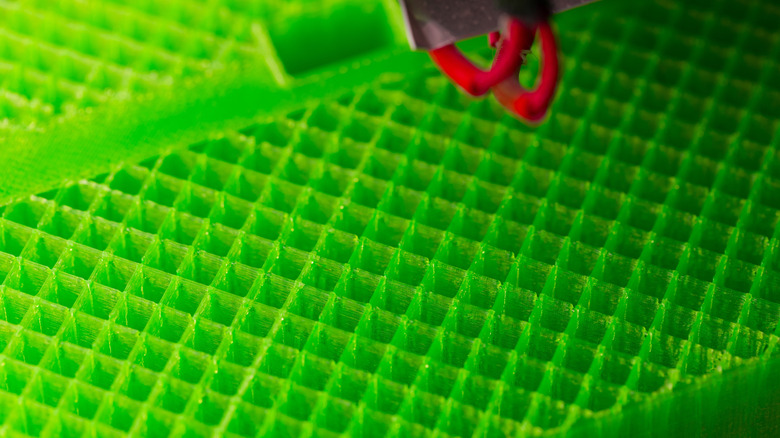

Close-up of a 3D printer building a green lattice infill structure.
nikkytok/Shutterstock

The infill density is given as a percentage. A model printed at 0 percent is hollow. The greater the percentage, the denser the internal structure. The slicer can also attempt to fill the interior at 100 percent, but you won’t need to do that very often, if at all.

Most models can be printed with 10 to 15 percent infill, according to Prusa, and Flashforge recommends 20 percent as a starting point for general use. Neither source considers those numbers to be a universal rule. That makes figures like 10 or 20 percent less frightening than they may seem. A decorative figure or test print might require minimal infill, but a bracket supporting weight or taking repeated hits deserves more support inside.

Even 0 percent can work! In some cases, a model with a closed bottom can print flawlessly with an empty interior if it gradually closes toward the top. A wide flat surface is a different matter, as the printer might need to lay down filament across a large area with nothing but air beneath it. The melted plastic coming from the nozzle will sag when there’s no structure to hold it up. That’s why it’s important to check your slicer’s layer preview before discovering the problem several hours into a print.

Higher infill also increases filament use, weight and printing time. It can enhance compression resistance, but the infill percentage is not a magic strength indicator. Wall thickness, print orientation and material choice all play a role, and Prusa points out that more perimeters can be more effective in improving overall strength than more infill when you want a stronger part.

The infill pattern matters too
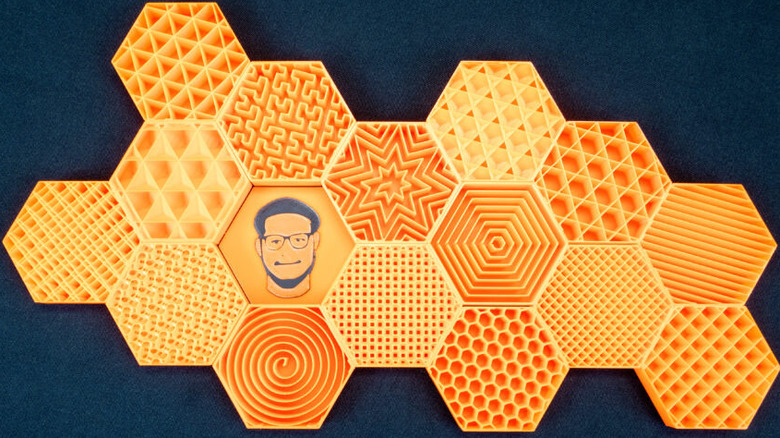

Orange 3D-printed hexagonal samples displaying different infill patterns.
Prusa Research

The amount of infill a printer will create depends on the density. All that plastic takes the shape of the pattern.

There are several patterns available with slicers, as no one pattern is ideal for all situations. Grid is a simple general-purpose solution. Cubic creates a 3D internal structure that can withstand forces from various directions. Gyroid is a replacement for straight lines with continuous curves and is often used for functional parts where a more even strength in multiple directions is beneficial. It also appears that someone has stuffed futuristic pasta into your print, which is a welcome addition no one requested.

Lightning infill moves almost in the opposite direction. It is not a regular structure throughout the model, but branches out mainly where upper surfaces need support. This can reduce the amount of filament used and the amount of time spent printing, but it will not offer the same amount of internal reinforcement as patterns designed for strength.

For beginners, it is not necessary to learn the whole infill menu of the slicer before printing anything. The default pattern and a moderate density are quite reasonable starting points. Replace them when the object provides you with a reason to.

A display model, electronics enclosure and load-bearing bracket all have different functions, and it doesn’t make sense to use the same infill for all three. Prusa says for normal models, infill over 30 percent is hardly ever needed.

Credit: Source link

ShareTweetSendSharePin

Related Posts

Fighting AI Slop in Science Papers – Unite.AI
AI & Technology

Fighting AI Slop in Science Papers – Unite.AI

October 4, 2026
What Are Amplifiers For And How Important Are They To Your Sound System’s Quality?
AI & Technology

What Are Amplifiers For And How Important Are They To Your Sound System’s Quality?

October 4, 2026
How Has Apple’s Mac Studio Changed Over The Years?
AI & Technology

How Has Apple’s Mac Studio Changed Over The Years?

October 4, 2026
What’s The Difference Between Battery Capacity And Battery Life?
AI & Technology

What’s The Difference Between Battery Capacity And Battery Life?

October 3, 2026
Next Post
Full Episode: TODAY Show – Sept. 29

Full Episode: TODAY Show - Sept. 29

Leave a Reply Cancel reply

Your email address will not be published. Required fields are marked *

Search

No Result
View All Result
OpenAI Launches dots: Always-On GPT-6 Astra Agents That Work From Their Own Cloud Computers

OpenAI Launches dots: Always-On GPT-6 Astra Agents That Work From Their Own Cloud Computers

September 29, 2026
How To Improve Your Router’s Security In 10 Minutes

How To Improve Your Router’s Security In 10 Minutes

September 27, 2026
SpaceX Starship Lifts Off for Key Orbital Test

SpaceX Starship Lifts Off for Key Orbital Test

September 28, 2026

About

Learn more

Our Services

Legal

Privacy Policy

Terms of Use

Bloggers

Learn more

Article Links

Contact

Advertise

Ask us anything

©2020- TradePoint.io - All rights reserved!

Tradepoint.io, being just a publishing and technology platform, is not a registered broker-dealer or investment adviser. So we do not provide investment advice. Rather, brokerage services are provided to clients of Tradepoint.io by independent SEC-registered broker-dealers and members of FINRA/SIPC. Every form of investing carries some risk and past performance is not a guarantee of future results. “Tradepoint.io“, “Instant Investing” and “My Trading Tools” are registered trademarks of Apperbuild, LLC.

This website is operated by Apperbuild, LLC. We have no link to any brokerage firm and we do not provide investment advice. Every information and resource we provide is solely for the education of our readers. © 2020 Apperbuild, LLC. All rights reserved.

No Result
View All Result
  • Main
  • AI & Technology
  • Stock Charts
  • Market & News
  • Business
  • Finance Tips
  • Trade Tube
  • Blog
  • Shop

© 2023 - TradePoint.io - All Rights Reserved!