

DNY59
When I started investing in REITs over a decade ago, I remember that W. P. Carey (NYSE:WPC) was one of the most popular REITs in the world.
W. P. Carey
It was loved by most REIT investors because:
- It had one of the longest dividend growth track records in the REIT sector.
- It had massively outperformed the average of the REIT sector.
- Its leases were unique in that they included CPI-based rent adjustments.
- Its portfolio was far better diversified than that of its net lease peers (O; NNN; ADC; etc.).
- Its future growth prospects seemed compelling, and yet, its valuation was quite reasonable, making it a compelling investment opportunity.
But today, it is the opposite.
The REIT is now hated by most REIT investors, and as a result, it is today priced at one of the lowest valuations in a very long time:
TIKR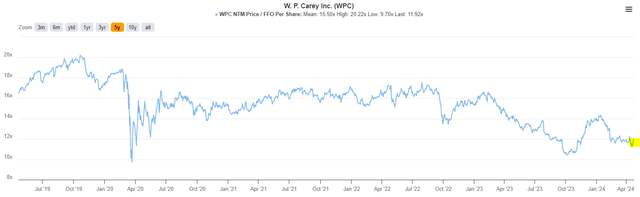
What caused this shift in market sentiment?
I believe that it is the result of two things:
Firstly, WPC has now had a long streak of disappointing growth. Already before the pandemic, WPC had begun to divest its asset management business, which had become a distraction and was resulting in conflicts of interest. It was well-known to everyone that getting out of this business would be dilutive to FFO per share, but the REIT argued that it would increase the quality of its earnings, justifying a higher valuation multiple. But so far, it has had the opposite effect. The gradual exit of this business caused its FFO per share to stagnate and hurt its market sentiment, as REIT investors began to perceive WPC as a REIT that was stuck with poor growth prospects. You can clearly see that in the tiny dividend hikes from 2018 to 2023.
This lack of growth led many investors to sell WPC and reinvest in some of its faster-growing peers, like Agree Realty (ADC). However, some investors still held hope that growth would soon reaccelerate as they complete their exit from the asset management business.
We were finally getting to that point and that’s when WPC announced that they would also exit the office property segment, spinning off most of its properties into a separate REIT and selling the rest individually in order to pay off debt and refocus on stronger property segments.
Naturally, this caused its cash flow to drop to a lower level and therefore, its dividend wasn’t sustainable anymore. WPC then used this as an opportunity to reset its dividend payout ratio at a materially lower level, which would allow it to retain a larger portion of its cash flow to reinvest in growth and be less dependent on public capital markets at a time when most REITs are discounted and their cost of capital is historically high.
That was the last straw for a lot of investors who had patiently held WPC because they were at least getting paid a steady dividend.
The cut then left a sour taste in the mouths of income investors who took this as a betrayal from the management team as it had previously emphasized that their dividend was safe.
W. P. Carey
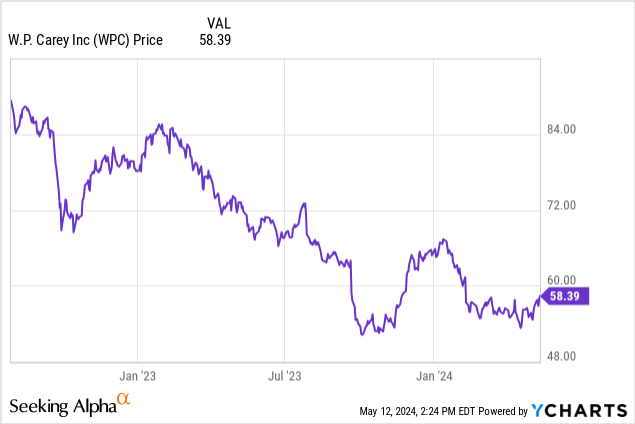
That brings us to today. Growth investors have given up because of the long stretch of zero growth, and income investors finally threw in the towel due to the dividend cut. As a result, WPC’s share price has crashed and the REIT is now hated by most of the market.
Is now a good time to buy this once-popular REIT while it is discounted?
Or should you sell before it drops even lower than it already has?
We are contrarian here and think that this is a great buying opportunity.
WPC has now almost completed its transformation and it has become a far better REIT in terms of its quality, risk profile, and future growth prospects, and yet, it is priced at a historically low valuation.
I understand the frustration of many investors who bought WPC years ago and suffered poor returns as they saw it turn into a value trap, but past results are not indicative of future returns and WPC is now well-positioned to return to faster growth in the coming years:
- It has become a traditional REIT with no major asset management component that would lower the quality of its earnings.
- It has sold most of its office properties, and become a quasi-industrial net lease REIT, generating about 2/3 of its income from industrial assets and the remaining 1/3 from essential retail net lease properties.
- Its leases enjoy CPI-based rent adjustments, which should result in above-average organic growth for a net lease REIT and warrant a premium valuation.
- It has a historically low payout ratio of 71% which should allow it to acquire additional properties and/or pay off debt.
All of these improvements warrant a higher valuation multiple, but investors have not realized that yet.
Right now, WPC is so hated that I see many investors claim that it is mismanaged and therefore uninvestable. But the reality is that WPC has been a public company for decades, and it has massively outperformed sector averages and even the S&P 500 (SPY):
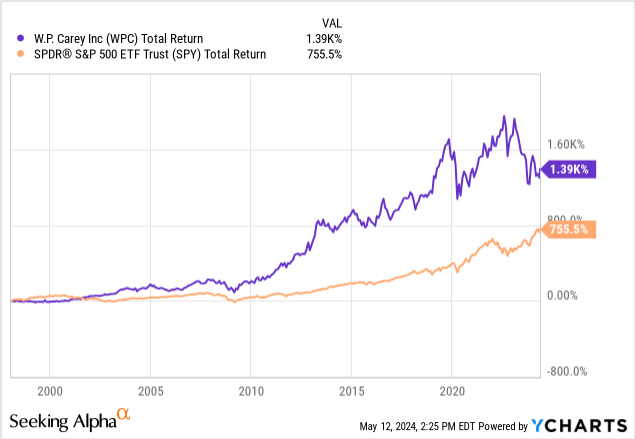
This is one of the best track records in the entire REIT sector, and you just don’t achieve such results by accident.
Their decision to exit the asset management business and the office property segment and to cut the dividend is hurting the REIT’s market sentiment over the short run, but they are likely the right long-term decisions for the company.
For which of these two REITs would you be willing to pay more?
1) A diversified net lease REIT with significant office exposure, an asset management business, and a high dividend payout ratio that hurts its growth prospects.
OR
2) A quasi-industrial net lease REIT with a more reasonable payout ratio and better growth prospects.
It is quite obvious that the second REIT deserves a materially higher valuation multiple because it is safer and able to grow at a faster pace.
Today, the REIT market is too shortsighted to see this, but as the REIT sees its growth accelerate in the coming years, I expect the market to warm up to it again and its valuation multiple to recover to a more reasonable level.
Today, it trades at just 12x FFO, which is about two times lower than the average valuation multiple of industrial REITs.
WPC deserves to trade at a discount because it is not a pure-play industrial REIT and its long leases limit its ability to hike rents, but could we see it reprice at 16x FFO?
I believe so.
16x FFO would still represent a steep discount to its industrial peer group, but it would unlock 30%+ upside from here and while you wait, you earn a safe and growing 6% dividend yield.
That’s very attractive coming from what used to be perceived as a “blue-chip REIT” with a BBB+ investment grade rating.
Closing Note
The market sentiment of REITs can change rapidly.
There was a time when Agree Realty Corporation was hated because it cut its dividend in 2011. But then it was one of the most rewarding net lease REITs in the following decade, and today, it is priced at one of the highest valuation multiples in its sector.
I expect the same to happen to WPC. It is today hated, but its transformation is almost complete, and its future prospects seem very compelling when you add up its yield, growth, and upside potential from future multiple expansion.
For this reason, we have been buying a lot more shares lately for our Retirement Portfolio.
Credit: Source link