






























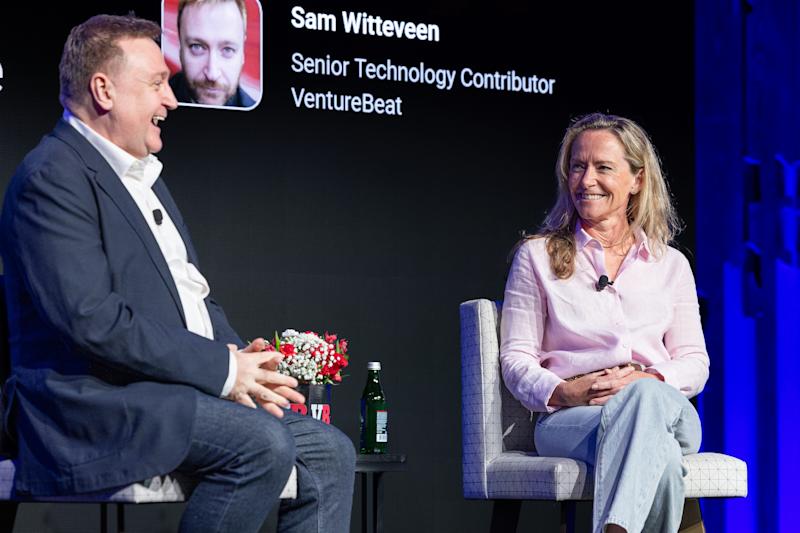

Target SVP Siobhán Mc Feeney says the AI models her company runs aren’t what gives Target its edge — everything built around them is.
“There’s a lot in it. That to us is the moat,” Mc Feeney said at VB Transform 2026. “The models are great, and they’re important. They’re just not sufficient to be the competitive advantage.”
That discipline shows up early in how Target decides whether to build an agent at all. Mc Feeney was blunt, even “controversial” by her own admission, about the current AI moment: every enterprise wants AI agents, but not everything needs one, she said.
Agents earn their autonomy over time rather than getting it by default, she said — a principle that runs through everything Target has built around them.
Mc Feeney said the goal is to make sure agents are aimed at the problems that drive the most value for Target’s guests. “We want to make sure we’re investing in the right places,” she said.
Being deliberate about agents
Agents are becoming part of Target’s underlying architecture, increasingly connecting signals, systems, and decisions across supply chain, replenishment, and demand forecasting.
Mc Feeney framed it as retail’s oldest promise — the right product, in the right place, at the right time — delivered at scale.
But her team has been deliberate about building AI agents, beginning with the simplest, most obvious question: What is the problem they’re trying to solve? This leads to several follow-on questions:
-
Does that problem need an agent?
-
If it does, what type of agent? An orchestrator? A super agent? A domain-specific agent?
-
Or is what you’re calling an “agent” actually just a tool?
“You define that upfront, and this may sound a little process-heavy, then you have to register and certify your agent,” Mc Feeney said. Because a solution may already exist, and you don’t want to duplicate work.
Agent design kicks off another series of important questions: What triggers an agent to act? Automation? An engineer? A timer? What needs to be put in place to track that?
“We’re trying to make sure we have lineage from the very beginning — the birthing of this agent, all the way through — because at 2 a.m. one morning, when something goes sideways, we want to make sure we understand everything that happened,” Mc Feeney said.
Autonomy level is another consideration; new agents typically start with base autonomy and earn more over time. What the agent has access to is a separate question: what data, what systems, what tables, what databases?
Finally, there’s monitoring and observability; agents won’t solve problems, or improve over time, if they’re not continuously evaluated.
“We measure everything: What it was intended to do, its calibration, its trajectory, not just runtime and latency,” Mc Feeney said. This creates full transparency, and allows agents to be tweaked over time.
“You’re talking about architecture and taxonomy and a data governance layer that absolutely had to be established,” she said.
There’s a lot in these “layers of autonomy” — that foundation is what gives Target the ability to scale and properly invest in the right models for the right problem.
Models have different “gradients” that are better for different jobs; for instance, frontier models excel at complex tasks that require crunching billions of pieces of data (like in heavy merchandising supply chains). But in some scenarios they can be cost-prohibitive.
“So it’s making sure there’s always a cost benefit,” Mc Feeney said.
Agents must earn their autonomy
A digital-twin simulation predicted men’s shorts inventory across three Target stores in Long Beach this summer — and one store came back needing six to seven times more stock than the others, she said. Inventory analysts’ first reaction: That can’t be right. But the system had found something they hadn’t factored in. That store sat less than two miles from the beach; the other two were 10 to 12 miles inland. Analysts let the recommendation stand, and the stock sold through.
“This is science. This is mathematically more significant and more confidence-filling than humans doing it,” Mc Feeney said. Results like that are what let Target’s agentic systems earn more autonomy over time, she said.
Target looks at AI agent autonomy as “earned” and structures it as a four-level ladder, Mc Feeney said: agents start by making observations without acting, then move to suggesting actions while waiting for approval, then to acting within defined guardrails. At the highest level Target currently operates, agents run end-to-end — but still with a human in the loop.
“The autonomy levels for the agents are super important,” Mc Feeney said. “They earn them, and they can lose them if they don’t perform as expected.” Models that drift will be taken out of service.
As she put it, humans earn autonomy when we prove we can do something over time. Nobody is given a bunch of extra responsibilities just because; they have to have shown they’re able to handle them.
In a similar way, agents can be scientifically measured and quantified: how accurate they were, how much they drifted, and how close they came to their intended goal. This helps establish guardrails, allowing builders to work faster, and “go fast forever,” because they’re not constantly wondering where the guardrails are.
“If you follow these guardrails, you [follow] security guidelines, you register the agent, and something still goes wrong, we have full lineage all the way through from the start,” Mc Feeney said. “Our ability to recover is much better.”
When it comes down to it, agent success is a confluence of factors, not just one, she said: “It’s about your architecture. It’s about your taxonomy. It’s about the autonomy levels your agents have, and it’s about security and observability.”
A new skill set for new workflows
Even when agent autonomy is high, though, builders must still be held accountable when something goes wrong. Mc Feeney noted that teams are now working at speeds no one could have anticipated, which means evaluation harnesses have to be established and agents registered and tracked.
A lot of it is cultural; the workforce is being reshaped and builders and engineers need new skills to manage human workers and AI systems side by side. These contexts are quite different, but the career evolution is “super exciting.”
“You’re a builder. You’re observing agents building, and you’re also coaching humans observing agents building,” Mc Feeney said. “The level of nuance is pretty special.”
Credit: Source link