































BharatGen introduced Patram 1.5 on November 25, 2026, a 7.8-billion-parameter open-weight vision-language model for document intelligence. Its two central additions are prompt-controlled OCR and abstention, the ability to hold back an answer when evidence is missing or conflicting, the input is unreadable, or the question is ambiguous.
A text-first extraction pipeline can flatten information that gives a document meaning. Patram instead processes page images directly, preserving visual cues such as table rows and columns, blank form fields, tick boxes, signatures, stamps and the relationships inside diagrams. Its six task areas cover document and element parsing, question answering, key-value extraction, OCR 3.0 and abstention, with inputs including handwriting, complex tables, charts and formulas.
Prompt-Controlled OCR and Abstention
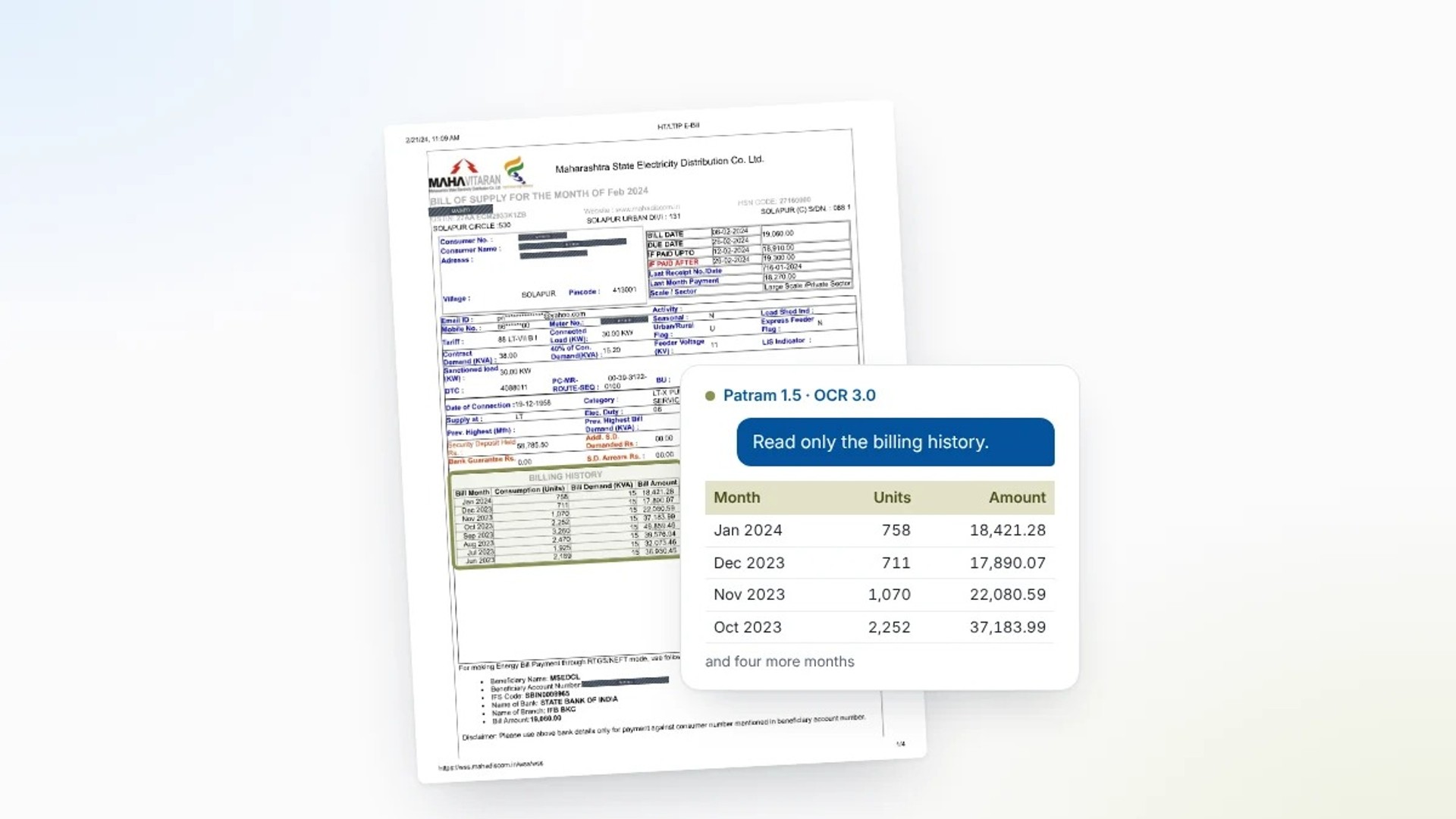
OCR 3.0 turns the prompt into the extraction specification. A user can select a whole page, a region or a semantic element; exclude unwanted material; retain text, structure, styling, layout or readability information; and request text, Markdown, HTML, JSON, LaTeX or Mermaid output. Field names can come from the user, structures can be flat or nested, and personal details can be masked during extraction.
One BharatGen example asks for only the electricity-bill months above 2,000 units and returns four JSON records containing month, units and amount, rather than the entire bill. That illustrates how extraction can move filtering and formatting into the model request, reducing the separate parsing work around it.
Abstention addresses a different failure: a confident value that the page cannot support. BharatGen’s triggers include an absent answer, source material that cannot be read as requested, an ambiguous question, a false premise and conflicting evidence. The model can answer the readable portion, explain what is missing, assign confidence to individual values, request a clearer copy or identify a best guess for review.
That behavior connects to BharatGen’s workflow design, in which the model reads and extracts, code checks the details, and people handle decisions that need review. For regulated or sensitive paperwork, the practical value is a documented reason for routing doubtful values to a person while allowing clearer answers to proceed.
BharatGen’s Benchmark Results
BharatGen evaluated Patram 1.5 on 15 PatramBench tasks and 34 public benchmarks against 27 other systems: 20 vision-language models and seven OCR or parsing systems. Every reported score came from BharatGen’s own runs under the same settings. The overall score equally weights the PatramBench and public results.
On that combined measure, BharatGen reports 83; its component scores are 85 on PatramBench and 81 on the public benchmarks. Patram is level with Qwen3.5-397B-A17B and DeepSeek-V4.1-Flash, listed at 403 billion and 763 billion parameters respectively. Those larger models each scored 82 on the public component, compared with Patram’s 81, so the overall parity does not mean it led every part of the evaluation.
BharatGen’s token comparison uses the same 10 question-answering tests. It reports that Patram produced 21 answers in the number of tokens Qwen3.5-9B used for one thinking-mode answer, while both scored 85. The measurement covers tokens written, not inference speed, so the result concerns output efficiency and leaves comparative response speed unresolved.
The published evaluation has explicit language limits. Its 15 PatramBench tasks contain 11,828 items drawn from 8,773 English document pages, while the public benchmarks use English test items only. The stated language scope is English and code-mixed pages. The full PatramBench account of its pages and 86 tasks is still forthcoming, while the AIKosh listing says a technical report detailing limitations and failure modes will follow.
Open Weights and Deployment
The Hugging Face model card lists a 32,768-token context length and identifies a SigLIP 2 vision encoder and an Olmo 3 7B Instruct language decoder. The weights carry an Apache 2.0 license, permitting commercial use and fine-tuning. Access is free and granted immediately, but automatically gated: users must log in and accept conditions that share their username and email address with BharatGen.
BharatGen says the model can run on a single GPU. Together with the downloadable weights, that gives organizations the option of processing sensitive documents on their own servers or cloud, keeping pages inside their own systems.
The vision-model page describes a limited Playground preview with 1,000 free credits per user. It includes Chat, Parse, Extract, Classify, Split and Section tools, plus ready-made workflows for identity verification, loan underwriting, health claims and contract work. API access remains on a waitlist.
For researchers and document-heavy organizations, the release offers a compact model they can examine and run locally, with promptable extraction shaping the data and abstention marking the values that still need human review. That combination addresses two practical barriers to document automation: keeping sensitive pages under the user’s control and concentrating review on uncertain values instead of every field.
Credit: Source link