
Sign up for CNN’s Wonder Theory science newsletter. Explore the universe with news on fascinating discoveries, scientific advancements and more.
CNN
—
The sun has a powerful magnetic field that creates sunspots on the star’s surface and unleashes solar storms such as the one that bathed much of the planet in beautiful auroras this month.
But exactly how that magnetic field is generated inside the sun is a puzzle that has vexed astronomers for centuries, going back to the time of Italian astronomer Galileo, who made the first observations of sunspots in the early 1600s, and noticed how they varied over time.
Researchers behind an interdisciplinary study have put forth a new theory in a report published Wednesday in the journal Nature. In contrast to previous research that assumed the sun’s magnetic field originates from deep within the celestial body, they suspect the the source is much closer to the surface.
The model developed by the team could help scientists better understand the 11-year solar cycle and improve the forecasting of space weather, which can disrupt GPS and communication satellites as well as dazzle night sky watchers with auroras.
“This work proposes a new hypothesis for how the sun’s magnetic field is generated that better matches solar observations, and, we hope, could be used to make better predictions of solar activity,” said Daniel Lecoanet, an assistant professor of engineering sciences and applied mathematics at Northwestern University’s McCormick School of Engineering and a member of the Center for Interdisciplinary Exploration and Research in Astrophysics.
“We want to forecast if the next solar cycle will be particularly strong, or maybe weaker than normal. The previous models (assuming the solar magnetic field is generated deep within the Sun) have not been able to make accurate forecasts or (determine) if the next solar cycle will be strong or weak,” he added.
Sunspots help scientists track the sun’s activity. They are the origin point for the explosive flares and ejection events that release light, solar material and energy into space. The recent solar storm is evidence of the sun approaching “solar maximum” — the point in its 11-year cycle when there is the highest number of sunspots.
“Because we think the number of sunspots tracks with the strength of the magnetic field within the Sun, we think the 11-year sunspot cycle is reflecting a cycle in the strength of the Sun’s interior magnetic field,” Lecoanet said.
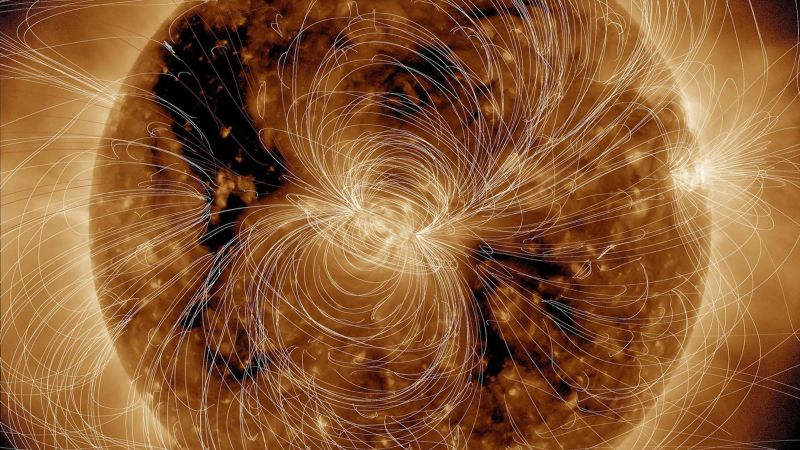
It’s difficult to see the sun’s magnetic field lines, which loop through the solar atmosphere to form a complicated web of magnetic structures far more complex than Earth’s magnetic field. To better grasp how the sun’s magnetic field works, scientists turn to mathematical models.
In a scientific first, the model that Lecoanet and his colleagues developed accounted for a phenomenon called torsional oscillation — magnetically driven flows of gas and plasma within and around the sun that contribute to sunspot formation.
In some areas, the rotation of this solar feature speeds up or slows down, while in others it remains steady. Like the 11-year solar magnetic cycle, torsional oscillations also experience an 11-year cycle.
“Solar observations have given us a good idea for how material moves around inside of the Sun. For our supercomputing calculations, we solved equations to determine how the magnetic field changes within the Sun due to the observed motions,” Lecoanet said.
“No one had done this calculation before because no one knew how to efficiently perform the calculation,” he added.
The group’s calculations showed that magnetic fields can be generated about 20,000 miles (32,100 kilometers) below the sun’s surface — far closer to the surface than had previously been assumed. Other models had suggested it was much deeper — around 130,000 miles (209,200 kilometers).
“Our new hypothesis provides a natural explanation for the torsional oscillations that is missing from previous models,” Lecoanet said.
An important breakthrough was developing new numerical algorithms for running the calculations, Lecoanet said. The paper’s lead author Geoff Vasil, a professor at the University of Edinburgh in the United Kingdom, came up with the idea about 20 years ago, Lecoanet said, but it took over 10 years to develop the algorithms and required a powerful NASA supercomputer to conduct the simulations.
“We have used around 15 million CPU-hours for this investigation,” he said. “That means that if I had tried to run the calculations on my laptop, it would have taken me about 450 years.”
In a commentary published alongside the study, Ellen Zweibel, a professor of astronomy and physics at the University of Wisconsin-Madison, said the initial results were intriguing and would help inform future models and research. She was not involved in the study.
Zweibel said the team had added “a provocative ingredient to the theoretical mix that could prove key to unravelling this astrophysical enigma.”
Credit: Source link