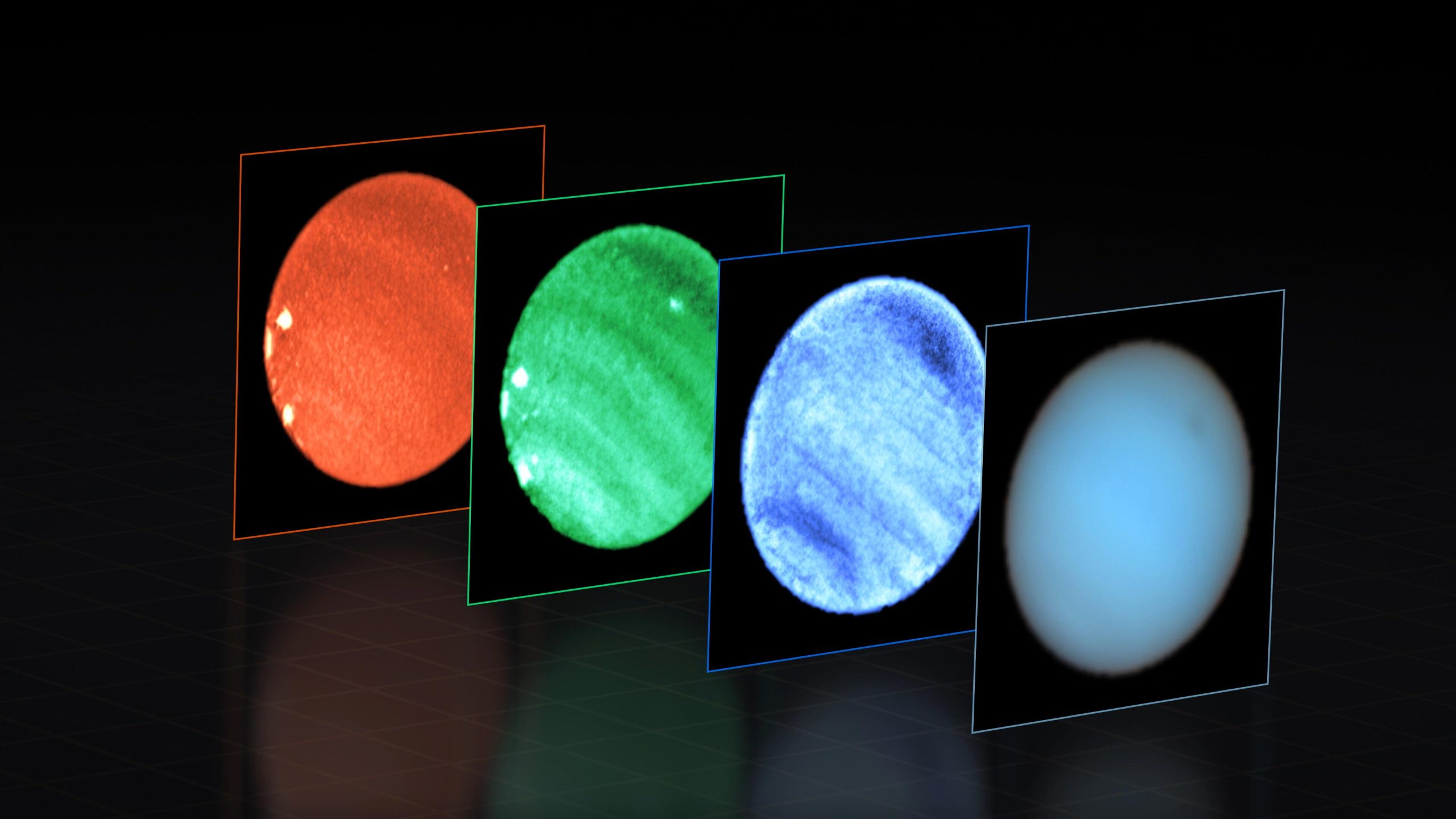

This image shows Neptune observed with the MUSE instrument at ESO’s Very Large Telescope (VLT). At each pixel within Neptune, MUSE splits the incoming light into its constituent colors or wavelengths. This is similar to obtaining images at thousands of different wavelengths all at once, which provides a wealth of valuable information to astronomers. Credit: ESO/P. Irwin et al.
Astronomers using the European Southern Observatory’s Very Large Telescope (VLT) have identified a significant dark spot in Neptune’s atmosphere, with an adjacent smaller bright spot. This marks the first such observation made with a terrestrial telescope.
Using the European Southern Observatory’s Very Large Telescope (VLT), astronomers have observed a large dark spot in Neptune’s atmosphere, with an unexpected smaller bright spot adjacent to it. This is the first time a dark spot on the planet has ever been observed with a telescope on Earth. These occasional features in the blue background of Neptune’s atmosphere are a mystery to astronomers, and the new results provide further clues as to their nature and origin.
Large spots are common features in the atmospheres of giant planets, the most famous being Jupiter’s Great Red Spot. On Neptune, a dark spot was first discovered by NASA’s Voyager 2 in 1989, before disappearing a few years later. “Since the first discovery of a dark spot, I’ve always wondered what these short-lived and elusive dark features are,” says Patrick Irwin, Professor at the University of Oxford in the UK and lead investigator of the study published on August 24 in Nature Astronomy.
Using ESO’s Very Large Telescope (VLT), astronomers have observed a large dark spot in Neptune’s atmosphere, with an unexpected smaller bright spot adjacent to it. This short video summarizes their discovery. Credit: ESO
Findings From the Observations
Irwin and his team used data from ESO’s VLT to rule out the possibility that dark spots are caused by a ‘clearing’ in the clouds. The new observations indicate instead that dark spots are likely the result of air particles darkening in a layer below the main visible haze layer, as ices and hazes mix in Neptune’s atmosphere.
Coming to this conclusion was no easy feat because dark spots are not permanent features of Neptune’s atmosphere and astronomers had never before been able to study them in sufficient detail. The opportunity came after the NASA/ESA Hubble Space Telescope discovered several dark spots in Neptune’s atmosphere, including one in the planet’s northern hemisphere first noticed in 2018. Irwin and his team immediately got to work studying it from the ground — with an instrument that is ideally suited to these challenging observations.
Using the VLT’s Multi Unit Spectroscopic Explorer (MUSE), the researchers were able to split reflected sunlight from Neptune and its spot into its component colors, or wavelengths, and obtain a 3D spectrum.[1] This meant they could study the spot in more detail than was possible before. “I’m absolutely thrilled to have been able to not only make the first detection of a dark spot from the ground, but also record for the very first time a reflection spectrum of such a feature,” says Irwin.

This image shows Neptune observed with the MUSE instrument at ESO’s Very Large Telescope. At each pixel within Neptune, MUSE splits the incoming light into its constituent colors or wavelengths. This is similar to obtaining images at thousands of different wavelengths all at once, which provides a wealth of valuable information to astronomers. This image combines all colors captured by MUSE into a “natural” view of Neptune, where a dark spot can be seen to the upper right. Credit: ESO/P. Irwin et al.
Significance of the Spectrum Analysis
Since different wavelengths probe different depths in Neptune’s atmosphere, having a spectrum enabled astronomers to better determine the height at which the dark spot sits in the planet’s atmosphere. The spectrum also provided information on the chemical composition of the different layers of the atmosphere, which gave the team clues as to why the spot appeared dark.
The observations also offered up a surprise result. “In the process, we discovered a rare deep bright cloud type that had never been identified before, even from space,” says study co-author Michael Wong, a researcher at the University of California, Berkeley, USA. This rare cloud type appeared as a bright spot right beside the larger main dark spot, the VLT data showing that the new ‘deep bright cloud’ was at the same level in the atmosphere as the main dark spot. This means it is a completely new type of feature compared to the small ‘companion’ clouds of high-altitude methane ice that have been previously observed.
This animation shows Neptune observed with the MUSE instrument at ESO’s Very Large Telescope. At each pixel within Neptune, MUSE splits the incoming light into its constituent colors or wavelengths. This is similar to obtaining images at thousands of different wavelengths all at once, which provides a wealth of valuable information to astronomers. In this animation we scan through all these different wavelengths, revealing different dark and bright features. Based on the wavelengths where these features are most prominent, astronomers can figure out what causes them and how deep within Neptune’s atmosphere they are located. Credit: ESO/P. Irwin et al./L. Calçada
Implications for Future Observations
With the help of ESO’s VLT, it is now possible for astronomers to study features like these spots from Earth. “This is an astounding increase in humanity’s ability to observe the cosmos. At first, we could only detect these spots by sending a spacecraft there, like Voyager. Then we gained the ability to make them out remotely with Hubble. Finally, technology has advanced to enable this from the ground,” concludes Wong, before adding, jokingly: “This could put me out of work as a Hubble observer!”
This animation shows Neptune observed with the MUSE instrument at ESO’s Very Large Telescope. At each pixel within Neptune, MUSE splits the incoming light into its constituent colors or wavelengths. This is similar to obtaining images at thousands of different wavelengths all at once, which provides a wealth of valuable information to astronomers.
The first image in this animation combines all colors captured by MUSE into a “natural” view of Neptune, where a dark spot can be seen to the upper right. Then we see images at specific wavelengths: 551 nanometres (blue), 831 nm (green), and 848 nm (red); note that the colors are only indicative, for display purposes.
The dark spot is most prominent at shorter (bluer) wavelengths. Right next to this dark spot MUSE also captured a small bright one, seen here only in the middle image at 831 nm and located deep in the atmosphere. This type of deep bright cloud had never been identified before on the planet. The images also show several other shallower bright spots towards the bottom-left edge of Neptune, seen at long wavelengths.
Imaging Neptune’s dark spot from the ground was only possible thanks to the VLT’s Adaptive Optics Facility, which corrects the blur caused by atmospheric turbulence and allows MUSE to obtain crystal-clear images. To better highlight the subtle dark and bright features on the planet, the astronomers carefully processed the MUSE data, obtaining what you see here.
Credit: ESO/P. Irwin et al.
Notes
- MUSE is a 3D spectrograph that allows astronomers to observe the entirety of an astronomical object, like Neptune, in one go. At each pixel, the instrument measures the intensity of light as a function of its color or wavelength. The resulting data form a 3D set in which each pixel of the image has a full spectrum of light. In total, MUSE measures over 3500 colors. The instrument is designed to take advantage of adaptive optics, which corrects for the turbulence in the Earth’s atmosphere, resulting in sharper images than otherwise possible. Without this combination of features, studying a Neptune dark spot from the ground would not have been possible.
Reference: “Spectral determination of the colour and vertical structure of dark spots in Neptune’s atmosphere” by Patrick G. J. Irwin, Jack Dobinson, Arjuna James, Michael H. Wong, Leigh N. Fletcher, Michael T. Roman, Nicholas A. Teanby, Daniel Toledo, Glenn S. Orton, Santiago Pérez-Hoyos, Agustin Sánchez-Lavega, Lawrence Sromovsky, Amy A. Simon, Raúl Morales-Juberías, Imke de Pater and Statia L. Cook, 24 August 2023, Nature Astronomy.
DOI: 10.1038/s41550-023-02047-0
The team is composed of Patrick G. J. Irwin (University of Oxford, UK [Oxford]), Jack Dobinson (Oxford), Arjuna James (Oxford), Michael H. Wong (University of California, USA [Berkeley]), Leigh N. Fletcher (University of Leicester, UK [Leicester]), Michael T. Roman (Leicester), Nicholas A. Teanby (University of Bristol, UK), Daniel Toledo (Instituto Nacional de Técnica Aeroespacial, Spain), Glenn S. Orton (Jet Propulsion Laboratory, USA), Santiago Pérez-Hoyos (University of the Basque Country, Spain [UPV/EHU]), Agustin Sánchez Lavega (UPV/EHU), Lawrence Sromovsky (University of Wisconsin, USA), Amy Simon (Solar System Exploration Division, NASA Goddard Space Flight Center, USA), Raúl Morales-Juberias (New Mexico Institute of Technology, USA), Imke de Pater (Berkeley), and Statia L. Cook (Columbia University, USA).
Credit: Source link