














• bitcoinBitcoin(BTC)$84,545.000.33%
  • ethereumEthereum(ETH)$2,689.890.27%
  • tetherTether(USDT)$1.00-0.01%
  • binancecoinBNB(BNB)$777.081.40%
  • rippleXRP(XRP)$1.543.38%
  • usd-coinUSDC(USDC)$1.00-0.01%
  • solanaSolana(SOL)$117.522.15%
  • tronTRON(TRX)$0.340041-0.95%
  • zcashZcash(ZEC)$1,543.693.58%
  • Figure HelocFigure Heloc(FIGR_HELOC)$1.03-0.74%
  • HyperliquidHyperliquid(HYPE)$91.62-1.97%
  • dogecoinDogecoin(DOGE)$0.0962433.56%
  • moneroMonero(XMR)$569.782.69%
  • whitebitWhiteBIT Coin(WBT)$84.28-0.43%
  • chainlinkChainlink(LINK)$13.379.04%
  • USDSUSDS(USDS)$1.000.01%
  • cardanoCardano(ADA)$0.2512775.97%
  • RainRain(RAIN)$0.012033-1.62%
  • leo-tokenLEO Token(LEO)$8.92-0.84%
  • stellarStellar(XLM)$0.2184668.77%
  • bitcoin-cashBitcoin Cash(BCH)$338.88-0.33%
  • nearNEAR Protocol(NEAR)$4.577.95%
  • uniswapUniswap(UNI)$9.19-0.89%
  • litecoinLitecoin(LTC)$71.6115.62%
  • Ethena USDeEthena USDe(USDE)$1.000.00%
  • daiDai(DAI)$1.000.02%
  • CantonCanton(CC)$0.1150055.61%
  • avalanche-2Avalanche(AVAX)$10.260.49%
  • USD1USD1(USD1)$1.00-0.03%
  • suiSui(SUI)$1.048.09%
  • hedera-hashgraphHedera(HBAR)$0.0931703.66%
  • the-open-networkGram (prev. Toncoin)(GRAM)$1.40-0.16%
  • shiba-inuShiba Inu(SHIB)$0.0000063.21%
  • BittensorBittensor(TAO)$297.214.18%
  • Global DollarGlobal Dollar(USDG)$1.000.01%
  • crypto-com-chainCronos(CRO)$0.0644805.44%
  • MemeCoreMemeCore(M)$1.23-0.28%
  • paypal-usdPayPal USD(PYUSD)$1.00-0.01%
  • tether-goldTether Gold(XAUT)$4,286.79-0.29%
  • BitwayBitway(BTW)$0.95-10.21%
  • OndoOndo(ONDO)$0.5329.10%
  • okbOKB(OKB)$120.021.09%
  • Circle USYCCircle USYC(USYC)$1.140.01%
  • Ripple USDRipple USD(RLUSD)$1.000.02%
  • EthenaEthena(ENA)$0.23044313.09%
  • BlackRock USD Institutional Digital Liquidity FundBlackRock USD Institutional Digital Liquidity Fund(BUIDL)$1.000.00%
  • Ondo US Dollar YieldOndo US Dollar Yield(USDY)$1.14-0.20%
  • aaveAave(AAVE)$146.466.47%
  • mantleMantle(MNT)$0.684.50%
  • polkadotPolkadot(DOT)$1.165.79%
TradePoint.io
  • Main
  • AI & Technology
  • Stock Charts
  • Market & News
  • Business
  • Finance Tips
  • Trade Tube
  • Blog
  • Shop
No Result
View All Result
TradePoint.io
No Result
View All Result

Google DeepMind’s WeatherNext 3 Trains on Weather Station Observations to Deliver 5 km Global Forecasts, Refreshed Every Hour

September 4, 2026
in AI & Technology
Reading Time: 19 mins read
A A
Google DeepMind’s WeatherNext 3 Trains on Weather Station Observations to Deliver 5 km Global Forecasts, Refreshed Every Hour
ShareShareShareShareShare

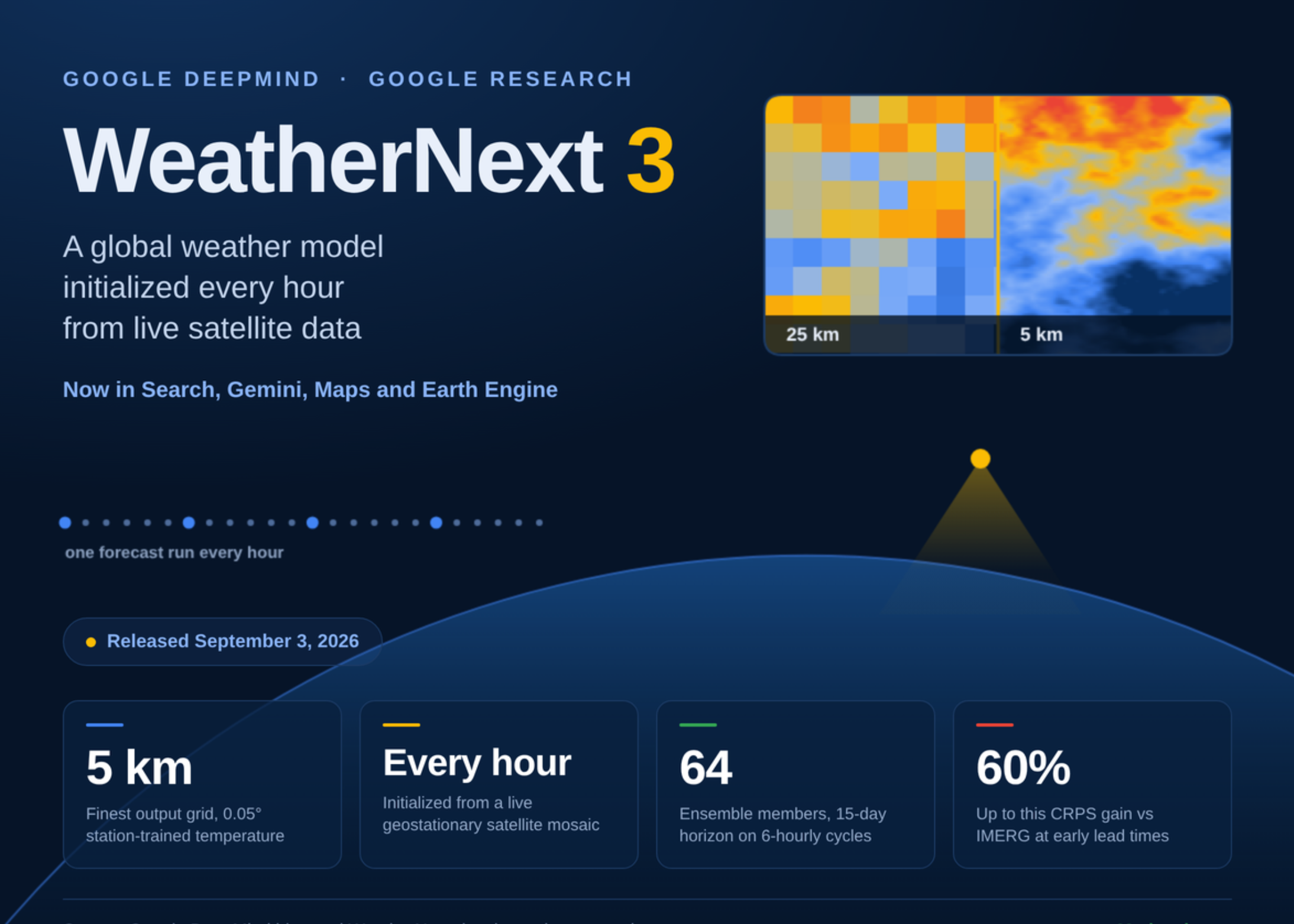
AI weather models have spent three years closing the gap with physics-based forecasting, but two problems stayed open: resolution too coarse for local terrain, and initialization tied to numerical weather prediction (NWP) analysis that arrives about six hours late. WeatherNext 3, released by Google DeepMind and Google Research, attacks both. It takes a live global geostationary satellite mosaic as a direct model input, re-initializes every hour, and emits forecasts down to 0.05° (~5 km) while training against raw weather station measurements rather than reanalysis grids alone. According to Google AI, independent live evaluations from Brightband rank it as the most accurate global weather model to date.

Is it deployable? Partially. Forecast data is available now through BigQuery, Earth Engine and Cloud Storage after an allowlist request, but WeatherNext 3 weights are not open source and on-demand custom inference still runs WeatherNext 2.

YOU MAY ALSO LIKE

Warzone Is Adding A Button To Hide All The Goofy Skins

How These AI Glasses Compare

Architecture and inputs

WeatherNext 3 is a Functional Generative Network (FGN) mesh transformer, the same probabilistic family introduced with WeatherNext 2, scaled to multi-resolution output. Inputs are a live geostationary satellite mosaic plus ECMWF HRES analysis. Training draws on ERA5/HRES-fc0, NASA’s IMERG, station observations and satellite mosaics.

Most AI forecasters learn from NWP reanalysis, which smooths away the local variation that coastlines, valleys and mountains actually produce. WeatherNext 3 trains dedicated observational heads directly on raw station measurements, so its 0.05° temperature and dew point outputs are calibrated to what instruments record rather than to a model’s representation of the atmosphere.

Resolution and cadence

A single forward pass produces three tiers: 0.05° (~5 km) station-trained 2 m temperature and dew point; 0.1° (~10 km) gridded surface wind at 10 m and 100 m, pressure, sea surface temperature, cloud layers, solar radiation and 1-hour precipitation; and 0.25° (~25 km) atmospheric fields across 13 pressure levels. WeatherNext 2 produced 0.25° fields in 6-hour increments, which is where the roughly 5x sharper claim comes from.

Cadence is the second change. The model initializes 24 times a day. The 00, 06, 12 and 18 UTC synoptic cycles run out to 15 days (360 hours) with 64 ensemble members; interim hourly runs cover 48 hours. For fast-developing convection, an hourly refresh grounded in current satellite observations is meaningfully different from a six-hourly cycle anchored to lagged analysis.

Precipitation and clean energy variables

Precipitation is where global models historically fail, producing blurred fields that miss storm boundaries. WeatherNext 3 trains against three precipitation sources: ECMWF reanalysis, NASA’s IMERG satellite retrievals, and Google’s own satellite-radar precipitation reanalysis. Google reports CRPS improvements over baselines of up to 60% against IMERG, 30% against MRMS and 10% against rain gauges at early lead times; the research separately states up to a 50% reduction in Brier score and CRPS versus NWP baselines when evaluated against IMERG.

For renewables, the model outputs 100 m wind speed at approximate turbine hub height, full low/medium/high cloud distributions, and both solar irradiance components (SSRD and FDIR). That combination is what grid operators need to forecast wind and solar output against demand, and it is the clearest sign that this release is aimed at operational buyers, not only at benchmark tables.

Key Takeaways

  • Hourly initialization from live geostationary satellite data replaces the six-hour NWP analysis lag.
  • Multi-resolution output: 0.05° station variables, 0.1° gridded surface, 0.25° pressure levels, one forward pass.
  • 64-member ensemble; 15-day horizon on 00/06/12/18 UTC cycles, 48 hours on interim hourly runs.
  • Precipitation CRPS improves up to 60% against IMERG at early lead times, per Google’s evaluations.
  • Data access is open by request; the model itself is not open weights.

Check out the Paper and Technical details. Also, feel free to follow us on Twitter and don’t forget to join our 150k+ML SubReddit and Subscribe to our Newsletter. Wait! are you on telegram? now you can join us on telegram as well.

Need to partner with us for promoting your GitHub Repo OR Hugging Face Page OR Product Release OR Webinar etc.? Connect with us


Michal Sutter is a data science professional with a Master of Science in Data Science from the University of Padova. With a solid foundation in statistical analysis, machine learning, and data engineering, Michal excels at transforming complex datasets into actionable insights.

Credit: Source link

ShareTweetSendSharePin

Related Posts

Warzone Is Adding A Button To Hide All The Goofy Skins
AI & Technology

Warzone Is Adding A Button To Hide All The Goofy Skins

September 24, 2026
How These AI Glasses Compare
AI & Technology

How These AI Glasses Compare

September 24, 2026
Congressman Calls for National Data Center Strategy
AI & Technology

Congressman Calls for National Data Center Strategy

September 24, 2026
New York Times Cooking Is Coming To Meta’s AI And Display Glasses
AI & Technology

New York Times Cooking Is Coming To Meta’s AI And Display Glasses

September 24, 2026
Next Post
SEC sues LSU as athletes plead in court to regain eligibility with college sports season underway – AP News

SEC sues LSU as athletes plead in court to regain eligibility with college sports season underway - AP News

Leave a Reply Cancel reply

Your email address will not be published. Required fields are marked *

Search

No Result
View All Result
Build columns, not Trump’s arch, D.C. official tells administration – The Washington Post

Build columns, not Trump’s arch, D.C. official tells administration – The Washington Post

September 18, 2026
Meet the Press NOW — August 27

Meet the Press NOW — August 27

September 22, 2026
Judge responds to Clancy lawyer request to remove juror

Judge responds to Clancy lawyer request to remove juror

September 18, 2026

About

Learn more

Our Services

Legal

Privacy Policy

Terms of Use

Bloggers

Learn more

Article Links

Contact

Advertise

Ask us anything

©2020- TradePoint.io - All rights reserved!

Tradepoint.io, being just a publishing and technology platform, is not a registered broker-dealer or investment adviser. So we do not provide investment advice. Rather, brokerage services are provided to clients of Tradepoint.io by independent SEC-registered broker-dealers and members of FINRA/SIPC. Every form of investing carries some risk and past performance is not a guarantee of future results. “Tradepoint.io“, “Instant Investing” and “My Trading Tools” are registered trademarks of Apperbuild, LLC.

This website is operated by Apperbuild, LLC. We have no link to any brokerage firm and we do not provide investment advice. Every information and resource we provide is solely for the education of our readers. © 2020 Apperbuild, LLC. All rights reserved.

No Result
View All Result
  • Main
  • AI & Technology
  • Stock Charts
  • Market & News
  • Business
  • Finance Tips
  • Trade Tube
  • Blog
  • Shop

© 2023 - TradePoint.io - All Rights Reserved!