


• bitcoinBitcoin(BTC)$85,526.004.48%
  • ethereumEthereum(ETH)$2,740.261.84%
  • tetherTether(USDT)$1.000.00%
  • binancecoinBNB(BNB)$790.760.98%
  • rippleXRP(XRP)$1.515.13%
  • usd-coinUSDC(USDC)$1.000.01%
  • solanaSolana(SOL)$117.363.99%
  • tronTRON(TRX)$0.3466080.97%
  • zcashZcash(ZEC)$1,469.12-4.35%
  • Figure HelocFigure Heloc(FIGR_HELOC)$1.011.25%
  • HyperliquidHyperliquid(HYPE)$93.15-1.15%
  • dogecoinDogecoin(DOGE)$0.09830610.24%
  • moneroMonero(XMR)$579.192.22%
  • whitebitWhiteBIT Coin(WBT)$86.082.84%
  • RainRain(RAIN)$0.013869-2.73%
  • chainlinkChainlink(LINK)$12.911.21%
  • USDSUSDS(USDS)$1.00-0.01%
  • cardanoCardano(ADA)$0.2435434.71%
  • leo-tokenLEO Token(LEO)$8.970.47%
  • stellarStellar(XLM)$0.2111855.59%
  • nearNEAR Protocol(NEAR)$4.321.69%
  • uniswapUniswap(UNI)$8.961.38%
  • bitcoin-cashBitcoin Cash(BCH)$263.462.25%
  • avalanche-2Avalanche(AVAX)$11.08-5.07%
  • Ethena USDeEthena USDe(USDE)$1.00-0.02%
  • litecoinLitecoin(LTC)$61.042.42%
  • CantonCanton(CC)$0.1170065.11%
  • daiDai(DAI)$1.00-0.04%
  • USD1USD1(USD1)$1.00-0.02%
  • suiSui(SUI)$1.039.30%
  • the-open-networkGram (prev. Toncoin)(GRAM)$1.454.23%
  • hedera-hashgraphHedera(HBAR)$0.0916266.26%
  • shiba-inuShiba Inu(SHIB)$0.0000066.75%
  • BittensorBittensor(TAO)$307.4514.39%
  • Global DollarGlobal Dollar(USDG)$1.000.00%
  • crypto-com-chainCronos(CRO)$0.0653706.40%
  • MemeCoreMemeCore(M)$1.42-7.26%
  • paypal-usdPayPal USD(PYUSD)$1.000.01%
  • tether-goldTether Gold(XAUT)$4,351.19-0.58%
  • okbOKB(OKB)$123.472.83%
  • Circle USYCCircle USYC(USYC)$1.140.01%
  • Ripple USDRipple USD(RLUSD)$1.000.01%
  • BlackRock USD Institutional Digital Liquidity FundBlackRock USD Institutional Digital Liquidity Fund(BUIDL)$1.000.00%
  • Ondo US Dollar YieldOndo US Dollar Yield(USDY)$1.140.68%
  • aaveAave(AAVE)$143.172.40%
  • OndoOndo(ONDO)$0.439290-0.56%
  • EthenaEthena(ENA)$0.210167-5.72%
  • mantleMantle(MNT)$0.643.31%
  • pepePepe(PEPE)$0.00000522.37%
  • BitwayBitway(BTW)$0.762.72%
TradePoint.io
  • Main
  • AI & Technology
  • Stock Charts
  • Market & News
  • Business
  • Finance Tips
  • Trade Tube
  • Blog
  • Shop
No Result
View All Result
TradePoint.io
No Result
View All Result

Enhancing Tensor Contraction Paths Using a Modified Standard Greedy Algorithm with Improved Cost Function

May 21, 2024
in AI & Technology
Reading Time: 5 mins read
A A
Enhancing Tensor Contraction Paths Using a Modified Standard Greedy Algorithm with Improved Cost Function
ShareShareShareShareShare

Tensor contradictions are used to solve problems related to different research fields, including model counting, quantum circuits, graph problems, and machine learning. But to minimize the computational cost, finding a contradiction order is important. If one sees the result of the computation of the product of a sequence of matrices A, B, and C, then the result will always be the same, but there will be different computational costs based on matrix dimensions. Moreover, the cost of the contraction scales for tensor networks increases with the increase in the number of tensors. The path used for finding which two tensors contract at each other is important to enhance computation time.

Earlier works have focused on finding efficient contraction paths (CPs) for tensor hypernetworks. To compute tensor contraction paths, one of the existing methods is to use a simulated annealing and a genetic algorithm that outperforms the standard greedy approach for smaller networks. The second method is graph decomposition in which Line-Graph (LG) and Factor-Tree (FT) methods are used. LG uses structured graph analysis to find a contraction order, whereas FT is used in the preprocessing to handle high-rank tensors. The third method, where reinforcement learning (RL) and Graph Neural Networks (GNNs) are combined and used to find an efficient path, includes real and synthetic quantum circuits.

A team of researchers has introduced a novel method to enhance tensor contraction paths using a modified standard greedy algorithm with an improved cost function. The cost function used by the standard greedy algorithm (SGA) to find the pairwise contractions for the path at each step is straight and depends on the size of two input tensors and the output tensor. To overcome this, the proposed method finds the costs of pairwise contractions using more information, such as providing different cost functions to cover a broad range of problems. The method outperforms the state-of-the-art greedy implementations by Optimized Einsum (opt_einsum), and in some cases, it outperforms methods like hypergraph partitioning combined with greedy.

Researchers used the SGA in opt_einsum to find CPs efficiently for large numbers of tensors. There are three phases in which the CP is computed:

  • The computation of Hadamard products which are, elementwise multiplication of tensors with the same set of index.
  • Contraction of remaining tensors until all contraction indices are over by selecting the lowest cost pair at each step.
  • Computation of outer products by selection of the pair that minimizes the input sizes sum at each step

Further, the modified greedy algorithm uses cost functions as parameters, unlike the SGA which uses only one cost function. Then, different cost functions are utilized at runtime and the most appropriate cost function is selected for generating further CPs. 

CPs for 10 problems are computed to calculate the multiple-cost-functions approach, various algorithms are compared, and for each algorithm, flops are measured. Researchers performed two experiments. In the first experiment, 128 paths are computed with each algorithm for each problem example. The goal is to calculate the solution’s quality without considering computation time. In the second experiment, the limitation is not on the number of paths but rather on computation time, which is limited to 1 second. The goal is to show a balance between time and quality to find an efficient path quickly for practical scenarios.
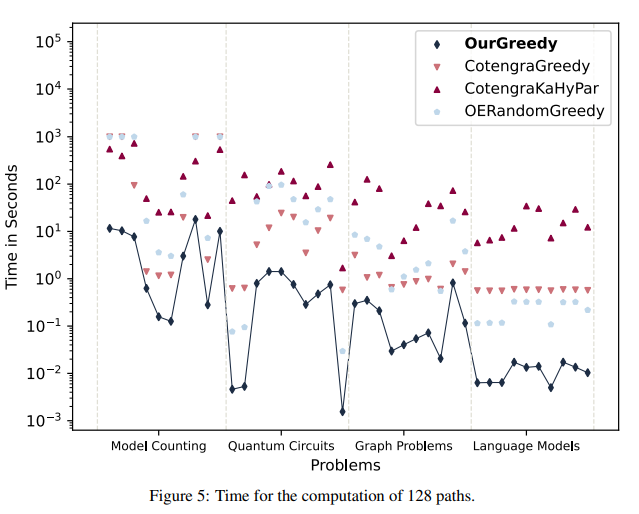
In conclusion, researchers proposed a novel approach to enhance tensor contraction paths using a modified standard greedy algorithm. A multiple-cost-functions approach is used where each cost function is calculated for each problem example and the best cost function is selected for computing the CP. Compared to standard greedy and random greedy algorithms by opt_einsum, and the greedy algorithm and hypergraph partitioning method, the proposed method can find efficient CPs in less time and solve complex problems but other methods fail to do the task. 


Check out the Paper. All credit for this research goes to the researchers of this project. Also, don’t forget to follow us on Twitter. Join our Telegram Channel, Discord Channel, and LinkedIn Group.

If you like our work, you will love our newsletter..

Don’t Forget to join our 42k+ ML SubReddit


YOU MAY ALSO LIKE

Why Is Your Laptop Fan So Loud?

AWS Strands Agents Team Releases Strands Harness: An Open-Source Agent Harness With 28% Lower Token Cost at Comparable Accuracy

Sajjad Ansari is a final year undergraduate from IIT Kharagpur. As a Tech enthusiast, he delves into the practical applications of AI with a focus on understanding the impact of AI technologies and their real-world implications. He aims to articulate complex AI concepts in a clear and accessible manner.


🐝 Join the Fastest Growing AI Research Newsletter Read by Researchers from Google + NVIDIA + Meta + Stanford + MIT + Microsoft and many others…


Credit: Source link

ShareTweetSendSharePin

Related Posts

Why Is Your Laptop Fan So Loud?
AI & Technology

Why Is Your Laptop Fan So Loud?

September 22, 2026
AWS Strands Agents Team Releases Strands Harness: An Open-Source Agent Harness With 28% Lower Token Cost at Comparable Accuracy
AI & Technology

AWS Strands Agents Team Releases Strands Harness: An Open-Source Agent Harness With 28% Lower Token Cost at Comparable Accuracy

September 21, 2026
Bungie Leaders Now Say The Studio’s ‘Not Done With Destiny’
AI & Technology

Bungie Leaders Now Say The Studio’s ‘Not Done With Destiny’

September 21, 2026
Here’s Why Apple’s Mac Studio Has Become So Expensive
AI & Technology

Here’s Why Apple’s Mac Studio Has Become So Expensive

September 21, 2026
Next Post
This AI Paper from KAUST and Purdue University Presents Efficient Stochastic Methods for Large Discrete Action Spaces

This AI Paper from KAUST and Purdue University Presents Efficient Stochastic Methods for Large Discrete Action Spaces

Leave a Reply Cancel reply

Your email address will not be published. Required fields are marked *

Search

No Result
View All Result
Clippers owner suspended over salary cap scandal

Clippers owner suspended over salary cap scandal

September 18, 2026
Hawai’i hit by flooding as Hurricane Lowell gets closer

Hawai’i hit by flooding as Hurricane Lowell gets closer

September 16, 2026
Current with Christine Romans – Sept. 4 | NBC News NOW

Current with Christine Romans – Sept. 4 | NBC News NOW

September 17, 2026

About

Learn more

Our Services

Legal

Privacy Policy

Terms of Use

Bloggers

Learn more

Article Links

Contact

Advertise

Ask us anything

©2020- TradePoint.io - All rights reserved!

Tradepoint.io, being just a publishing and technology platform, is not a registered broker-dealer or investment adviser. So we do not provide investment advice. Rather, brokerage services are provided to clients of Tradepoint.io by independent SEC-registered broker-dealers and members of FINRA/SIPC. Every form of investing carries some risk and past performance is not a guarantee of future results. “Tradepoint.io“, “Instant Investing” and “My Trading Tools” are registered trademarks of Apperbuild, LLC.

This website is operated by Apperbuild, LLC. We have no link to any brokerage firm and we do not provide investment advice. Every information and resource we provide is solely for the education of our readers. © 2020 Apperbuild, LLC. All rights reserved.

No Result
View All Result
  • Main
  • AI & Technology
  • Stock Charts
  • Market & News
  • Business
  • Finance Tips
  • Trade Tube
  • Blog
  • Shop

© 2023 - TradePoint.io - All Rights Reserved!