
Drew Angerer
Q3 Results – Good, But Less Of A Surprise This Time
Unlike last quarter when I wrote that Berkshire Hathaway’s (NYSE:BRK.A) (NYSE:BRK.B) results “blew away the bears”, the 3Q results showed similar strength but were more anticipated by analysts. For example, in the preview article here on Seeking Alpha, the CFRA analyst quoted was expecting operating earnings of $4.85 per B share. The actual number came in at $4.96, much less of a “beat” than we saw last quarter.
Most Berkshire shareholders prefer to take a longer view than the quarterly results. From that viewpoint, we see that positive trends that started last quarter are still continuing. Insurance continued its trend of strong underwriting performance. While absence of major catastrophe events helped, the company also saw cost savings and lower claims frequencies from more selective policy writing.
BNSF Railroad continued to show the effects of a slower economy, but quarterly compared to YTD numbers suggest the trend may be bottoming. Cost control is starting to show signs of improvement as well. The one scary development this quarter happened at Berkshire Hathaway Energy, usually the star performer of the group. BHE’s Pacific Northwest electric utility, PacifiCorp, is being sued over wildfires in Oregan and Northern California in 2020 and 2022. The company took another $1.4 billion charge in 3Q, bringing the YTD total to $1.9 billion (pretax). Plaintiffs are looking for far more, so it’s possible the company will take further charges in the future.
Within manufacturing, industrial products continue to be a bright spot, while building products are struggling in the tough real estate market. Consumer products seem to have turned around their sales decline and are benefitting from higher margins. Service and retail are benefitting from strong aviation and automotive markets, but a weaker consumer in the other businesses.
Berkshire Hathaway continues to be conservative with its capital, further growing the cash balance while pursuing modest buybacks. The company remains a net seller of stocks from its equity portfolio. My sum of the parts intrinsic value estimate is now 14.7% above market price, a small increase since last quarter. Price to book ratio is now 1.45 times, a bit richer than is has been in recent quarters, but not yet excessive. Let’s dig in to the details.
Insurance
Insurance is the standout performer of the group this quarter, which is no surprise after 2Q results. Part of this is due to good luck. There have been almost no large catastrophic loss events such as hurricanes this year. This is in contrast to 3Q 2022 when Hurricane Ian hit. The company is also benefitting from a downward revision of loss estimates made in prior years. Still, there is plenty that Berkshire is doing within its control to drive these good results. At Geico, the company greatly reduced advertising and marketed more selectively to customers. This cut underwriting expenses but also reduced policies in force by 12.7%. Thanks to higher premiums, Geico managed to keep premiums earned flat despite the lower policy count. The remaining policy holders seem to be less risky, as claims frequency is down, helping offset an increase in claims severity from inflation. As a result, the combined ratio at Geico went from well over 100 to below 90.
Berkshire Hathaway Form 10-Q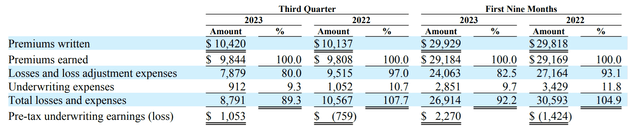
Berkshire’s other primary insurance and reinsurance businesses have not dialed back new policy issuance as much as Geico, and they have also grown due the Alleghany acquisition. These companies also strongly benefitted from the absence of cat losses this year.
Insurance investment income is now running $1 billion per quarter ahead of last year thanks to Berkshire’s huge cash balance and much higher rates on T-Bills.
BNSF Railroad
At first glance, BNSF looks unimpressive with another decline in profits from last year. Looking closer, the decline could be bottoming. As measured by car volumes, the declines in the third quarter were not as severe as the YTD numbers. Industrial products car loadings even swung to an increase in 3Q.
Berkshire Hathaway Form 10-Q
On the cost side, BNSF also finally appears to be gaining ground vs. its competitors. When volumes are dropping, I expect the operating expense ratio to get worse since some costs are more fixed and not as easy to cut in line with revenue. For BNSF this quarter, operating ratio increased 0.7% from last year to 68.4%. At Union Pacific (UNP), while the operating ratio was still better than BNSF at 63.4%, the increase from last year was much higher at 3.5%. While BNSF still has a way to go to catch up, they are now closing the gap.
Berkshire Hathaway Energy
BHE is usually the star of the group, so it is disappointing to see their results so impacted by legal issues. The primary one relates to lawsuits over wildfires in Oregon and Northern California within PacifiCorp’s service area in 2020 and 2022. The company recorded another $1.4 billion in estimated losses in 3Q, taking the YTD total to $1.9 billion pretax. I encourage everyone to read Note 23 on Form 10-Q for more details. The significant thing I got out of that section was that the damages could be much higher in the worst case.
Berkshire Hathaway Form 10-Q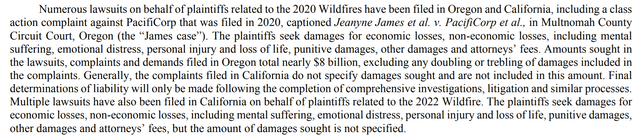
In the worst case, Berkshire could be looking at damages on the order of the (BP) oil spill. I am not a lawyer and not predicting that outcome, but I know judges and juries can be unpredictable. The “good” news, if you can call it that, is that Berkshire’s financial condition would let it weather the worst case. A $24 billion judgement only amounts to $10 per B share, although I could see market sentiment taking the shares much lower and creating a better buying opportunity than currently available.
BHE is also the subject of a couple smaller legal actions. Berkshire Hathaway Realty is part of an antitrust case over artificially inflated real estate commissions. Finally, the Haslams, owners of the remaining 20% of Pilot, are suing Berkshire over the accounting method to be used to set the sale price for this stake if the Haslams exercise their put option. These two cases could also impact market sentiment toward Berkshire but in my opinion carry much less monetary risk than the PacifiCorp case.
Outside of the legal issues, BHE was also hurt by lower volumes due to weather, higher costs, and lower tax benefits. While BHE is a solid business long term, the legal issues may drive negative sentiment for a while.
Pilot Travel Centers
My outlook is similar to last quarter. I still expect Pilot to earn $520 million for Berkshire this year. As I mentioned previously, both depreciation and interest expense are higher this year than they were for Pilot on a standalone basis in 2022. Pilot’s debt is not guaranteed by Berkshire but it would be nice to see Berkshire help them find a way to refinance at lower rates.
Manufacturing
Industrial products again had the strongest growth, led by Precision Castparts, which is benefitting from the aerospace cycle. Marmon has grown by incorporating some businesses from the Alleghany acquisition, while Lubrizol continues to struggle. Building products continues to have a tough time due to the housing market, but they did improve margins slightly. Consumer products actually swung to sales growth in 3Q and greatly improved margins compared to last year.
Service And Retail
NetJets, Flight Safety, and Berkshire Hathaway Automotive continue to be the standout businesses in this group. Electrical components distributor TTI was a drag on services. BH Automotive again offset big declines in the other retailers.
Investment Portfolio
Based on changes in the cash flow statement between quarters, Berkshire bought $1.7 billion of new stock positions in 3Q but sold $6.95 billion of existing positions. We will have to wait for the 13-F to see the details, but from the top 5 holdings listed in the 10-Q’s, it looks like Berkshire continued selling down its stake in Chevron. The company sold about 13 million shares in the quarter, or 10.5% of its starting position. This generated about $2.1 billion of cash.
We also know that the Activision Blizzard merger has closed, and Berkshire held 14.66 million shares at the start of 3Q, based on the 2Q 13-F. We don’t know if the company sold these in 3Q or held until the deal with Microsoft (MSFT) closed in October, but at the $95 deal price, Berkshire would have raised $1.4 billion in cash.
Berkshire also had to sell about $0.3 billion of Occidental (OXY) preferred shares in the quarter. After the quarter ended, Berkshire spent a similar amount increasing its OXY common stock position.
Capital Management
Like each quarter this year, Berkshire’s insurance float grew by another $1 billion and now stands at $167 billion. Berkshire’s cash and T-Bill position is now $152 billion, up $10.1 billion from last quarter. With T-Bills yielding around 5.5%, the company can afford to take its time entering new investments.
Share buybacks in 3Q further slowed to $1.1 billion from $1.4 billion in 2Q. Due to a more active 1Q, the company has spent $7 billion on buybacks YTD, or about 1% of its starting market cap. Free cash flow has improved considerably at $21.1 billion YTD compared to $16.1 billion in the first nine months of 2022.
Berkshire Stock Valuation
My regular sum-of-the-parts valuation model is presented below.
Adding it all up, I now value Berkshire at $403.62 per B share, an upside of 14.7% from market price. This is just a slightly wider premium to market price compared to the 13.4% upside I calculated last quarter. The insurance business is worth more thanks to both higher investment income and better underwriting performance in a period where peers struggled. In order to calculate a better ongoing value for BHE, I excluded the PacifiCorp liability charge from this year’s earnings estimate, but I also subtracted the one-time charge from the total value. Offsetting the gains in these two businesses, BNSF valuation was down $5 billion and Manufacturing was down $4 billion due to lower peer earnings multiples. The mark-to-market of the equity portfolio lowered its value by $35 billion.
Author Spreadsheet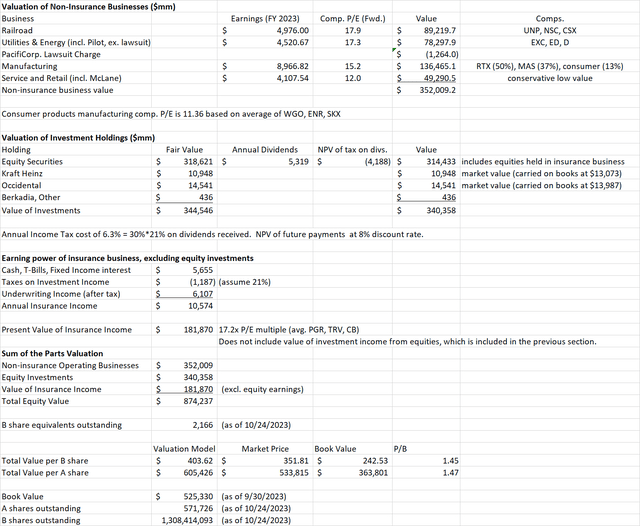
The price to book multiple of 1.45 is up a little from last quarter’s value of 1.39 times.
Conclusion
Expectations were higher for Berkshire Hathaway going into the 3Q earnings release due to the improvement in insurance results starting last quarter. Geico continues to improve while the other insurance businesses remain strong with some help from the lack of major cat losses. BNSF looks like it may finally be turning around, but legal issues at BHE are the biggest worry going forward.
Berkshire continues to completely ignore the armchair quarterbacks looking for a flashy deal, earning 5%+ on its cash while focusing on the operating businesses. The share price has gotten slightly richer compared to book value, but my estimate of intrinsic value has also come up slightly. The 14.7% upside from market to intrinsic value won’t produce a get rich quick opportunity, but it provides a margin of safety for shareholders. The conservative balance sheet should allow the company to weather legal challenges at BHE, but any negative developments could hurt market sentiment and provide an even better buying opportunity.
Credit: Source link