

fizkes
Investment Thesis
Zoom Video Communications (NASDAQ:ZM) has fallen out of favor with investors. In fact, I will always contend that just because a stock is down from its highs, doesn’t make a stock undervalued.
Rather, for investors, what truly matters is whether the stock offers investors a compelling risk-reward. No investor gets all stock picks right. But our job is to deploy capital, and to do so selectively, only when we believe that the stock offers investors a very compelling risk-reward.
Given Zoom’s current prospects, I do not believe this stock offers investors a compelling risk-reward. Therefore, I remain neutral on this name, as I’ve been for a while.
Rapid Recap,
Back in September, I said in a neutral analysis of Zoom,
I believe that Microsoft Teams’ (MSFT) extensive distribution channels, coupled with its deep integration into Microsoft’s ecosystem, is too formidable a competitor. On top of that, I also highlight some perfectly viable free alternatives for small startups.
Now, to be clear, I’m not bearish on Zoom. On the contrary, I believe that its stock is already cheap enough to factor in this significant risk factor.
In essence, I find this stock fairly valued.
Author’s work on ZM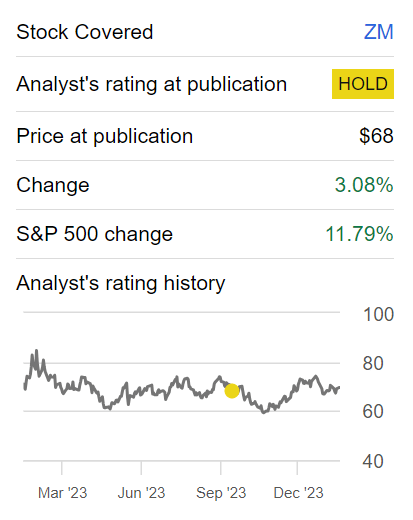
Since I made those comments, the stock has practically nowhere, and has substantially underperformed the S&P500. Further, as I look ahead to the next twelve months, I maintain that this stock is fair valued.
Zoom’s Near-Term Prospects
Zoom is a video conferencing platform. Whether for work, education, or social gatherings, Zoom provides a user-friendly interface for hosting and participating in video calls, making it easy for individuals and groups to communicate and collaborate remotely. The platform has become one of the main go-to solutions for virtual meetings.
That being said, Zoom has encountered a few challenges despite achieving important milestones. One challenge is the impact of macroeconomic factors on the company’s performance, with more deal scrutiny.
Another challenge is the evolving competitive landscape, particularly in the realm of AI features. While Zoom has introduced an AI companion with features like meeting summaries, there is acknowledgment of the need to differentiate these offerings from competitors. The company aims to leverage AI technologies for optimization and improvements in user experience but recognizes the ongoing need for investment in this domain.
However, ultimately, I contend that we can cut to the chase by simply highlighting one graphic:
ZM FQ3 2024
What you see is Zoom’s customer adoption curve. This concretely shows that Zoom is no longer a high-growth business. Consequently, it won’t be rewarded with a premium valuation on its stock. Therefore, investors’ risk-reward is unappetizing.
Given that background, let’s discuss its financials, next.
Revenue Growth Rates Are Unimpressive
ZM revenue growth rates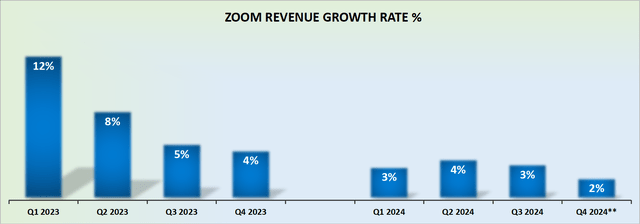
The graphic above is a stark reminder that Zoom is no longer a growth business. Now, the only question that looms large is whether or not Zoom can stabilize its growth rates? And if Zoom can stabilize its growth rates, is there enough juice left in the tank for it to deliver 5% CAGR on the topline?
Earnestly, I do believe Zoom could grow by 5% CAGR in the coming year. Here’s my reasoning. If we look at Zoom’s 2-year stack, we see that its CAGR is growing at approximately 5%. But also, we have to keep in mind that Zoom’s fiscal 2025 (starting in February 2024), is up against a substantially easier comparable period relative to this year, when Zoom reported low mid-single digits.
Furthermore, as discussed higher up, it’s difficult for Zoom to grow its topline by 5% CAGR, when its customer adoption curve is starting to moderate towards the mid-single digits.
So what are shareholders left with here?
ZM Stock Valuation — ~13x Forward EPS
Right way we must keep in mind that Zoom is highly profitable. Furthermore, we need to also acknowledge that Zoom is debt-free. More specifically, Zoom holds about 30% of its market cap as just cash! Inevitably, if one invests in a business where 30% of its market cap is made up of cash, that provides a whopping fat margin of safety.
This means that if Zoom sought to start buying back its shares, this would see shareholder returns increasing. That being said, keep in mind that in fiscal 2023 (last year), Zoom repurchased approximately $1 billion worth of stock, or 5% of its present market cap. And yet, despite substantial share repurchases, the stock price is still lower.
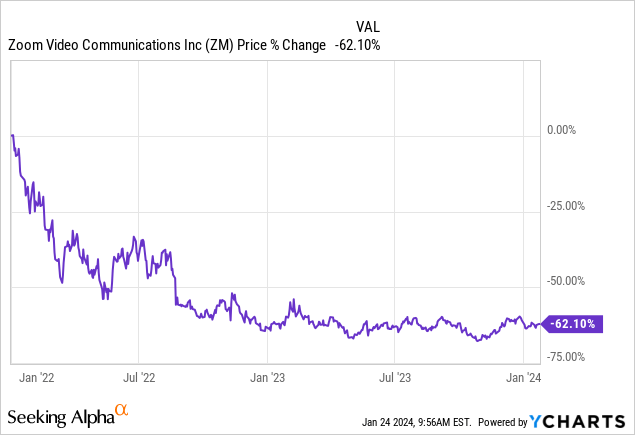
So I wouldn’t be too quick to presume that just because Zoom holds a massive war chest, that they are good capital allocators knowing how to return capital to shareholders.
Nonetheless, I believe that approximately $5.50 of EPS could be on the cards, provided that management is open and transparent about its efforts to stabilize revenue growth rates and right-size its cost structure.
Incidentally, I believe this is in actuality the bull case for Zoom and not the base case. Because the base case is that Zoom’s EPS doesn’t grow by more than 3% to 4% over the coming twelve months, and only delivers $5.20 of EPS.
So, the question that investors need to get comfortable with is this, does it make sense to pay around 12x to 14x forward PE for a company that is delivering approximately mid-single-digit EPS growth? I don’t find this an attractive risk-reward.
The Bottom Line
In my assessment of Zoom Video Communications, it’s evident that the company has fallen out of favor with investors.
Despite the stock’s decline from its peak, I maintain a neutral stance, emphasizing that a stock’s decrease in value doesn’t necessarily equate to undervaluation.
The key consideration for investors is whether the stock presents a compelling risk-reward scenario.
The graphic illustrating Zoom’s customer adoption curve indicates a departure from high-growth status, raising concerns about the stock’s premium valuation.
Analyzing the financials, the revenue growth rates are unimpressive, and the question arises whether Zoom can stabilize its growth rates and deliver meaningful returns going forward?
While the company is highly profitable and debt-free, its stock valuation at around 13x forward PE raises doubts about the attractiveness of the risk-reward proposition, especially given the anticipated mid-single-digit EPS growth.
Credit: Source link