

Funtap
Real estate investment trusts or REITs have delivered upbeat performances since November 1 as the Federal Reserve’s Chairman hinted that his institution could be done with hiking interest rates. Now, bearing in mind that the U.S. Central Bank remains data-driven signifying that there is no absolute certainty as to future monetary policy trajectory, it is important to select the most appropriate ETF for a recovery.
In this case, the Vanguard Real Estate Index Fund ETF Shares (VNQ) has more followers on Seeking Alpha than the Real Estate Select Sector SPDR Fund ETF (NYSEARCA:XLRE) as shown in the table below. The Vanguard ETF also offers higher dividend yields too.
Comparison XLRE and VNQ (seekingalpha.com)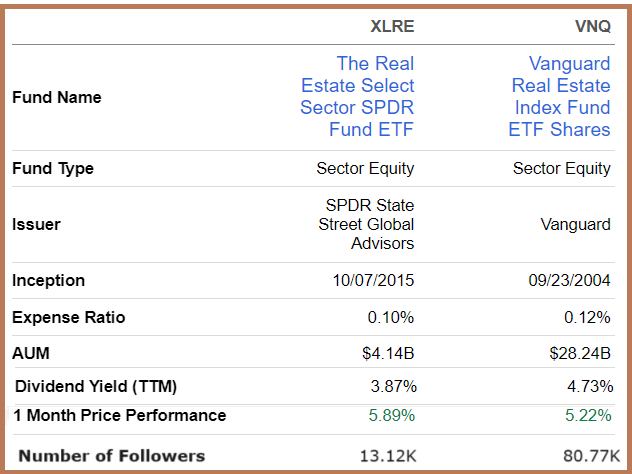
However, this thesis thinks otherwise as its aim is to show that the SPDR ETF is better positioned for the recovery in REITs if the Federal Reserve continues to adopt a more dovish posture, while also being open to the possibility of a more hawkish tone depending on how inflation evolves.
Debating the Idea of a Pause
Coming back to Wednesday, markets closed the session higher, while the decline in treasury yields continued in the wake of Fed Chairman Jerome Powell’s press conference. As expected, rates were kept unchanged for a second consecutive meeting, with the data also showing that the U.S. economy appeared to be slowing thereby increasing the likelihood of a further pause.
Looking deeper, the U.S. Central Bank’s task remains a balancing act, namely to tame inflation by raising interest rates while at the same time ensuring that the economy does not sustain lasting damage. Viewed from this perspective any deterioration in economic conditions implies that the chances of a hike get more remote.
Moving into Thursday, there was again a decline in treasury yields implying that bond investors are bullish, this time caused by the Jobs report for October indicating that there had been a cooling, or slowing in job growth while unemployment figures rose. This again shows that certain conditions are met for a further pause, but, there is still uncertainty, pertaining mainly to inflation.
For this purpose, historical data dating back to the 1965-1982 period shows a double inflation peak (as encircled in red in the chart below) including CPI’s resurgence to 15% after it had initially dropped to 5% from a high of 12%. Therefore, reminiscent of this event, the Fed may most probably stick to the 2% inflation target which may also imply that rates could stay “higher for longer”. Extrapolating further, this implies that the Fed may even have to resume tightening monetary policy if high inflation were to persist.
The Great Inflation (www.federalreservehistory.org)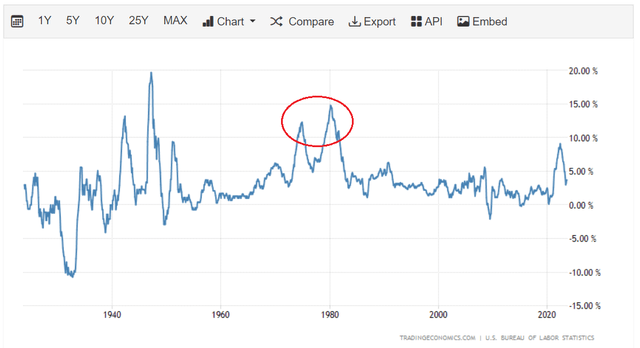
Now, rates staying higher for longer reduces the appeal for dividend stocks and ETFs alike, decreasing the likelihood of income seekers choosing VNQ which pays a yield of 4.87% because risk-free investments like treasury bonds or CD accounts can fetch yields of 5% and higher. For this matter, one could also argue that investors may even be less attracted to XLRE as it pays lower yields.
However, in addition to providing regular distributions, the SPDR fund delivers better capital gains as detailed further below. Now, combining dividends with capital gains, in case they are reinvested instead of being cashed out provides for higher total returns.
“Total Returns” vs. “Only Income”
Thus, as shown in the charts below covering the 2019 to 2023 period, the State Street fund has not only outperformed its Vanguard peer by around 10% but also delivered superior five-year returns, by 10.3% as charted below. Now this five-year period was initially marked by the near zero interest rates in the immediate aftermath of COVID-19 as the Fed rapidly eased monetary policy to de-freeze the economy. Subsequently, there was an unprecedented degree of policy tightening (in recent memory) as the Fed hiked rates from March of 2022 as the Fed tried to control rising inflation.
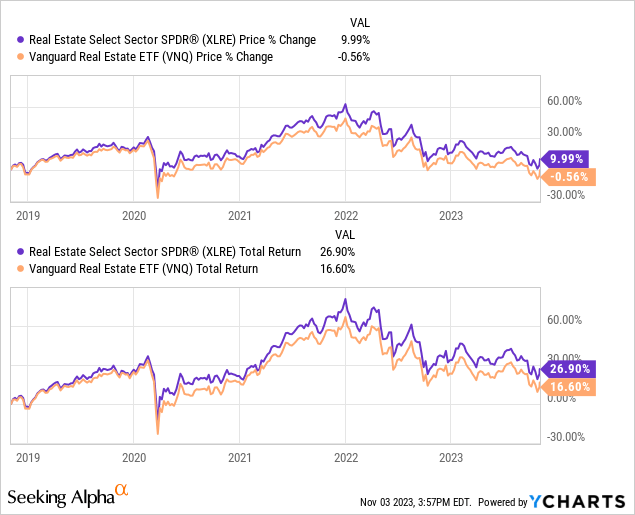
Therefore, it can be reasonably said that XLRE. despite paying a lower dividend yield, has outperformed in two completely different market conditions, irrespective of whether rates were low or high.
Looking deeper, both ETFs employ a passive strategy and hold a basket of sector-diversified REITs as shown below, but the reason for XLRE’s outperformance seems to be related to its holdings, namely higher exposure to specialized REITs when compared to VNQ. Conversely, the SPDR ETF holds fewer residential and office properties as a percentage of overall assets. It is precisely these two sectors that have suffered during the last two years with office REITs suffering the most as after the coronavirus-related infection fears forced millions to work from home during the pandemic, many have continued to work remotely thereby decreasing demand for associated properties.
VNQ and XLRE sector exposure (investor.vanguard.com)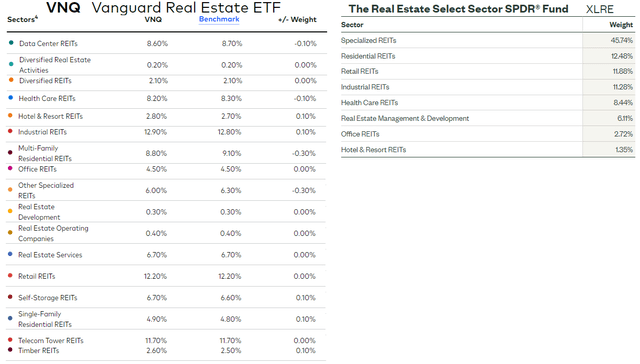
Residential REITs have also suffered as not all have been able to increase cash flow and dividends per share in a macroeconomic environment characterized by inflationary pressures making it difficult for landlords to continually ask for rent increases without risking tenants running away. Additionally, higher borrowing costs make it more difficult to invest in new properties. Therefore, not all properties may enjoy long-term leases and steady rent escalations, signifying that a “higher for longer” rates scenario should continue to weigh on residential REITs.
XLRE’s Edge over VNQ
Going forward, a slowing economy also means more uncertainties across different REIT sectors, but specialized ones seem to be benefiting from a better conjuncture. The reason is that these consist mostly of data center and cell tower companies which respectively host and transport the information required for digital transformation to occur. Now, the digital transformation trend which has already been ongoing for more than a decade as large public cloud providers like Amazon’s (AMZN) AWS got a boost from Covid. Furthermore, according to Data Center Knowledge, utilization of data center collocation space has seen renewed demand, this time from artificial intelligence workloads as ChatGPT has raised worldwide awareness as to Generative AI.
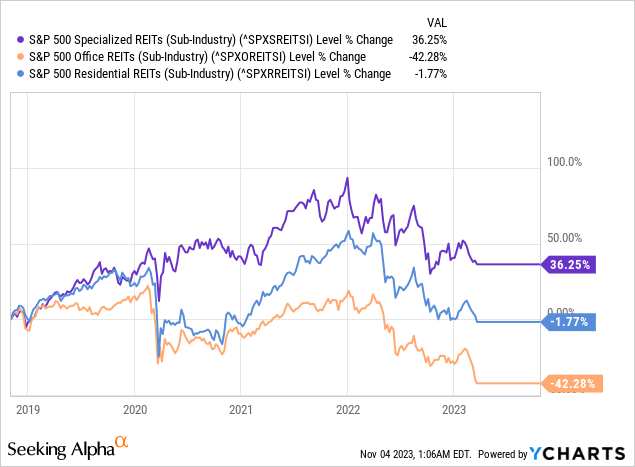
Thus, the demand-supply equation became favorable to demand in the fourth quarter of 2022 as hyperscalers (big public cloud providers) like Microsoft (NASDAQ:MSFT) booked large colocation capacity to host their GPU-based AI workloads. They are being emulated by enterprises wanting to profit from the enthusiasm around AI. This surge in demand has permitted colocation providers to hike pricing, by up to 20%-30% YoY in primary markets with the demand expected to last through 2024.
As for cell tower REITs, companies like American Tower (AMT) constituting 10% of XLRE’s total weight have invested heavily in edge computing which is about hyperscalers making processing capacity available nearer to population centers located far from core markets. Again, according to Data Center Knowledge, edge computing adoption is increasing in the wake of AI.
Therefore specialized REITs are seeing more demand which should result in revenue streams being sustained and signifies that they have a better cushion to weather the storms of uncertainty. This is noteworthy considering higher interest rates and uncertainty that prevails over the wider economy including on other types of properties.
XLRE is Better based on Sector Exposure
Consequently, based on its higher exposure to specialized REITs, XLRE has an edge over VNQ. Also, historical performance has shown that it has delivered superior total returns. Now, focusing on total returns also helps to highlight why REITs are not just income investments, as they also bring growth and capital appreciation to someone’s portfolio.
Therefore, considering that XLRE provides a 3.87% dividend yield, even if its share price appreciates by 2% on an annualized basis (based on averaging the 10% achieved over a five-year period as per the above chart), it can provide total returns of nearly 6%. On top, going forward, investors could see the bulk of their returns being generated from capital appreciation in case there is a continuous pause or cut by the Fed.
Talking valuations, based on historical performance specifically for the period between March 2022 to July 2023 when rates surged by nearly 5.5%, XLRE lost around 15% as charted below.
Comparing performances of XLRE and S&P 500 between March 2022 and July 2023 (seekingalpha.com)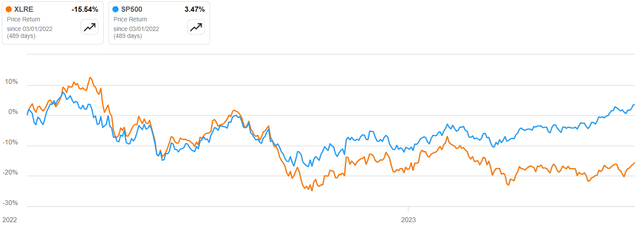
Therefore, any prolonged pause or a cut sometime around March 2024, as is being priced by some in the market could see its shares rebounding sustainably. An upside is also supported by its lower price-to-book multiple of 2.33x multiple which is heavily discounted compared to the SPDR S&P 500 ETF’s (SPY) 3.39x by around 45% (3.39/2.33). Therefore, a 15% upside, or the percentage by which its shares have suffered due to rising rates, could see XLRE at $40.25 (35 x 1.15) based on the current share price of around $35.
Thus, I have a Buy position, which represents an upgrade from the previous Hold position back in May when I had covered the ETF. At that time, I was prudent mainly because of the impact of rate hikes on the real estate sector as well as the lingering effects of the March banking turmoil.
To further justify my optimism, Quant has upgraded its position to a Hold from a Sell on November 4 based on the ETF’s momentum grade improving from C- to C+, possibly indicating that the upside seen since November 1 could continue. However, a higher momentum score could also play in the opposite direction, implying that there are downside risks in case of any adverse news hitting the market.
One example of such adverse news could be rising economic uncertainty likely to impact XLE’s non-specialized REITs which constitute 54.26% of the ETF’s overall weight, which is why some may want to wait for a moderate pullback to the previous support range of $32-$33 for improved upside potential. Therefore, investors should be aware that there are volatility risks. Continuing on a cautionary tone, historical performance shows that volatility can persist resulting in lower returns should the tightening of monetary policy be resumed as a result of inflationary pressures.
Finally, by going through its differences with VNQ, this thesis finds that XLRE is better positioned for the current juncture with its sizeable exposure to specialized REITs. Also, with better exposure to the AI theme and with the eventuality of a Fed continuing to remain dovish, it should deliver better returns.
Credit: Source link