




Black_Kira/iStock via Getty Images
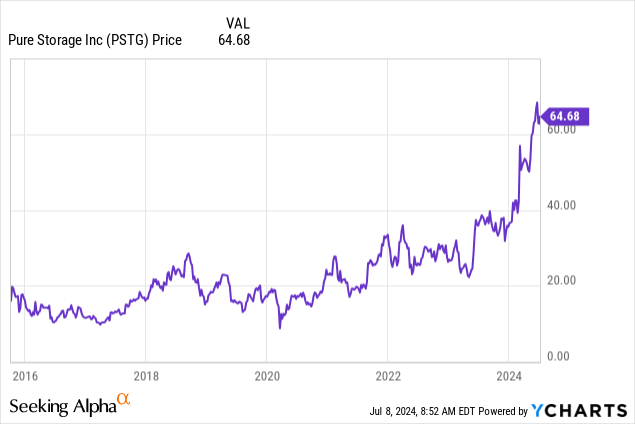
Pure Storage (NYSE:PSTG) is an enterprise data storage and management provider that entered the public markets in October 2015. The market has long viewed the data storage business as commoditized, and the stock hovered around $20 from when it became publicly traded until around the middle of 2021. Then the stock began to catch fire.
Pure Storage made significant contributions to modernizing data infrastructure, heavily promoting ideas like using flash memory for storage, developing a container data management platform, and creating a Storage-as-a-Service Platform. The company’s innovations have helped it become a leader in Gartner’s (IT) 2023 Magic Quadrant for Primary Storage for the fourth consecutive year.
Source: Pure Storage website.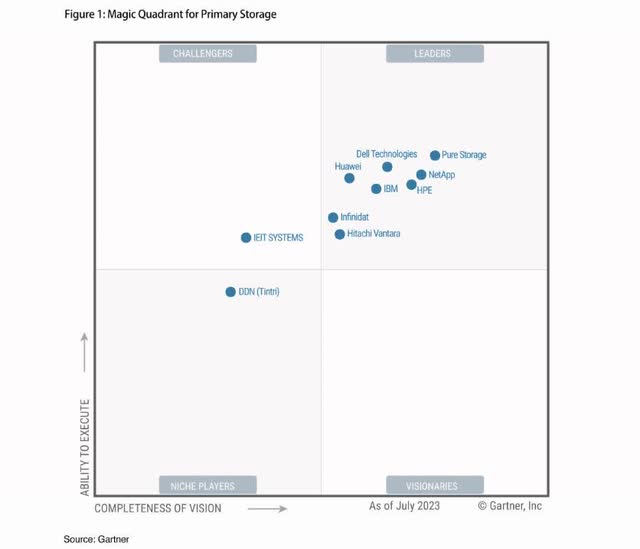
Several positive secular trends are also taking place in the data center market, one of which is the proliferation of artificial intelligence (“AI”), which has driven the company’s recent market share growth. Chief Executive Officer (“CEO”) Charlie Giancarlo said the following on the company’s first quarter FY 2025 earnings call, “We also believe that long-term secular trends for data storage are no longer based on the expectation of commoditized storage, but rather on high-technology data storage systems, and run very much in our favor.”
This article will discuss several secular trends driving the need for improved storage systems and Pure Storage’s product lineup to address those secular trends. It will also review the company’s risks and valuation and explain why aggressive growth investors can still buy at the current price.
Secular trends driving its enterprise and cloud storage business
The following three secular trends drive much of Pure Storage’s revenue growth.
1. Enterprises switching to faster storage solutions
Over the last decade, the need for Big Data analytics, AI, scientific and engineering simulations, financial modeling and risk analysis, and the creation of special effects for movies, animation, and video games has driven the need for High-Performance Computing (“HPC”). The Information Technology (“IT”) industry became increasingly aware of the need for advanced storage solutions as the usage of several different HPC applications began to grow. Older storage solutions that utilized Hard Disk Drives (HDDs) or, in some cases, tape drives were not up to retrieving information fast enough to feed the processors in several HPC applications. HDDs have mechanical parts that lead to slower read times. Tape drives may be even slower and require manual loading/unloading. The following commentary from Pure Storage highlights a problem that enterprises face today (emphases added):
Since 2019, up to 80% of primary storage workloads have been handled by all-flash arrays. Meanwhile, hard disk drives (HDD) are now largely relegated to secondary workloads, where factors like capacity and cost take precedence over speed. Despite this shift, HDDs still account for 90% of the total stored enterprise data, underscoring their significant presence and increasing negative impact in the storage landscape.
The rapid adoption of a specialized form of AI named generative AI only exacerbated the need for storage solutions with high-speed data retrieval rates. If organizations want to properly utilize their data for generative AI and other purposes, they must switch the 90% of total stored data from HDD to all-flash arrays. Pure Storage claims that by 2028, virtually all new data center storage solutions sold will be flash storage. Since the company only sells flash storage, the trend of enterprises switching from HDDs to flash memory should be a secular tailwind behind its business over the next several years. Flash storage helps create a lower total cost of ownership (“TCO”) for customers versus HDDs and solves several other issues.
Source: Product & Technology Focused Meeting for Financial Analysts Presentation.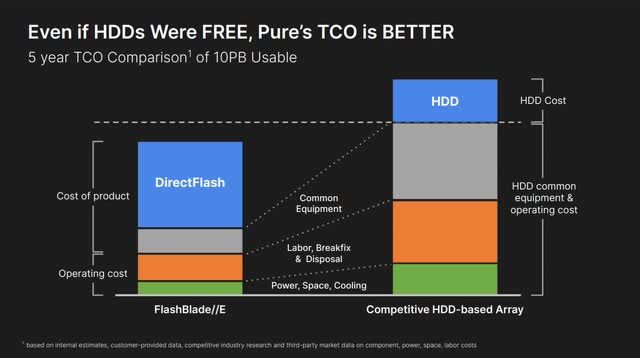
The above image shows how Pure Storage’s DirectFlash has lower costs than HDD, with one of those costs being power consumption, which has become a significant concern in data centers. The following quote comes from a May 15, 2024, Mission Critical Magazine article:
Currently, mission critical data centers are responsible for 2% of overall global energy consumption, according to the International Energy Agency (IEA). The projection is even more concerning in the US, with data centers accounting for 4% of total energy consumption. IEA projects the industry’s rate of energy consumption will double in the next two years. A new study suggests that for every 30 responses generated by an AI platform, the equivalent of a 16 oz. bottle of water is consumed in the necessary processes that data centers use to functionally cool servers.
The company claims on its website that (emphasis added) “Pure Storage’s DFMs [DirectFlash Modules] are already up to 10x more efficient in terms of energy and floorspace consumption than HDDs today.” Notice the commentary about floor space consumption. Data center space is at a premium. When a company gains data center space, it wants to use that space judiciously and prefers equipment with a smaller physical footprint over a larger one while still getting the job done.
The last significant factor driving enterprises to their all-flash solutions is the growth of unstructured data, which is data that doesn’t fit in structured formats like SQL databases. Unstructured data comes in different forms, from social media posts to music files, live chat, video, PDF files, and more. Flash memory can handle large volumes of unstructured data efficiently; HDD has suboptimal performance when handling the same data.
2. Hybrid cloud architecture
Despite the growing adoption of public cloud, organizations still spread their computing and storage needs across on-premises systems, edge, private, and public clouds. Some of the reasons that organizations are not 100% on the public cloud include:
- Compliance: Government regulations may require companies to store certain data in a specific geographic location.
- Security: Companies and governmental organizations may prefer sensitive information to remain on-premises under stricter security protocols than may be found in the public cloud. The same organization may prefer using the public cloud for non-sensitive information.
- Cost management: By balancing public and private cloud usage, organizations can create the most cost-effective IT solution.
- Convenience: In edge computing applications, keeping the data nearby is often more convenient than sending it to a distant cloud resource.
Treating multiple computing resources as one computing platform is called Hybrid computing. An article on the Pure Storage website says:
The big idea behind hybrid cloud computing is to treat all your clouds as a single environment. This can be difficult to pull off in practice, but the closer you get to a seamless integration between compute, storage, and networking resources across your on-premises, private, public, and edge environments, the more powerful your hybrid cloud.
Mordor Intelligence forecasts that the hybrid cloud market will grow from $129.68 billion in 2024 at a CAGR of 22.12% to $352.28 billion by 2029. The market’s growth is a secular tailwind for Pure Storage, which offers a solution to assist hybrid cloud architecture.
3. AI-based opportunities
One massive potential issue some organizations run into when using their data in AI or generative AI applications is data fragmentation and storage devices delivering data too slowly to the AI inference engine. CEO Giancarlo said in the company’s first quarter FY 2025 earnings call, “Data stored on widely diverse platforms, with different operating and management systems, which are siloed and individually managed, are unable to feed real-time data to AI inference engines.” Since the company offers hardware, software, and cloud products capable of feeding data to AI inference engines at the necessary rate, Pure Storage can help its customers utilize AI applications effectively.
Pure Storage products and services
Pure Storage can be confusing to analyze at first glance because it is part hardware storage, part software, and part cloud company. The following descriptions of Pure Storage’s products and services may contain slight inaccuracies because I am not an IT professional or storage expert. Much of this company’s technology can be hard to understand for a novice. However, I did a lot of research and tried to be as accurate as possible.
If you are like me and listen to the company’s conference calls without knowing what products and services the company performs, it’s easy to get confused by what Pure Storage does. On top of that confusion, the company is also transitioning from mostly selling its hardware products in a one-time sales model to managing a customer’s storage needs in a subscription model. I tried to make my descriptions of these products and services informative and understandable without getting too geeky. However, understanding enterprise storage systems is a geeky topic, and it may be challenging to understand what makes Pure Storage’s memory products better than NetApp’s (NTAP) or Dell Technologies’ (DELL) without delving a little into some technical aspects of the storage market.
The following image shows several of the company’s products and services.
Source: Pure Accelerate 2024 Investor Presentation.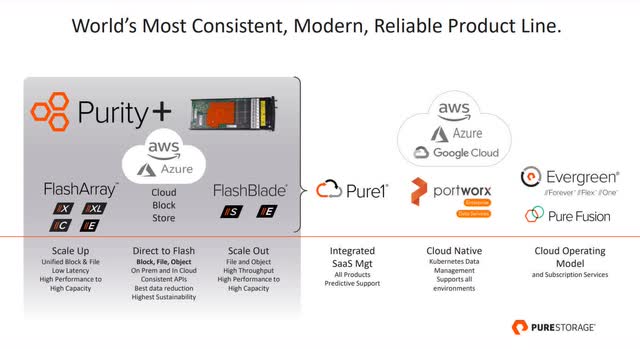
1. FlashArray and FlashBlade
These products are the company’s hardware storage solutions. Pure Storage sells multiple FlashArray models to suit its enterprise customers’ needs. The company bases its FlashArray on flash memory drives rather than spinning-disk HDD technology. The company initially only sold FlashArray for HPC applications, as the first flash memory was more expensive than HDD and cost-prohibitive for storage needs outside of HPC. However, the economics of flash memory have changed to the point where FlashArray is now viable for storage needs outside of HPC. The company’s FY 2024 10-K states, “Pure//E family of products delivers flash reliability and efficiency at prices now comparable to traditional hard disk [HDD] systems.” FlashArray handles block and file workloads. Customers buy FlashArray when they want to scale up by adding more modules to a storage array to increase total storage capacity. Customers also use FlashArray to address more structured data workloads.
The company also sells FlashBlade, which handles file and object workloads. Without getting into the weeds of file management systems, file, block, and object are different methods of storing data. Customers buy FlashBlade when they want to scale out by adding more servers and networking the storage in those servers to act as a single unit. Customers also use FlashBlade to process unstructured data workloads and for AI applications. The company’s FlashBlade//S is especially suited for AI. Pure Storage uses it in the company’s recently released AI infrastructure product, which it created in collaboration with NVIDIA (NVDA) named AIRI on NVIDIA DGX BasePOD.
2. Cloud Block Store
The company states on its website that “Cloud Block Store™ (CBS) is enterprise-grade block storage in the public cloud.” This solution extends specific Purity data architecture and services into Microsoft’s (MSFT) Azure and Amazon’s (AMZN) AWS public cloud.
3. Purity and direct flash modules
Purity is the software that directly controls its FlashArray, FlashBlade, and Cloud Block Store products. The company describes the software as “Secure, highly scalable, and simple to use, Purity powers all of Pure Storage®, including FlashArray//X™ and FlashArray//XL™ to deliver comprehensive data services for performance-sensitive applications, FlashArray//C™ for capacity-oriented applications, and Pure Cloud Block Store™ for seamless data mobility.”
The company believes that this software differentiates the company’s FlashArray and FlashBlade storage products from standard solid-state drives (“SSDs”) in the following three ways that it lists in its FY 2024 10-K (emphasis added):
Our extended advantage stems from three technology differentiators: Our leadership with direct-to-NAND software, our integrated hardware/software direct flash modules, and our data reduction capabilities. Because our highly sophisticated flash management software requires less NAND, we drive significant efficiency advantages over SSDs by eliminating over-provisioning, extending endurance, requiring far less common equipment and reducing environmental impact.
NAND is the technical term for flash memory, which is a memory that continues storing data after the removal of power (long-term memory). The company states on its website, “DirectFlash is a flash module designed by Pure Storage that allows all-flash arrays to communicate directly with raw flash storage.” What raw flash storage means for the non-memory expert is that Pure Storage buys custom-made flash memory chips from manufacturers and avoids using pre-built off-the-shelf SSDs from Micron or Samsung. This custom-made flash memory chip that Pure Storage uses is a high-density TLC (Triple-Level Cell) or QLC (Quad-Level Cell). The most significant advantage of TLC and QLC flash memory is that they can store more data in a smaller area than other NAND flash memory types.
Additionally, QLC is a more economical chip than other NAND flash types. The disadvantage of a QLC chip is that it needs sophisticated management software (Purity) and requires much calibration to get the chip to work effectively. DirectFlash and Purity software communicates with and controls the custom-made TLC and QLC NAND flash memory chips. The company believes this module and software combination gives it a competitive advantage in efficiency and performance over other Flash memory providers.
4. Pure1
Pure1 is the company’s cloud management service for managing FlashArray, FlashBlade, Cloud Block Store, and Purity software (private cloud). The company uses machine learning and analytics to make it easier for IT staff to monitor and manage a company’s storage needs globally using mobile devices. This service gives IT staff information and suggestions for them to act on. Additionally, the company later added Pure1 Meta, which the company calls “self-driving storage” and analogizes it to how self-driving cars automate the driving process.
Source: Pure Storage Website.
Pure1 Meta’s goal is to ” eliminate manual operations” by automating the management of the company’s hardware and software private cloud storage products.
5. Portworx
To understand Portworx, one must first understand containers and Kubernetes. A container is an all-in-one package that holds everything an application needs to run in almost any computing environment. The Kubernetes website describes Kubernetes as “an open-source system for automating deployment, scaling, and management of containerized applications.” Portworx is Pure Storage’s proprietary platform that sits on top of open-source Kubernetes. It provides complimentary data services to Kubernetes functionalities, including disaster recovery, backup functionality, storage services, and DevOps integration.
6. Pure Fusion
Source: Pure Accelerate 2024 Investor Presentation.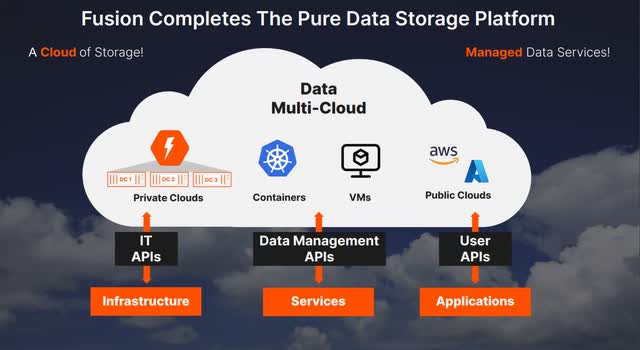
The company describes Pure Fusion as a way to “Automate your enterprise storage, and deploy and scale workloads across any environment. Streamline complex tasks and boost efficiency, enabling your business to focus on growth while reducing risks and overhead.” This Software-as-a-Service (SaaS) application uses AI to automate storage management on private clouds, containers, Virtual Machines (VMs), and public clouds. Pure Fusion enhances the operation of a hybrid cloud environment.
7. Evergreen
One disadvantage of traditional storage systems is that they can quickly become obsolete. Pure Storage addresses this problem through a service named Evergreen. The company describes the service in its latest 10-K:
Our differentiated Evergreen architecture enables our hardware storage systems to not become obsolete or require wholesale replacement like traditional systems. Our architecture includes several key technology elements that allow our arrays to be upgraded non-disruptively, which is a critical underpinning of delivering a full as-a-service experience.
Pure Storage designs its hardware system so customers can easily replace or upgrade each component. The company can also update its software online without disrupting its operations. It offers customers three services named Evergreen that include these services:
- Evergreen//One is a single storage “pay-as-you-go” subscription service that uses service level agreements to detail Pure Storage’s management of its customers’ on-premises and public-cloud data storage. The service monitors and upgrades the on-prem storage hardware and software without disrupting a customer’s operations. This service uses a storage as a service (STaaS) business model, and customers do not own the hardware.
- Evergreen//Flex is a subscription service where the customer owns and maintains the hardware but pays based on how much storage capacity they consume. The subscription includes hardware upgrades and SaaS-delivered software updates. A FAQ on the service states, “This unique consumption model allows for lower upfront costs and better asset utilization for organizations that need to maintain ownership of their IT infrastructure based on business or regulatory needs.”
- Evergreen//Forever is a traditional storage offering in which customers own the storage hardware and buy a subscription for software and hardware upgrades.
Please pay close attention to the company’s Evergreen business, as higher-margin subscription services are becoming a more significant percentage of its revenue.
Pure Storage business results
Customers must like the company’s products. The following image shows the company’s market share changes compared to competitors over the last decade.
Source: Pure Accelerate 2024 Investor Presentation.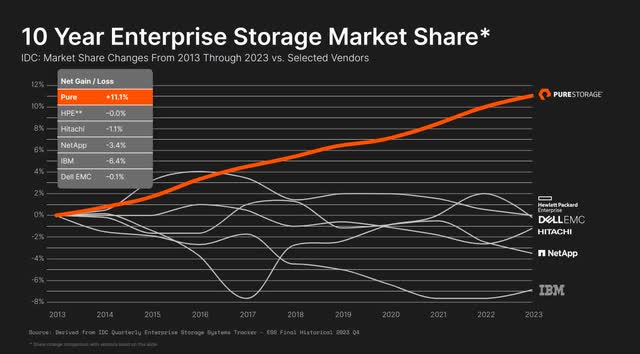
According to IDC, by the end of the calendar year (“CY”) 2023, the company had grown to the second largest market share for all-flash storage, at 19.9%
Source: Pure Accelerate 2024 Investor Presentation.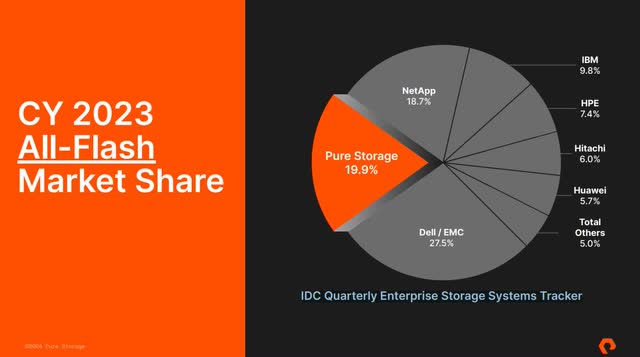
The following pie chart shows that as of the end of the March quarter, Pure Storage had a 21.1% market share in the Enterprise storage market. According to the chart, it looks like it picked up most of its market share gains at the expense of Dell/EMC. This market share grab has caught investors’ eyes and is one reason some are interested in the company.
Source: Pure Accelerate 2024 Investor Presentation.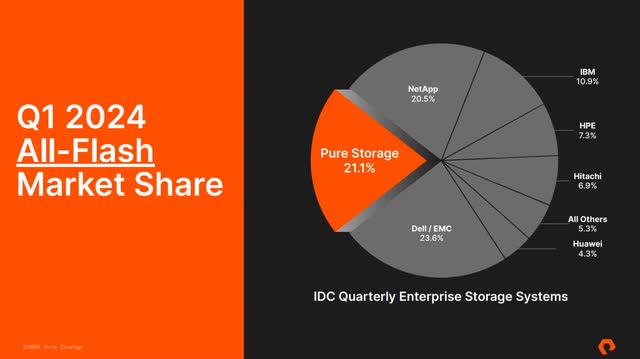
Let’s go over the recent trends in Pure Storage’s revenue growth. The following chart compares Pure Storage’s quarterly revenue growth with that of its peers.
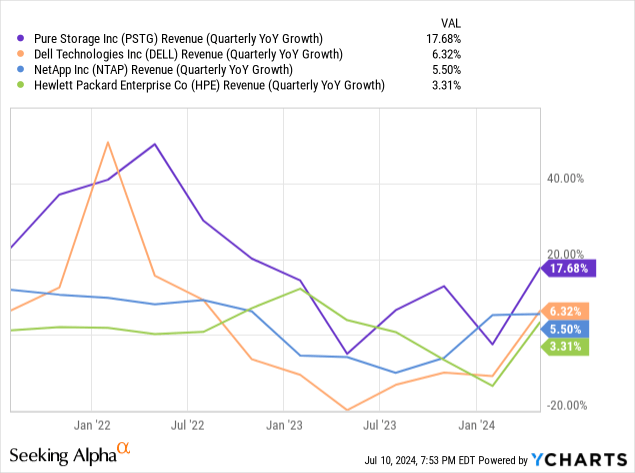
Like several of its peers in the enterprise storage industry, growth rapidly declined starting around the middle of 2022 as the impact of rising interest rates stirred up recession fears. After the company produced declining year-over-year revenue growth in the first quarter of CY 2023 (FY 2024), investors were disappointed that management gave a dismal revenue forecast for its fourth quarter of FY 2024. The stock sank 14% on November 30, 2023, the day after reporting its weak guidance. When the company did report its fourth quarter numbers, year-over-year revenue growth had declined by 3%. If Pure Storage has such a great growth story, what is going on here with such weak growth numbers?
Remember when I said to pay close attention to the company’s Evergreen subscription business? The following table shows that since 2020, subscriptions as a percentage of total revenue grew from 25% to 43%.
| Fiscal Year Period | Subscription Revenue Year-over-Year Growth | Subscription % of Total Revenue |
| 2024 | 26% | 43% |
| 2023 | 30% | 35% |
| 2022 | 37% | 34% |
| 2021 | 33% | 32% |
| 2020 | 43% | 25% |
This growth in Evergreen subscription revenue has hurt revenue growth in the near term since accounting rules call for subscription revenue recognition over time instead of revenue recognition at the time of sale, such as the company’s hardware sales. The following table from the company’s first quarter FY 2025 earnings release shows that product revenue grew 12% year-over-year. Subscription revenue grew even faster at 23% year-over-year. Subscription services revenue is now at nearly 50% of total revenue.
Pure Storage First Quarter FY 2025 Earnings Release.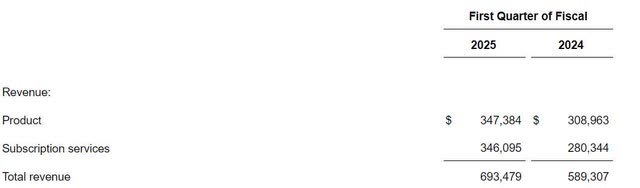
Virtually every company that has switched from one-time product sales to a subscription business has seen a temporary drop in revenue growth as the percentage of subscription revenue increases. However, over the long term, a subscription business can be more beneficial to Pure Storage, as it should have steadier, more predictable revenue growth. The following image shows that year-over-year revenue growth rebounded to 18% in the first quarter.
Pure Storage First Quarter FY 2025 Investor Presentation.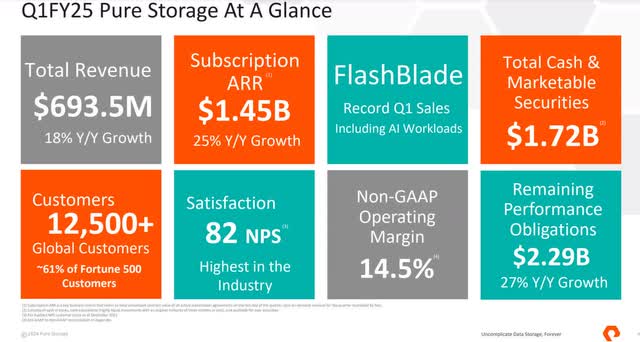
Pay close attention to the company’s subscription-related numbers in future quarters. Ideally, we want to see subscription ARR (annual recurring revenue), the revenue the company expects to receive annually from subscriptions, growing faster than subscription revenue growth. We also want to see RPO (Remaining Performance Obligations), the revenue the company expects to receive once delivering contracted future services to customers, grow faster than subscription revenue. Higher ARR and RPO represent future growth potential, and when both numbers grow faster than revenue growth, they often represent faster growth of predictable future revenue streams. Since subscription ARR of 25% and RPO growth of 27% are higher than subscription revenue, it portends future solid revenue growth.
The company ended FY 2024 with 2.80% revenue growth. The following table shows Pure Storage’s guidance for the second quarter and FY 2025. The company expects revenue growth of 9.6% in the second quarter and 10.5% for FY 2025. The guidance also includes TCV (total contract value) of the company’s storage-as-a-service Evergreen// One and Evergreen// Flex offerings, which are the most critical subscription services. The TCV number reflects the future revenue potential from these subscriptions. This guidance for 50% TCV for FY 2025 is a positive indicator for future revenue growth.
Pure Storage First Quarter FY 2025 Earnings Release.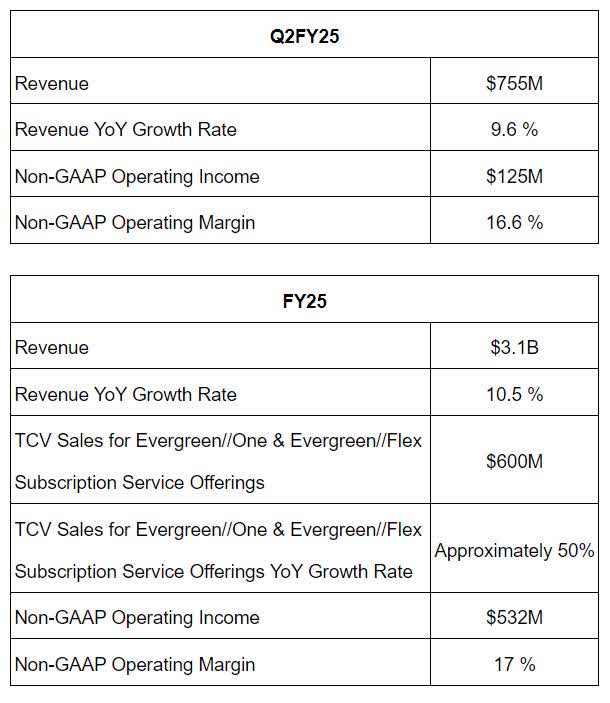
The following table shows analysts expecting annual revenue growth to double digits over the next several years. One analyst believes annual revenue growth will reach 20% by FY 2028.
Seeking Alpha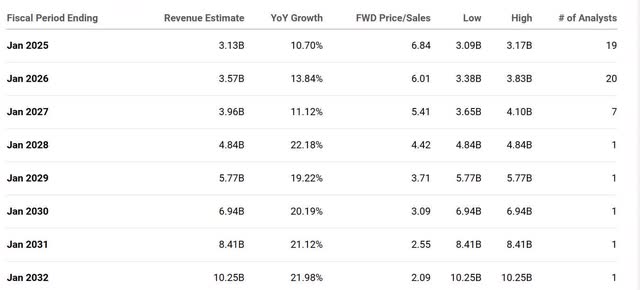
The following image includes non-GAAP (Generally Accepted Accounting Principles) gross margins and operating margins. Note that subscription gross margins are higher than product gross margins, implying that the company’s profitability should increase as subscription revenue becomes a larger portion of income. Additionally, over the past three years, first-quarter margins have increased for both product revenue and subscription revenue, a positive trend.
Pure Storage First Quarter FY 2025 Earnings Release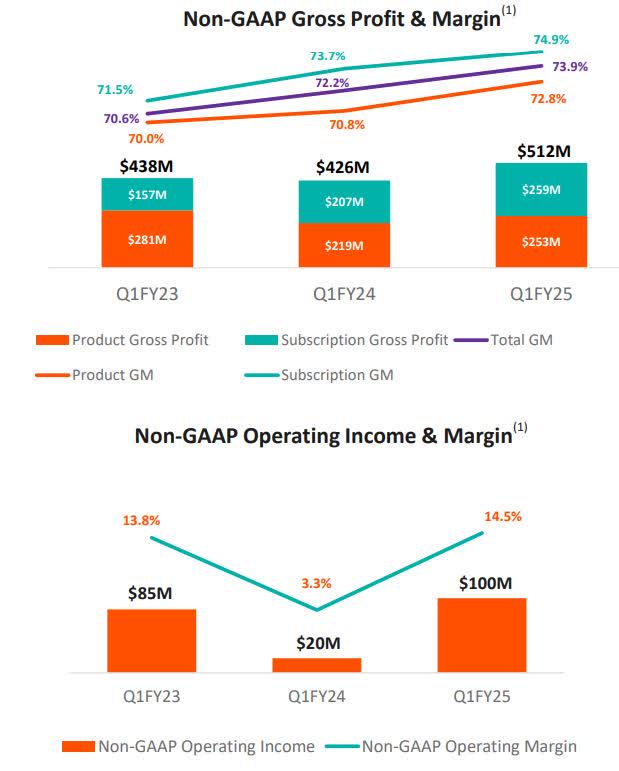
The company’s non-GAAP operating margin for the first quarter of FY 2024 was 3.3%, substantially lower than the previous quarter. However, operating margins improved to 14.5% in the first quarter of FY 2025. The company guidance for the second quarter of FY 2025 non-GAAP operating margin of 16.6% and FY 2025 operating margin of 17% is a positive indicator of improving profitability.
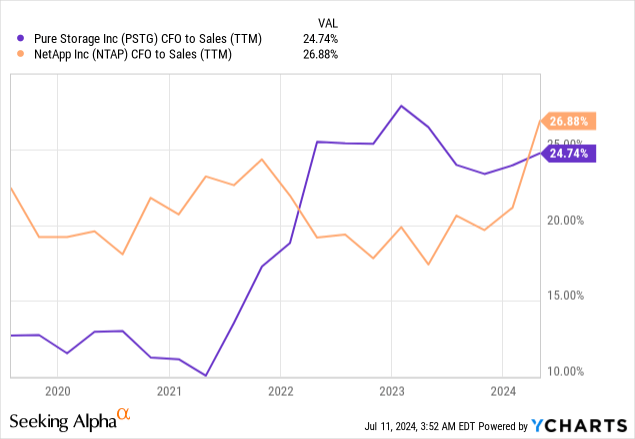
The following chart compares Pure Storage’s cash flow from operations (“CFO”) to sales to competitor NetApp’s CFO-to-sales. Pure Storage should have room to increase this metric by several points. Its CFO-to-sales of 24.74% means that for every dollar of sales, Pure Storage generates $0.25. Investors should monitor this metric, as a growing CFO-to-sales has positive implications for free cash flow (“FCF”).
The following chart shows that at the end of the first quarter, Pure Storage produced $533.42 million in trailing 12-month FCF. It has $1.72 billion in cash and short-term investments and $100 million in long-term debt.
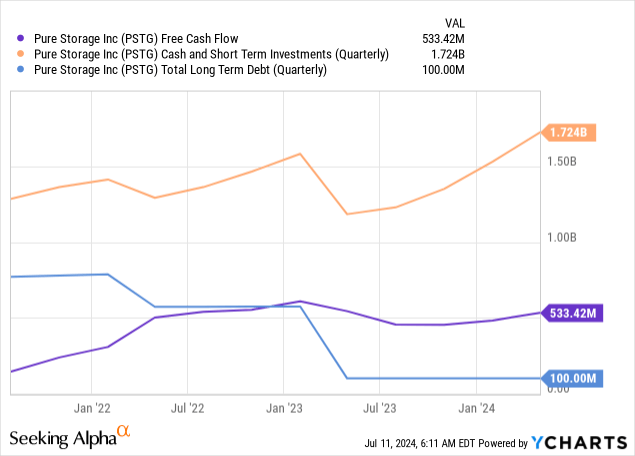
Pure Storage spent $49 million on capital expenditures (“CapEx”) during the first quarter, approximately 7% of revenue. This level of spending is a drag on the company’s FCF. For example, although competitor NetApp spent a similar amount on CapEx during the quarter ($46 million), it’s only 2.75% of its total revenue, a partial reason that NetApp has an FCF margin nearly 6% better than Pure Storage. The company’s Chief Financial Officer Kevan Krysler said the following on the company’s first quarter FY 2025 earnings call, “Factors contributing to capital expenditures included test equipment supporting our engineering teams for new innovations, continued build out of our new headquarters, and infrastructure supporting our Evergreen// One storage-as-a-service sales.” These investments could lead to future growth and potentially improve FCF margins in the long term.
Risks
The most significant risk for Pure Storage is competition. Although the company has been a leading innovator in flash technology, other companies may be catching up. For instance, Meta Platforms (META) has been a significant customer since 2017 and Pure Storage was in line to help the company build a massive supercomputer in 2022. However, in March, the market learned that rival private company Hammerspace will assist Meta in building its supercomputer. Block & Files published an article that stated:
Meta has partnered with Hammerspace “to co-develop and land a parallel network file system (NFS) deployment to meet the developer experience requirements for this AI cluster … Hammerspace enables engineers to perform interactive debugging for jobs using thousands of GPUs as code changes are immediately accessible to all nodes within the environment. When paired together, the combination of our Tectonic distributed storage solution and Hammerspace enable fast iteration velocity without compromising on scale.”
Analysts have woken up to competition potentially hurting Pure Storage’s market share. Seeking Alpha published an article quoting UBS Group (UBS) analyst David Vogt on July 2, 2024 (emphasis added):
“Pure’s valuation has benefitted from the view that AI infrastructure investments will accelerate growth,” analyst David Vogt wrote in an investor note. “However, AI related storage spending will likely be slower than the [market] expects and more tied to inference, a slower growth market than training. Finally, private vendors like Weka, VAST Data, and Hammerspace are gaining share as evidenced by Meta’s announcement it is partnering with Hammerspace to co-develop and land a parallel network file system deployment in its GenAI clusters.” Other competitors in the flash space, such as NetApp’s C-series, [Hewlett Packard Enterprise’s] (HPE) Alletra and others are expected to gain market share, leaving Pure Storage with roughly 15% of the market, below the 19% consensus estimate, Vogt added.
Investors should monitor future earnings reports for signs that competition has negatively impacted the company’s market share and results.
Valuation
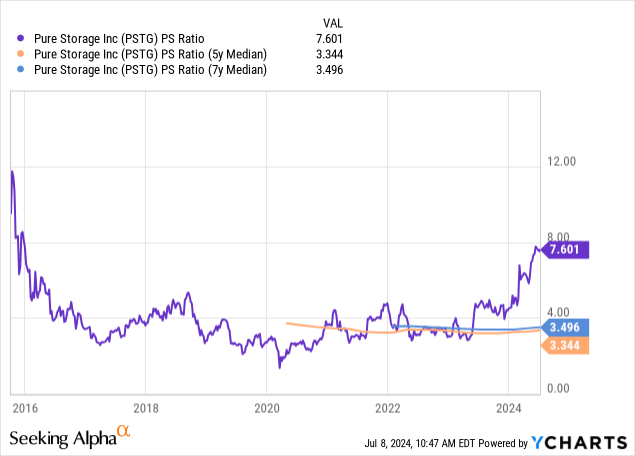
Pure Storage has a price-to-sales (P/S) ratio of 7.6, well above its five- and seven-year median and above the Information Technology (“IT”) sector’s median of 3.03. Some think the market overvalues the stock at the current valuation.
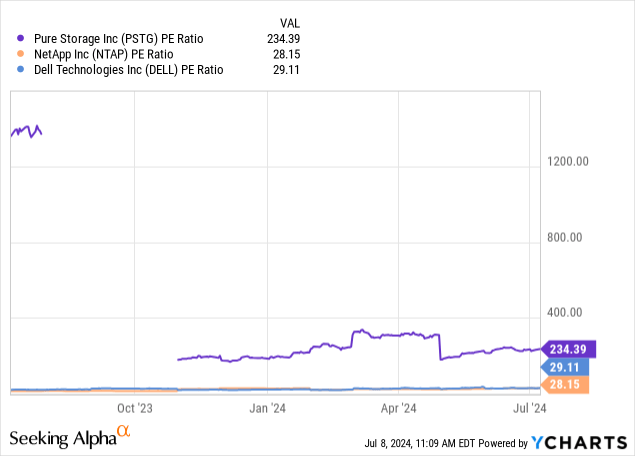
Its price-to-earnings (P/E) ratio is 234, well above its two primary competitors, NetApp and Dell, and the IT sector median of 30.55, a potential sign of overvaluation.
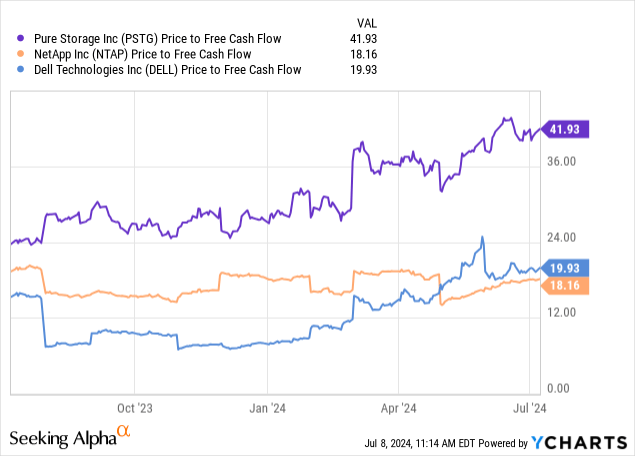
The stock trades at a price-to-FCF of 41.93, well above its peers and the IT sector median of 19.59. Seeking Alpha Quant rates the stock’s valuation a D-.
Let’s compare the company’s forward P/E ratio to its EPS growth estimates over the next three years. The following image shows that Pure Storage’s forward P/E exceeds its year-over-year EPS growth estimates over the next three fiscal years, which suggests that the market overvalues the stock. The risk of the stock falling if the company misses profitability and revenue growth estimates is high.
Seeking Alpha
Let’s do a reverse discounted cash flow (“DCF”) analysis of the stock to see what FCF growth rate the current stock price implies.
Pure Storage Reverse DCF
|
The first quarter of FY 2025 reported Free Cash Flow TTM (Trailing 12 months in millions) |
$533 |
| Terminal growth rate | 3% |
| Discount Rate | 10% |
| Years 1 – 10 growth rate | 16.9% |
| Current Stock Price (July 10, 2024 closing price) | $67.71 |
| Terminal FCF value | $2.616 billion |
| Total Present Value of Cash Flows | $14.411 billion |
| FCF margin | 18% |
NetApp, one of its older competitors, achieved an FCF margin of 24.4% in its latest quarter. Suppose Pure Storage achieves an FCF margin of 24%; the FCF growth rate it would need to achieve to justify the current stock price is 13.2%. According to one analyst, Pure Storage will grow revenue at a 17.45% compound annual growth rate over the next eight years to reach $10.25 billion. Let’s say it can achieve a revenue growth rate of 16% over ten years; the estimated intrinsic value is $83.50, above the July 10 closing price by 23.3%.
A buy recommendation
This company should be a massive beneficiary of companies adopting AI, which should be a rising tide that lifts many boats. Although competition is rising, Pure Storage is still an innovation leader in the storage industry. If you are an aggressive growth investor willing to invest in a high-risk, high-reward investment, the company’s valuation based on a reverse DCF still leaves room for potential upside. I give Pure Storage a buy recommendation.
Credit: Source link