

Klaus Vedfelt/DigitalVision via Getty Images
This post is motivated partially by practical implications and partially by instilling self-discipline. I will start with the security description and certain trivial points.
Athene has five series of preferred stocks – (ATH.PR.A), (ATH.PR.B), (NYSE:ATH.PR.C), (ATH.PR.D), and (ATH.PR.E) with varying attributes. We will focus solely on Series C which is a perpetual non-cumulative preferred stock issued by the retirement subsidiary of Apollo Global (APO) with a liquidation value of $25 and a current fixed dividend of 6.375%. For its complete description, please check below:
Quantumonline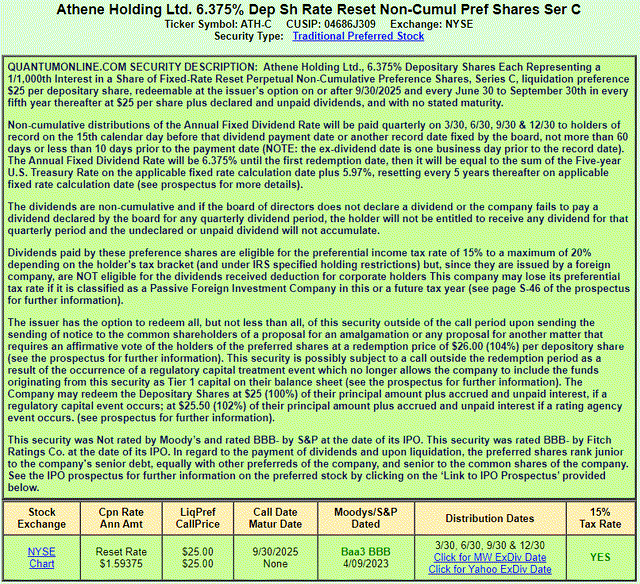
Importantly, it can be called on 9/30/2025, and if not, its dividend will be reset at the rate of 5-year US Treasuries plus 5.97% for the next 5 years. Since paying close to 10% in after-tax dividends is improbable for an A+ graded company like Athene, I believe the Series C preferred stock will be called at the end of September 2025, barring any catastrophic events.
Series C routinely trades slightly below $25 but sometimes exceeds this number. At the time of writing, its value is $24.93 and its stripped yield is 6.8%. Its yield-to-call is close to 7% due to incremental capital gains.
Series C has a BBB rating. Below are the returns of investment-grade securities of the same maturity (they are available from many sources, I used Fidelity):
- Treasuries – ~5%
- CDs – ~5.3%
- A-grades corporate bonds – ~5.5%
- Corporate bonds with BBB- rating – ~6.1%
Of importance for taxable portfolios, Series C dividends are qualified, meaning they are (together with small expected long-term capital gains) subject to a 15% tax rate above certain AGI thresholds and a zero rate below them. Since interest on comparable securities is taxed as ordinary income, it represents another important advantage contingent on the investor’s tax status.
Compared to Treasuries, Series C should deliver more than a 2% spread without big sacrifices in liquidity – the issue will likely remain hovering around $25.
Apollo and Athene ultra-brief
I have described the companies many times but for convenience, I have to do it again albeit in the shortest style.
Apollo Global consists of an alternative asset manager Apollo (“old Apollo”) and an annuity provider Athene. Apollo charges various fees for managing third-party assets, including those on Athene’s balance sheet. Athene’s dominant business is issuing fixed annuities including group annuities (aka pension risk transfer (“PRT”)), and reinsuring annuities originated by other insurers. It is the #1 fixed annuity issuer in the US. Being technically a life insurer, Athene does not underwrite any life business. It makes Athene safer than most other life insurers, as its book has no mortality or legacy (such as long-term care, for example) risks.
Due to tax advantages, Athene was originally set up in 2009 as a Bermuda corporation, even though it operated mostly in the US and its major operating subsidiaries have always been US-located. After merging with Apollo in January 2022, Athene became a full US taxpayer and at the end of 2023, it was redomiciled in Delaware.
Due to multiple mark-to-market entries, arcane accounting rules, and other factors, some of Athene’s GAAP statements are difficult to read, and investors often refer to adjusted numbers presented in Athene’s supplementary filings.
How safe are Athene’s preferred stocks?
We will start with a standard credit review and proceed with a deeper dive into the safety of its preferred stocks. Please note that Athene’s credit profile is separate from Apollo’s. The company files separate Qs, Ks, and other SEC forms in addition to SAP-based filings for each state and holds separate quarterly calls with analysts. Thus, Athene’s safety is always in the crosshairs of rating agencies, investors, and insurance regulators.
Company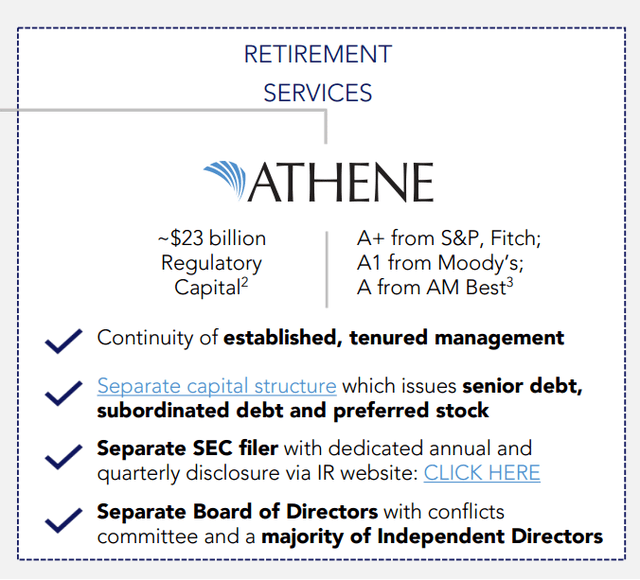
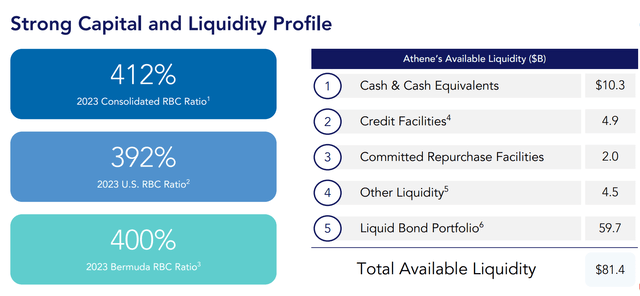
Management often talks about Athene’s fortress balance sheet:
Company Company Company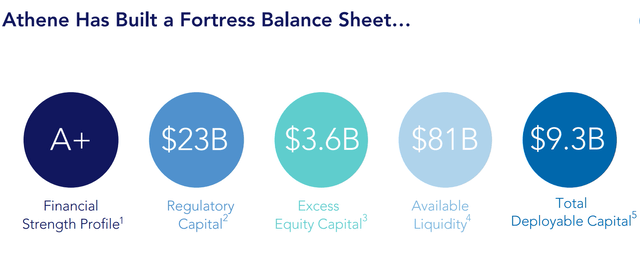
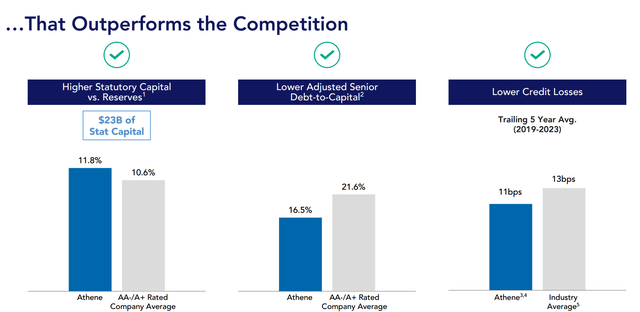
Company Company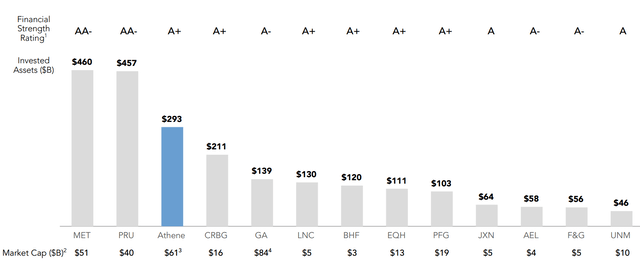
From the copy-and-paste session above, I would like my readers to realize the following:
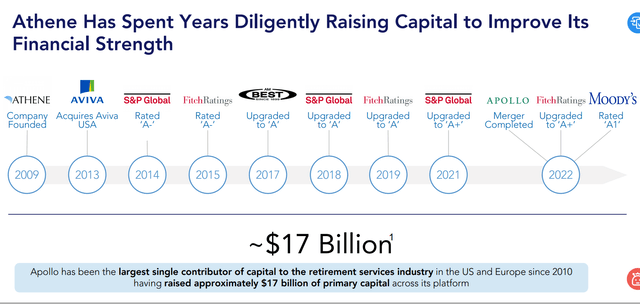
1. Even though Athene has an A+ credit rating, I believe its financials are on par with Prudential (PRU) and MetLife (MET) rated AA-. Management is committed to maintaining these superior financials and hopeful of an eventual credit upgrade to AA- (if you are doubtful, I suggest you check Athene’s fixed-income calls transcripts).
2. Athene’s balance sheet has enormous liquidity that can be used in an unfavorable economic environment.
3. Athene has excess equity compared with what regulators require and maintains a lower debt/capital ratio than its peers. If necessary, it can issue additional debt without risking its ratings, in my view.
I recently authored another article on Apollo and Athene, and my readers were particularly concerned with two issues. Some investors considered Athene’s non-cumulative preferred dividend risky because its common stock was not publicly traded. I believe this is simply wrong. Apollo owns 100% of Athene’s common stock, and Athene pays Apollo approximately $750 million in annual dividends, in addition to its share of taxes. The common dividend dwarves preferred dividends of about $136M in 2023. Apollo can hardly function without receiving Athene’s dividends. Since insiders own approximately 30% of Apollo’s stock, it is inconceivable that Athene would intentionally miss its preferred dividend as long as it has the means to pay it. Moreover, any missed preferred dividends would jeopardize Athene’s crucial credit ratings. I consider this issue closed.
Some other investors were concerned with Athene’s ~12:1 assets-to-equity ratio, which is more or less standard for the life insurance industry. It brings unpleasant associations with similarly leveraged banks.
The crucial difference between Athene (and other life insurers) and banks is the nature of their liabilities. Banks’ liabilities are predominantly deposits that can be cashed or transferred to other financial institutions momentarily. When it happens, banks have to liquidate their longer-term assets and, under this scenario, even a super safe balance sheet may not be adequate. This is exactly what happened during the banking crisis of 2023.
Life insurers have illiquid long-term liabilities, most of which are impossible or costly to demand at the whim.
Company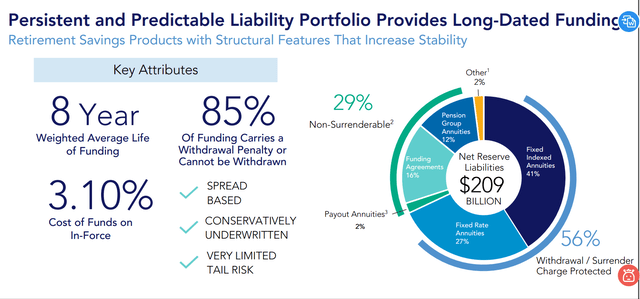
Importantly, 29% of liabilities cannot be withdrawn in principle. Surrender charges protect another 56%. For 61% of the latter, surrender charges are 6% or greater!
In addition to surrender charges, liabilities have other forms of structural protection such as market value adjustments, ordinary income taxes payable when annuities are withdrawn, and 10% IRS penalties imposed on withdrawals before the age of 59.5 years.
All this combined makes Athene’s surrenders unlikely and forecastable events:
Company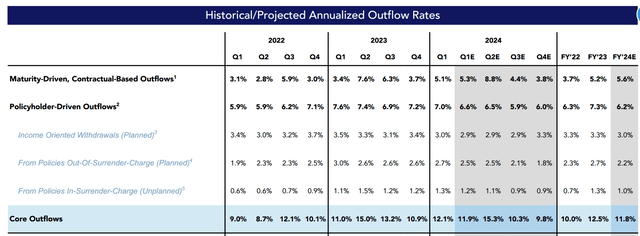
Certainly, not everything is going according to forecasts. There are three recent examples when mass surrenders led to a crisis for life insurers with none of them in the US. One was a recent isolated event in Italy when a rescue effort had to be launched for a particular insurance company. Another example was an isolated event in the UK. Since Athene is one of the safest US life insurers, we are more interested in systemic rather than isolated failures.
Exactly such happened in South Korea in 1998-2002 which was a consequence of the Asian Financial Crisis of 1997-1998. I will not go into details but please note the following:
- A general financial deterioration preceded the life insurance crisis.
- The crisis lasted for several years after the broader financial deterioration.
- South Korean life insurance system was relatively young compared to the US, and regulators had limited experience. After the crisis, the regulatory environment went through changes.
Let us assume now that something similar occurs in the US. How would Athene fare?
Before we proceed, I need to digress. Until now, we have focused on Athene’s liabilities. This doesn’t mean we should ignore the safety of Athene’s assets; quite the opposite. However, I have already discussed Athene’s assets in several of my previous articles. What follows will evaluate Athene’s overall safety, considering both its assets and liabilities.
Athene regularly stress tests its balance sheet in the Fed’s style and publishes the results, even though it is not required. Three separate scenarios are being considered: baseline recession, deep recession similar to 2008-2009, and stagflation. Historical data is used for distinct asset classes of Athene’s balance sheet. I will present one slide from the last test.
Company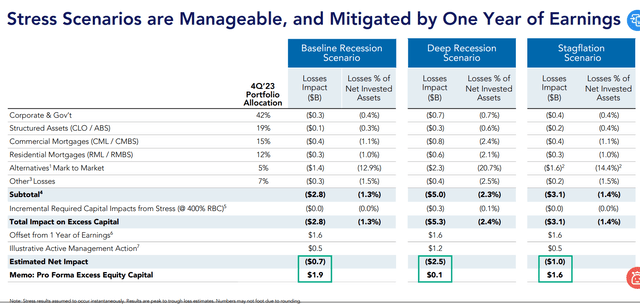
Athene concludes that even under the Deep Recession Scenario, the company will maintain excess equity capital. Management actions and one year of earnings should further mitigate losses.
One can take these tests with a grain of salt as we know that generals tend to prepare for the last war fought. But it is better to have the tests than not.
Everything so far has been about Athene’s credit in general. However, our focus is on the Series C preferred shares, which are almost certain to be called 16 months from now. Even under extremely unfavorable scenarios, it may take much longer than that for serious implications to fully develop and affect the safety of Athene’s preferred stocks.
The safety of Series C is further supported by the following:
- No debt matures between now and Sep 2025. The earliest debt maturity date for Athene is January 12, 2028.
- After redomicile in the US, Athene’s debt interest became tax deductible and the company started issuing subordinated debt in Q1 2024 at 7.250% fixed coupon (subject to reset) maturing in 2064. It is equivalent to 5.8% in after-tax interest, lower than Series C not tax-deductible 6.375%. Subordinated debt creates an easy and advantageous opportunity to replace preferred capital.
Asset allocation
Based on William Bengen, investors should allocate from 50 to 75% of their liquid capital to risky assets (William Bengen is the author of the famous 4% withdrawal rule. If you have not read his famous article, please do). Almost all preferred stocks regardless of their yield, belong to the same basket of risky assets together with junk credit (sometimes BBB- bonds are on the border with junk debt). Whatever is left can be invested in cash, Treasuries, and safe credit. I believe that’s where Series C belongs and I deem it safer than its BBB rating suggests.
In my opinion, investors nearing or in retirement should be able to sustain themselves for at least five years using only high-quality liquid assets (HQLA) and pensions, without relying on dividends or counting interest.
Why five years? Based on historical data since 1929, I calculated that equities have a ~90% probability of recovering from losses within five years (you can readily reproduce my calculations using S&P 500 stats). Additionally, several unquantifiable factors further improve this probability:
- I did not account for the interest from HQLA.
- 5 years is sufficient to adjust one’s financial footprint, i.e. reduce one’s living expenses.
- And finally, we have to account for investor’s mortality.
In summary, I consider having five years’ worth of high-quality liquid assets (HQLA) plus pension as a practical requirement. There should be no compromise on HQLA – solely cash and shorter-term bonds with a rating of at least A-. Given today’s tight spreads, Treasuries are uniquely suitable for this purpose.
Let us consider a single investor who needs $100K in annual expenses and receives $20K in Social Security. He consumes $80K of his investments annually and needs $400K in HQLA assets. If this investor has $1M in investable assets and wants to invest 50% of it into risky security, it leaves another $100K to invest in safe assets. Series C belongs there (I consider other Athene’s preferred stocks as risky assets).
Conclusion
I challenge my readers to suggest a safe asset that returns more than the Series C’s 7%. Such assets may exist, and sharing this information would benefit us all. However, as a word of caution, multiple preferreds yielding around 8% do not qualify as safe assets as described. Due to interest rate and credit risks, their total return may end up being lower than their yield.
One might wonder why the author devoted so much space to issues that seem intuitively clear. As I mentioned at the very beginning, it is partly to instill self-discipline, demarcate safe and risky assets, and help avoid the temptation of excessive yield-chasing in the basket of safe assets.
Credit: Source link