













• bitcoinBitcoin(BTC)$64,428.00-4.02%
  • ethereumEthereum(ETH)$1,792.64-5.34%
  • tetherTether(USDT)$1.000.04%
  • binancecoinBNB(BNB)$590.13-4.16%
  • usd-coinUSDC(USDC)$1.000.01%
  • rippleXRP(XRP)$0.96-3.03%
  • solanaSolana(SOL)$70.39-6.44%
  • tronTRON(TRX)$0.307279-1.68%
  • Figure HelocFigure Heloc(FIGR_HELOC)$1.071.87%
  • HyperliquidHyperliquid(HYPE)$65.42-5.62%
  • zcashZcash(ZEC)$897.95-1.08%
  • moneroMonero(XMR)$489.89-7.73%
  • dogecoinDogecoin(DOGE)$0.057880-7.44%
  • USDSUSDS(USDS)$1.000.00%
  • leo-tokenLEO Token(LEO)$9.12-2.04%
  • whitebitWhiteBIT Coin(WBT)$62.45-4.57%
  • chainlinkChainlink(LINK)$9.10-4.80%
  • cardanoCardano(ADA)$0.150501-7.62%
  • Ethena USDeEthena USDe(USDE)$1.000.03%
  • stellarStellar(XLM)$0.137323-3.89%
  • daiDai(DAI)$1.000.02%
  • nearNEAR Protocol(NEAR)$3.14-5.86%
  • bitcoin-cashBitcoin Cash(BCH)$204.05-4.54%
  • Quantix FinanceQuantix Finance(QFI)$999.150.00%
  • litecoinLitecoin(LTC)$44.80-6.95%
  • avalanche-2Avalanche(AVAX)$7.20-9.87%
  • CantonCanton(CC)$0.079927-5.53%
  • USD1USD1(USD1)$1.000.02%
  • tether-goldTether Gold(XAUT)$3,819.33-1.10%
  • uniswapUniswap(UNI)$4.99-9.38%
  • the-open-networkGram (prev. Toncoin)(GRAM)$1.05-2.07%
  • suiSui(SUI)$0.72-6.69%
  • Ripple USDRipple USD(RLUSD)$1.00-0.02%
  • Global DollarGlobal Dollar(USDG)$1.000.00%
  • paypal-usdPayPal USD(PYUSD)$1.000.01%
  • RainRain(RAIN)$0.003627-2.66%
  • hedera-hashgraphHedera(HBAR)$0.057191-3.68%
  • Ondo US Dollar YieldOndo US Dollar Yield(USDY)$1.150.01%
  • shiba-inuShiba Inu(SHIB)$0.000004-6.45%
  • crypto-com-chainCronos(CRO)$0.043717-5.36%
  • BittensorBittensor(TAO)$187.74-9.11%
  • quant-networkQuant(QNT)$146.12-5.39%
  • Circle USYCCircle USYC(USYC)$1.140.00%
  • Spiko Amundi Overnight Swap Fund (EUR)Spiko Amundi Overnight Swap Fund (EUR)(EURSAFO)$1.120.00%
  • MemeCoreMemeCore(M)$0.80-4.61%
  • okbOKB(OKB)$86.12-5.75%
  • pax-goldPAX Gold(PAXG)$3,821.54-1.07%
  • Falcon USDFalcon USD(USDF)$1.00-0.01%
  • pepePepe(PEPE)$0.000004-7.27%
  • BlackRock USD Institutional Digital Liquidity FundBlackRock USD Institutional Digital Liquidity Fund(BUIDL)$1.000.00%
TradePoint.io
  • Main
  • AI & Technology
  • Stock Charts
  • Market & News
  • Business
  • Finance Tips
  • Trade Tube
  • Blog
  • Shop
No Result
View All Result
TradePoint.io
No Result
View All Result

What Are The Limitations Of eGPUs Vs Onboard Graphics Cards For Laptops?

November 15, 2026
in AI & Technology
Reading Time: 5 mins read
A A
What Are The Limitations Of eGPUs Vs Onboard Graphics Cards For Laptops?
ShareShareShareShareShare

An eGPU can bring desktop-class graphics to a laptop, but cables, bandwidth limits and extra costs can eat into the advantage.


Razer

Connecting a desktop graphics card to your laptop seems like a neat solution to one of the oldest problems in portable computing. Use the thin machine for work and travel, and connect to a much more powerful GPU when you get home. An external GPU (eGPU) can do just that, but all that extra graphics power still has to travel through Thunderbolt or USB4 instead of the direct internal connection used by a built-in laptop GPU. That bandwidth bottleneck can eat into the desktop card’s advantage, and the cable it’s connected to holds sway as well.

YOU MAY ALSO LIKE

Which NVIDIA GPU Is Closest To The PS5? The Answer Isn’t So Simple

This Sony Patent Would Add A Credit Card Reader To Your PlayStation Controller

In this comparison, “onboard” primarily refers to a dedicated GPU built into the laptop, not the integrated graphics in the laptop’s processor. Even when a laptop GPU shares its name with a desktop GPU, the hardware can be vastly different. The RTX 5090 Laptop GPU features 10,496 CUDA cores, 24GB of GDDR7 memory, and a GPU subsystem power range of 95W to 150W. Meanwhile, you’ll find 21,760 CUDA cores and 32GB of GDDR7 memory on NVIDIA’s desktop RTX 5090. That’s a significant gap before even considering bottlenecks, like Thunderbolt.

Thunderbolt is still the bottleneck
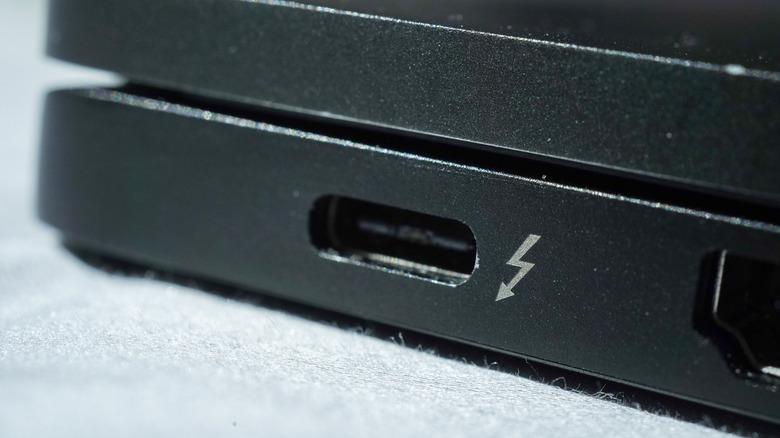

Closeup view of the Thunderbolt port on a laptop.
Eric H Cheung/Shutterstock

A modern eGPU typically communicates with the laptop via Thunderbolt or USB4, rather than directly on its PCIe bus, and that’s where some of the desktop card’s edge is lost. A built-in laptop GPU uses an internal PCIe connection instead.

Thunderbolt 4 has 40 Gbps of overall bandwidth and requires 32 Gbps of PCIe data throughput, while Thunderbolt 5 upgrades the base speed to 80 Gbps and doubles that PCIe requirement to 64 Gbps. Internal laptop GPUs can use wider multi-lane PCIe connections, depending on the laptop’s design, giving them more room to move data without the Thunderbolt bottleneck. 

That bottleneck is more noticeable when it comes to a powerful desktop card. NVIDIA’s desktop RTX 5090 has 1,792GB/s of memory bandwidth and a 575W total graphics power rating, compared with 896GB/s and a 95W to 150W GPU subsystem power range for the RTX 5090 Laptop GPU. Those aren’t PCIe bandwidth figures, but they show how much more raw hardware the desktop card brings before the external connection starts holding it back.

Thunderbolt 5 also has a 120 Gbps Bandwidth Boost mode, but that isn’t 120 Gbps of PCIe bandwidth for the GPU. Intel says PCIe data throughput remains at 64 Gbps. While USB4 can also support PCIe traffic, a USB-C-shaped port alone doesn’t guarantee eGPU compatibility. The host hardware needs the right support, and the enclosure, drivers, GPU and power requirements must all cooperate (because apparently one cable was getting too easy).

Using the laptop’s built-in display can add another penalty because rendered frames may have to travel back through the same limited connection. This is why some brands suggest connecting an external monitor directly to the eGPU for better performance. There’s no universal performance-loss percentage, since the GPU, laptop, connection, resolution and game all affect the result.

There’s a reason the built-in GPU is slower
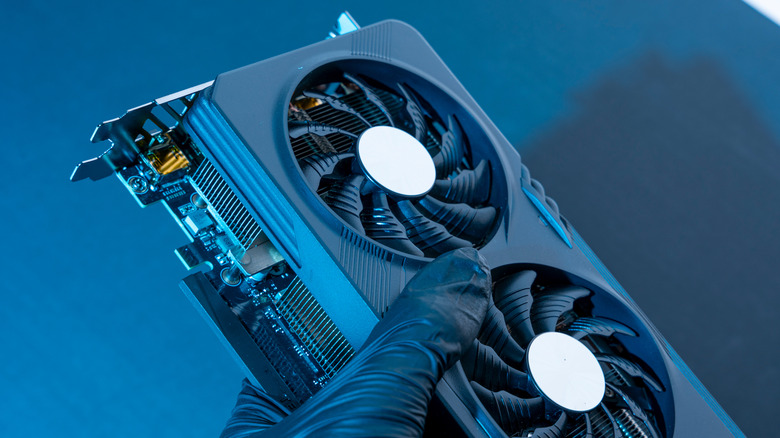

A person holding a desktop GPU.
Andrey Znamenskyi/Getty Images

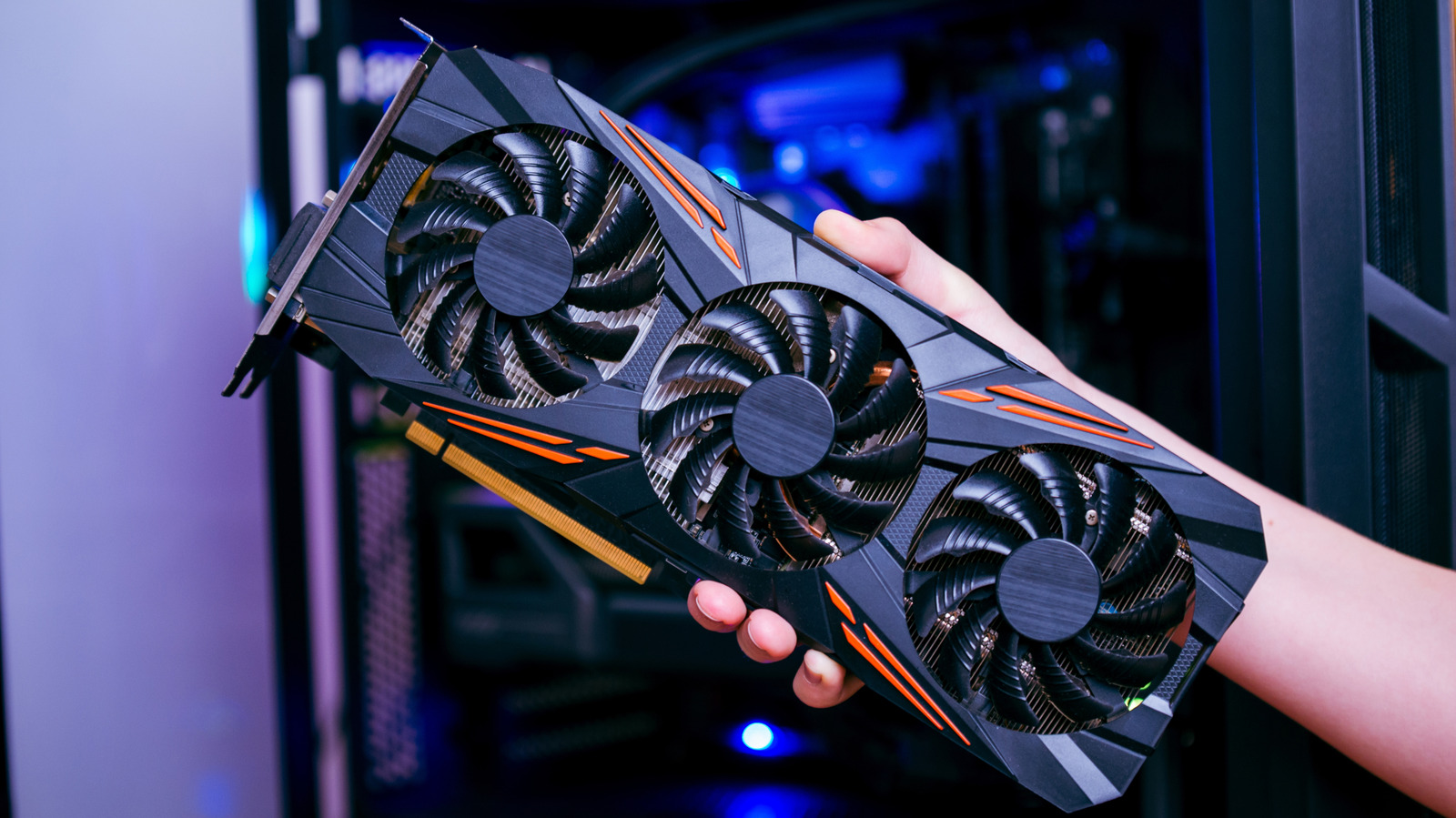
A laptop GPU begins with less raw hardware, but it doesn’t have to deal with most of this plumbing. It operates within the laptop’s cooling and power constraints, doesn’t have to send rendered frames back over an external cable, and remains in the laptop when you pick it up. The portability benefit is more like a suggestion with a traditional desktop-card eGPU. You now have an enclosure, a desktop GPU, and maybe an ATX power supply on the desk, while a big card can add size and noise to the mix.

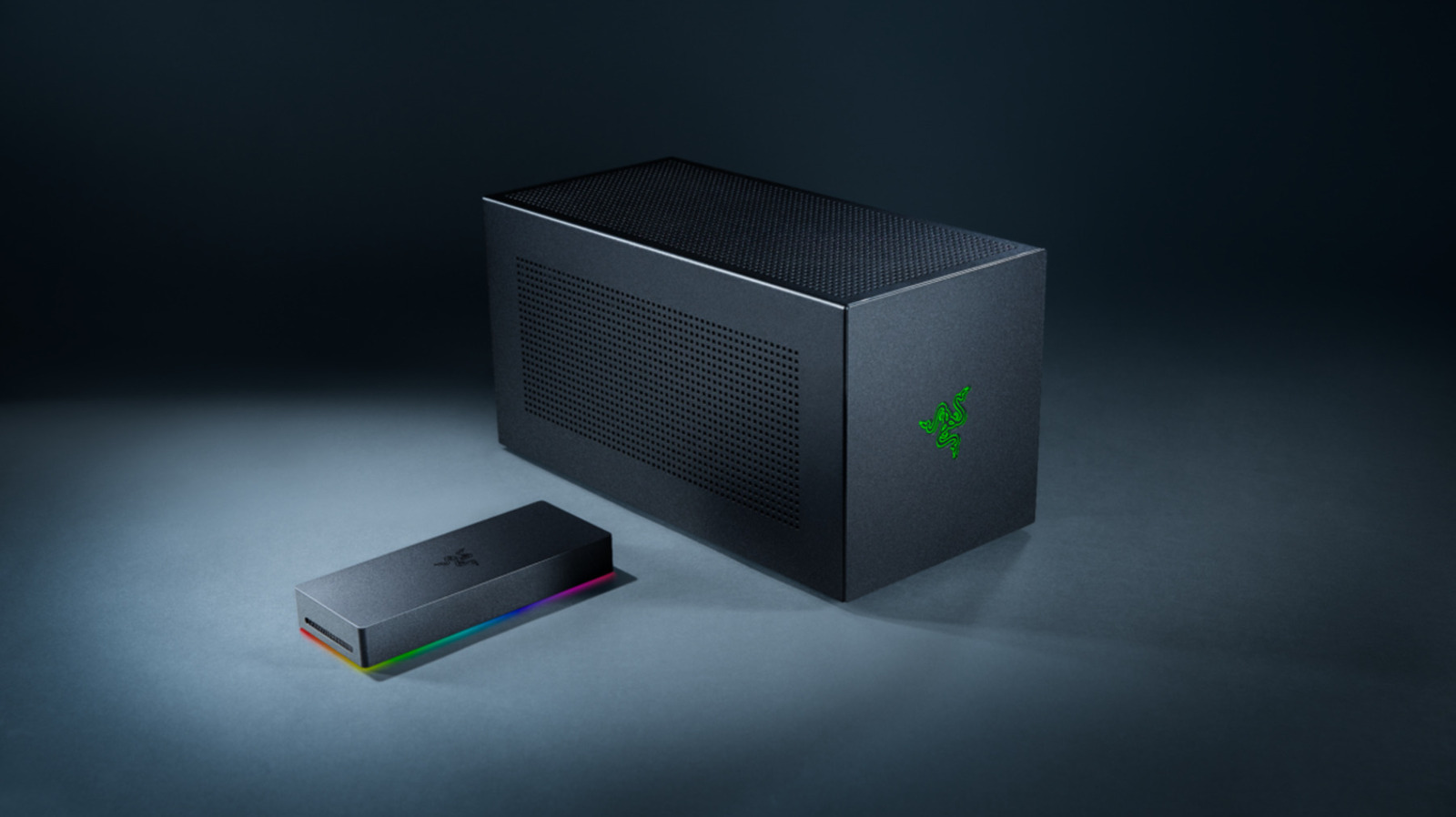
Let’s not forget to talk about the cost associated with eGPUs. As an example, Razer’s Thunderbolt 5 Core X V2 supports full-size NVIDIA and AMD desktop cards up to four slots wide. The enclosure also has its own 120mm cooling fan, but it doesn’t come with a GPU or even the necessary ATX power supply to keep it running. Those would be added expenses on top of approximately $350 for the enclosure itself.

That math gets considerably friendlier if you have a suitable GPU sitting around after a desktop upgrade. At that point, the enclosure could significantly upgrade your laptop without buying another computer. It’s more difficult to justify purchasing a high-end desktop card specifically for an eGPU, especially since you’re paying for all that power and then sending it through a cable that might not allow you to use it all.

Credit: Source link

ShareTweetSendSharePin

Related Posts

Which NVIDIA GPU Is Closest To The PS5? The Answer Isn’t So Simple
AI & Technology

Which NVIDIA GPU Is Closest To The PS5? The Answer Isn’t So Simple

November 15, 2026
This Sony Patent Would Add A Credit Card Reader To Your PlayStation Controller
AI & Technology

This Sony Patent Would Add A Credit Card Reader To Your PlayStation Controller

November 15, 2026
11 Gadgets Under  That Solve Everyday Problems
AI & Technology

11 Gadgets Under $10 That Solve Everyday Problems

November 15, 2026
Here’s When A Dedicated Graphics Card Is Worth It
AI & Technology

Here’s When A Dedicated Graphics Card Is Worth It

November 14, 2026
Next Post
NBC Nightly News with Tom Llamas Full Episode – Oct. 28

NBC Nightly News with Tom Llamas Full Episode - Oct. 28

Leave a Reply Cancel reply

Your email address will not be published. Required fields are marked *

Search

No Result
View All Result
Microsoft restores service to Outlook and Teams after historic outage crippled businesses, governments

Microsoft restores service to Outlook and Teams after historic outage crippled businesses, governments

November 14, 2026
ICE officer indicted after allegedly hitting and injuring a man with his vehicle

ICE officer indicted after allegedly hitting and injuring a man with his vehicle

November 14, 2026
How voters’ opinions on the economy affected midterm elections

How voters’ opinions on the economy affected midterm elections

November 10, 2026

About

Learn more

Our Services

Legal

Privacy Policy

Terms of Use

Bloggers

Learn more

Article Links

Contact

Advertise

Ask us anything

©2020- TradePoint.io - All rights reserved!

Tradepoint.io, being just a publishing and technology platform, is not a registered broker-dealer or investment adviser. So we do not provide investment advice. Rather, brokerage services are provided to clients of Tradepoint.io by independent SEC-registered broker-dealers and members of FINRA/SIPC. Every form of investing carries some risk and past performance is not a guarantee of future results. “Tradepoint.io“, “Instant Investing” and “My Trading Tools” are registered trademarks of Apperbuild, LLC.

This website is operated by Apperbuild, LLC. We have no link to any brokerage firm and we do not provide investment advice. Every information and resource we provide is solely for the education of our readers. © 2020 Apperbuild, LLC. All rights reserved.

No Result
View All Result
  • Main
  • AI & Technology
  • Stock Charts
  • Market & News
  • Business
  • Finance Tips
  • Trade Tube
  • Blog
  • Shop

© 2023 - TradePoint.io - All Rights Reserved!