
bin kontan/iStock via Getty Images
W. P. Carey Inc. (NYSE:WPC) announced that it would spin off its office real estate portfolio into a separate publicly traded real estate investment trust and that it would sell its remaining office properties that are not part of the spin-off transaction.
The announcement led to a major selloff last Thursday, which I took advantage of and resulted in me doubling my position in the commercial trust.
W. P. Carey’s office exposure has led to downward valuation pressure in light of remote work trends that have weighed on office sector occupancy. The spin-off transaction will result in a less risky investment portfolio, but the dividend is set to be reduced (though likely not substantially). As such, I welcome the spin-off and continue to see strong potential for W. P. Carey.
My Rating History
Before the spin-off transaction, I slapped a buy rating on the commercial REIT, primarily because I thought that the trust’s office exposure is low enough to not fundamentally affect the investment thesis.
W. P. Carey convinced me with its good dividend coverage (low pay-out ratio of 77% in the last twelve months), high portfolio occupancy of 99% in the second quarter, and an inflation-protected real estate portfolio.
The office spin-off transaction does not fundamentally change my view of the trust. While the dividend is set to be slashed following the close of the transaction, I continue to see WPC as a compelling long-term dividend investment opportunity for passive income investors.
Strategic Actions Lead To Stock Selloff
W. P. Carey announced a major strategic action last Thursday that will see the REIT spin off its office real estate into a separate entity that will be publicly traded as a standalone trust.
W. P. Carey had 16% of its assets invested in office real estate in the second quarter, but the trust has reduced its exposure to office investments for a long time.
The office market is presently experiencing stress following a quick increase in interest rates and rising occupancy levels following the Covid-19 pandemic.
In 2015, offices accounted for 30% of investment assets for W. P. Carey, a percentage that has since shrunk to about 16%. Once the spin-off transaction is completed (the expected date for spin-off is on or around November 1, 2023), the trust is expected to reduce its office exposure to less than 6%.
In conjunction with the spin-off announcement, W. P. Carey said that it would seek to sell its remaining office portfolio as well so that the trust won’t own any more offices in its portfolio once the office sales are completed.
Office Exposure (W. P. Carey Inc.)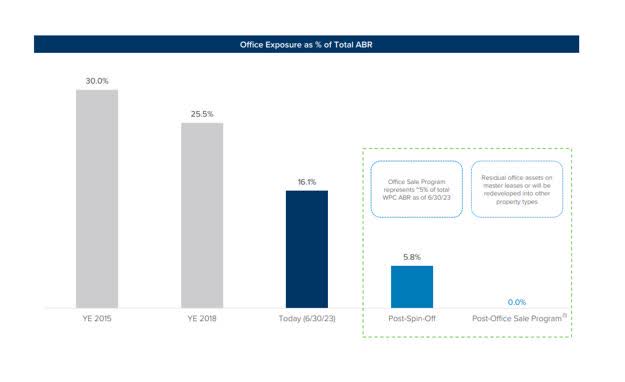
The new entity, which will be called Net Lease Office Properties/NLOP, will consist of 59 office properties and 8.7 million square feet.
The majority of properties (89%) will be located in the U.S., while 11% of rental income will be achieved in Europe. By spinning off its office properties, which tend to have a shorter lease duration than other real estate types, W. P. Carey could potentially achieve a higher valuation multiple following the spin-off transaction.
The weighted average lease term of W. P. Carey’s total portfolio at the end of the second quarter was 11.2 years, which is set to rise to 11.8 years following the spin-off. After the remaining offices are sold, the weighted average lease term increases further to 11.9 years.
Portfolio Overview (W. P. Carey Inc.)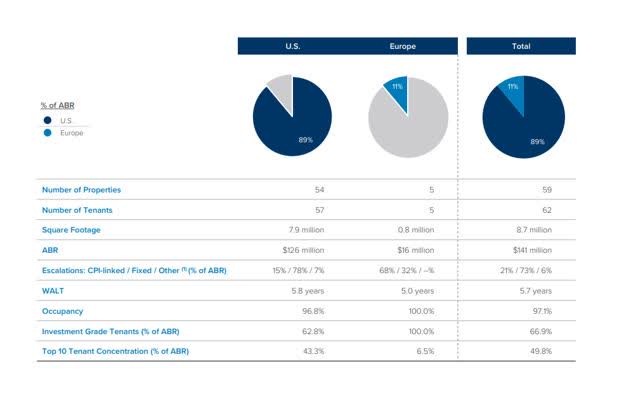
Benefits For Shareholders
The deal obviously has huge implications for shareholders, the biggest one being that W. P. Carey can remove a struggling asset class from its balance sheet and portfolio.
For passive income investors, this means that W. P. Carey will carry less risk in its portfolio, even though the dividend is going to be reset to a lower level. However, I think that the removal of office properties will eventually be favorable to W. P. Carey as well as shareholders.
WPC has lost approximately a quarter of its market value in 2023, primarily because investors feared the fallout from a troubled office real estate market.
With office assets removed from the portfolio, W. P. Carey might also see a valuation re-rating: WPC has guided for a new AFFO of between $5.18 and $5.26, reflecting an AFFO multiple of 11.3x (which takes account of yesterday’s 8% stock price drop). The simplification of W. P. Carey’s portfolio could lead to a narrowing valuation gap between WPC and its REIT peers.
AFFO Multiples (W. P. Carey Inc.)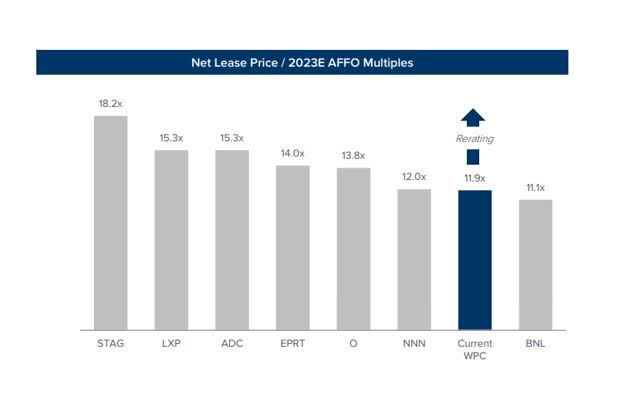
New Dividend Policy Implies Dividend Cut
The present dividend pay-out is $4.28 per share annually, and the trust raised its pay-out to $1.07 per share only in the middle of September (up from $1.0690 per share).
W. P. Carey said that it will reset its dividend policy and, moving forward, target a pro-forma AFFO pay-out ratio of 70-75%. With the new AFFO guidance, I see a new dividend level of $3.70-3.80 per share, which would reflect a 12% dividend cut. Based on the present stock price, the dividend yield on WPC is set to drop to mid-6%. The present dividend yield on WPC is 7.3%.
Risk Perspective: Should Investors Buy, Hold Or Sell Following The Spin-Off Announcement?
My personal opinion is that passive income investors that are invested for the long term should not sell into the weakness. The dividend cut is likely not going to be excessive, and the trust has said that it will seek a stable pay-out ratio in order to ensure dividend predictability.
While the yield is set to drop, investors have to consider that this yield will be achieved with a lower level of risk in the portfolio, and a yield of 6% is still pretty decent.
Taking into account that W. P. Carey has grown its dividend every year since 1998, I would expect the trust to resume its dividend growth once the transaction has been completed and the dividend has been reset at a lower level.
My Conclusion
The office spin-off transaction is a smart decision for W. P. Carey, and though the dividend is set to be slashed, the reduction is likely going to be minor.
Following the spin-off transaction, W. P. Carey will move a troubled asset category from its portfolio and balance sheet, which may give passive income investors a reason to buy the trust, even though they are set to receive a lower dividend yield than before the spin-off.
I doubled my position following the transaction since I think that investors are overreacting to the strategic maneuvering.
Since W. P. Carey also looks to sell the remaining offices that are not part of the spin-off transaction, I think W. P. Carey’s simpler and less risky portfolio could lead to WPC catching up to its peers in terms of valuation multiple.
Credit: Source link