• bitcoinBitcoin(BTC)$79,575.001.60%
  • ethereumEthereum(ETH)$2,387.473.08%
  • tetherTether(USDT)$1.000.04%
  • binancecoinBNB(BNB)$710.571.65%
  • rippleXRP(XRP)$1.312.15%
  • usd-coinUSDC(USDC)$1.000.03%
  • solanaSolana(SOL)$95.332.90%
  • tronTRON(TRX)$0.318141-0.17%
  • Figure HelocFigure Heloc(FIGR_HELOC)$1.051.54%
  • zcashZcash(ZEC)$1,299.201.01%
  • HyperliquidHyperliquid(HYPE)$81.97-3.33%
  • moneroMonero(XMR)$636.05-1.27%
  • dogecoinDogecoin(DOGE)$0.0759031.59%
  • USDSUSDS(USDS)$1.000.01%
  • whitebitWhiteBIT Coin(WBT)$76.862.17%
  • chainlinkChainlink(LINK)$11.432.94%
  • leo-tokenLEO Token(LEO)$9.350.29%
  • cardanoCardano(ADA)$0.1956373.15%
  • stellarStellar(XLM)$0.1642780.86%
  • bitcoin-cashBitcoin Cash(BCH)$288.465.53%
  • nearNEAR Protocol(NEAR)$3.93-1.98%
  • daiDai(DAI)$1.000.03%
  • Ethena USDeEthena USDe(USDE)$1.000.04%
  • uniswapUniswap(UNI)$7.30-0.50%
  • litecoinLitecoin(LTC)$55.201.09%
  • RainRain(RAIN)$0.005872-4.54%
  • CantonCanton(CC)$0.1003922.50%
  • avalanche-2Avalanche(AVAX)$8.680.02%
  • suiSui(SUI)$0.911.23%
  • USD1USD1(USD1)$1.00-0.02%
  • tether-goldTether Gold(XAUT)$4,097.991.80%
  • the-open-networkGram (prev. Toncoin)(GRAM)$1.14-2.69%
  • hedera-hashgraphHedera(HBAR)$0.0715911.48%
  • quant-networkQuant(QNT)$201.381.53%
  • Global DollarGlobal Dollar(USDG)$1.000.02%
  • shiba-inuShiba Inu(SHIB)$0.0000051.51%
  • BittensorBittensor(TAO)$231.501.63%
  • paypal-usdPayPal USD(PYUSD)$1.000.00%
  • crypto-com-chainCronos(CRO)$0.0515751.65%
  • Ripple USDRipple USD(RLUSD)$1.000.03%
  • EthenaEthena(ENA)$0.178637-0.23%
  • Ondo US Dollar YieldOndo US Dollar Yield(USDY)$1.150.04%
  • okbOKB(OKB)$109.861.80%
  • Circle USYCCircle USYC(USYC)$1.140.01%
  • pepePepe(PEPE)$0.000005-1.57%
  • aaveAave(AAVE)$130.720.24%
  • OndoOndo(ONDO)$0.399446-0.15%
  • Pump.funPump.fun(PUMP)$0.004219-2.20%
  • BlackRock USD Institutional Digital Liquidity FundBlackRock USD Institutional Digital Liquidity Fund(BUIDL)$1.000.00%
  • Spiko Amundi Overnight Swap Fund (EUR)Spiko Amundi Overnight Swap Fund (EUR)(EURSAFO)$1.14-0.39%
TradePoint.io
  • Main
  • AI & Technology
  • Stock Charts
  • Market & News
  • Business
  • Finance Tips
  • Trade Tube
  • Blog
  • Shop
No Result
View All Result
TradePoint.io
No Result
View All Result

VulScribeR: A Large Language Model-Based Approach for Generating Diverse and Realistic Vulnerable Code Samples

August 12, 2024
in AI & Technology
Reading Time: 4 mins read
A A
VulScribeR: A Large Language Model-Based Approach for Generating Diverse and Realistic Vulnerable Code Samples
ShareShareShareShareShare

In software engineering, detecting vulnerabilities in code is a crucial task that ensures the security & reliability of software systems. If left unchecked, vulnerabilities can lead to significant security breaches, compromising the integrity of software and the data it handles. Over the years, the development of automated tools to detect these vulnerabilities has become increasingly important, particularly as software systems grow more complex and interconnected.

A significant challenge in developing these automated tools is the lack of extensive and diverse datasets required to effectively train deep learning-based vulnerability detection (DLVD) models. Without sufficient data, these models struggle to accurately identify and generalize different types of vulnerabilities. This problem is compounded by the fact that existing methods for generating vulnerable code samples are often limited in scope, focusing on specific types of vulnerabilities and requiring large, well-curated datasets to be effective.

Traditionally, approaches to generating vulnerable code have relied on methods like mutation and injection. Mutation involves altering vulnerable code samples to create new ones, maintaining the code’s functionality while introducing slight variations. Conversely, injection involves inserting vulnerable code segments into clean code to generate new samples. While these methods have shown promise, they are often restricted in generating diverse and complex vulnerabilities, which are crucial for training robust DLVD models.

Researchers from the University of Manitoba and Washington State University introduced a novel approach called VulScribeR, designed to address these challenges. VulScribeR employs large language models (LLMs) to generate diverse and realistic vulnerable code samples through three strategies: Mutation, Injection, and Extension. This approach leverages advanced techniques such as retrieval-augmented generation (RAG) and clustering to enhance the diversity and relevance of the generated samples, making them more effective for training DLVD models.

The methodology behind VulScribeR is sophisticated and well-structured. The Mutation strategy prompts the LLM to modify vulnerable code samples, ensuring that the changes do not alter the code’s original functionality. The Injection strategy involves retrieving similar vulnerable and clean code samples, with the LLM injecting the vulnerable logic into the clean code to create new samples. The Extension strategy takes this a step further by incorporating parts of clean code into already vulnerable samples, thereby enhancing the contextual diversity of the vulnerabilities. To ensure the quality of the generated code, a fuzzy parser filters out any invalid or syntactically incorrect samples.
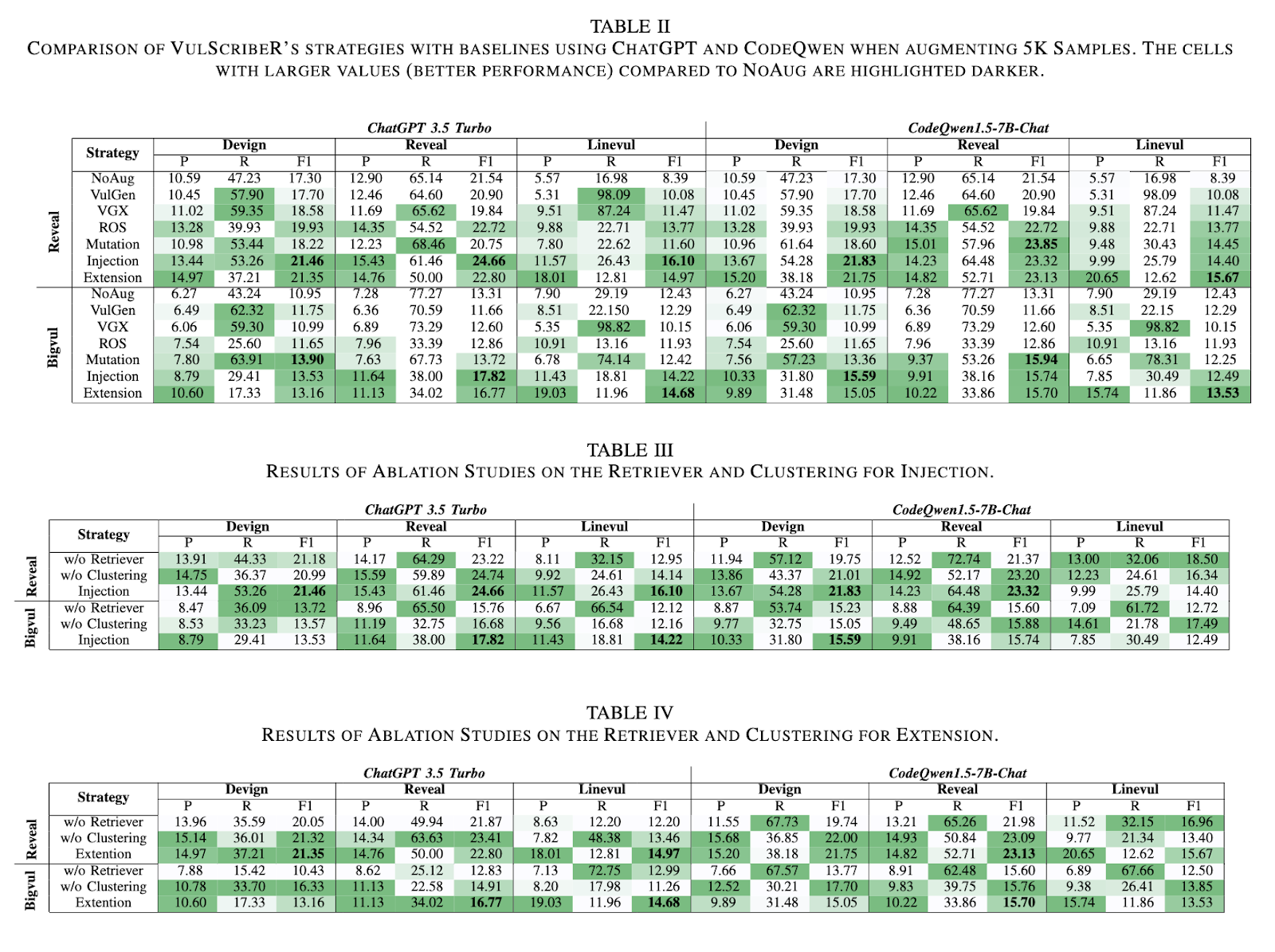
In terms of performance, VulScribeR has demonstrated significant improvements over existing methods. The Injection strategy, for instance, outperformed several baseline approaches, including NoAug, VulGen, VGX, and ROS, with F1-score improvements of 30.80%, 27.48%, 27.93%, and 15.41%, respectively, when generating an average of 5,000 vulnerable samples. When scaled up to 15,000 samples, the Injection strategy achieved even more impressive results, surpassing the same baselines by 53.84%, 54.10%, 69.90%, and 40.93%. These results underscore the effectiveness of VulScribeR in generating high-quality, diverse datasets that significantly enhance the performance of DLVD models.

The success of VulScribeR highlights the importance of large-scale data augmentation in the field of vulnerability detection. By generating diverse and realistic vulnerable code samples, this approach provides a practical solution to the data scarcity problem that has long hindered the development of effective DLVD models. VulScribeR’s innovative use of LLMs, combined with advanced data augmentation techniques, represents a significant advancement in the field, paving the way for more effective and scalable vulnerability detection tools in the future.


Check out the Paper. All credit for this research goes to the researchers of this project. Also, don’t forget to follow us on Twitter and join our Telegram Channel and LinkedIn Group. If you like our work, you will love our newsletter..

Don’t Forget to join our 48k+ ML SubReddit

Find Upcoming AI Webinars here



Nikhil is an intern consultant at Marktechpost. He is pursuing an integrated dual degree in Materials at the Indian Institute of Technology, Kharagpur. Nikhil is an AI/ML enthusiast who is always researching applications in fields like biomaterials and biomedical science. With a strong background in Material Science, he is exploring new advancements and creating opportunities to contribute.

YOU MAY ALSO LIKE

OpenAI Says It Will Protect Local Resources And Report On The Impact Of Its Data Centers

Gradium’s On-Device Phonon TTS Passes 200,000 Downloads in Two Weeks – Unite.AI


Credit: Source link

ShareTweetSendSharePin

Related Posts

OpenAI Says It Will Protect Local Resources And Report On The Impact Of Its Data Centers
AI & Technology

OpenAI Says It Will Protect Local Resources And Report On The Impact Of Its Data Centers

November 5, 2026
Gradium’s On-Device Phonon TTS Passes 200,000 Downloads in Two Weeks – Unite.AI
AI & Technology

Gradium’s On-Device Phonon TTS Passes 200,000 Downloads in Two Weeks – Unite.AI

November 5, 2026
Sony Is Selling More PS5 Games But Still Struggling To Meet Console Demand
AI & Technology

Sony Is Selling More PS5 Games But Still Struggling To Meet Console Demand

November 5, 2026
Together AI Releases Together Compiler: Agents Make Inference Up to 2.6x Faster
AI & Technology

Together AI Releases Together Compiler: Agents Make Inference Up to 2.6x Faster

November 5, 2026
Next Post
Hallie Jackson NOW – April 9 | NBC News NOW

Hallie Jackson NOW - April 9 | NBC News NOW

Leave a Reply Cancel reply

Your email address will not be published. Required fields are marked *

Search

No Result
View All Result
Why Trump is campaigning in reliably red states

Why Trump is campaigning in reliably red states

October 30, 2026
Can dogs understand what we’re saying?

Can dogs understand what we’re saying?

November 1, 2026
How Senate races are shaping up in battleground states ahead of midterms

How Senate races are shaping up in battleground states ahead of midterms

October 30, 2026

About

Learn more

Our Services

Legal

Privacy Policy

Terms of Use

Bloggers

Learn more

Article Links

Contact

Advertise

Ask us anything

©2020- TradePoint.io - All rights reserved!

Tradepoint.io, being just a publishing and technology platform, is not a registered broker-dealer or investment adviser. So we do not provide investment advice. Rather, brokerage services are provided to clients of Tradepoint.io by independent SEC-registered broker-dealers and members of FINRA/SIPC. Every form of investing carries some risk and past performance is not a guarantee of future results. “Tradepoint.io“, “Instant Investing” and “My Trading Tools” are registered trademarks of Apperbuild, LLC.

This website is operated by Apperbuild, LLC. We have no link to any brokerage firm and we do not provide investment advice. Every information and resource we provide is solely for the education of our readers. © 2020 Apperbuild, LLC. All rights reserved.

No Result
View All Result
  • Main
  • AI & Technology
  • Stock Charts
  • Market & News
  • Business
  • Finance Tips
  • Trade Tube
  • Blog
  • Shop

© 2023 - TradePoint.io - All Rights Reserved!