


josefkubes
Volkswagen AG (OTCPK:VWAGY) has been through a lot of problems since it had its notorious power struggle in 2009, which pushed the stock price to record levels. The company then faced a scandal related to emissions, the diesel gate, in 2015. The company had a stock price resurgence in 2021, in line with the whole market, but it has since dropped back to the 2015 diesel gate levels. In part, this is because the market is seeing the auto industry as exposed to disruption and uncertainty due to the energy transition.
Seeking Alpha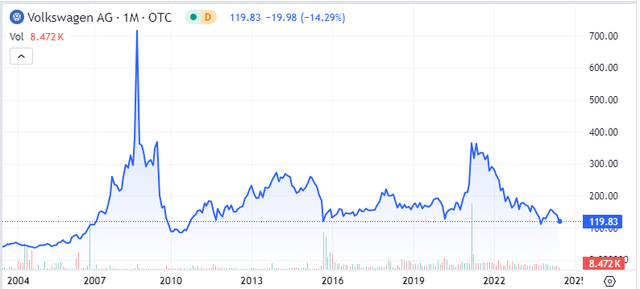
Generalizing, the blueprint for auto manufacturers’ brand strategy has been to follow mostly two different routes. One is to be mostly a one-brand company. A good example is Ford Motor Company (F), which sells most of its vehicles under the Ford moniker. The other is to have several brands under one roof that then get to share platforms and parts which helps to dilute fixed costs.
Manufacturers have followed this last route more often in the recent past. For instance, Stellantis N.V. (STLA) is the result of the recent merger between Fiat Chrysler and PSA Group. This strategy seems to be even more relevant now that auto companies are reaching the conclusion that they will have heavy development costs for their electric platforms. Part of the Stellantis merger’s rationale was based on this fact.
Volkswagen is another company that integrates several brands under one roof. Their brand strategy is based on each brand attracting different consumers. Theoretically, Volkswagen should be able to dilute its electrification costs through all the brands, which should help them in the transition.
The company developed a new steering model for the group. The brands are now grouped as follows: the Core group is now composed of Volkswagen, SEAT/CUPRA, and Skoda; the Progressive group includes Audi, Lamborghini, Bentley, and Ducati; the Sports Luxury group is Porsche; finally, TRATON SE includes trucks & buses under the brands MAN, Scania, and Volkswagen.
Recent developments
In 2021, the company unveiled the NEW AUTO strategy to face the electrification and new mobility challenges. One of the most critical points is battery production. The company intends to develop its own battery cell technology to the extent that it becomes a core competency. According to its 2023 annual report, the company estimates that the economies of scale in their approach can bring the costs down by up to 50%. To be able to cover the demand for batteries, they intend to build their own factories.
The company is launching its first models on its all-electric premium PPE platform, the Audi Q6 e-tron and the Porsche Macan. These are the first signs that the step to achieve the company’s transformation is underway. The company will seek synergies at a group-wide level. The targets for 2030 are the following:
Volkswagen financials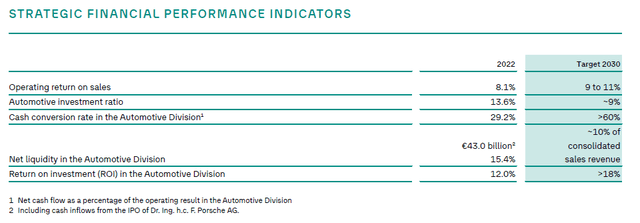
Financials
After some rough years following the diesel gate and the Covid crisis, Volkswagen seems to be back posting good operating performance. The gross margin is near the high level of its historical interval range for the past 10 years. The same can be said of both operating and profit margins.
YCharts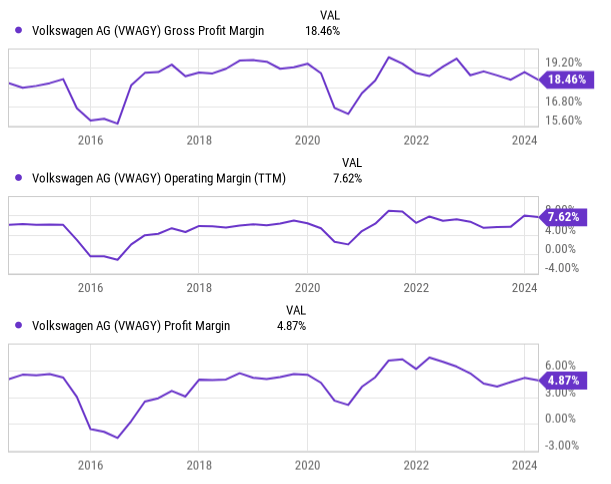
A look into the balance sheet also shows that liquidity seems adequate with a current ratio close to 1.16 and a debt-to-assets ratio around 30%. Debt relative to assets has been decreasing since it peaked in 2020.
YCharts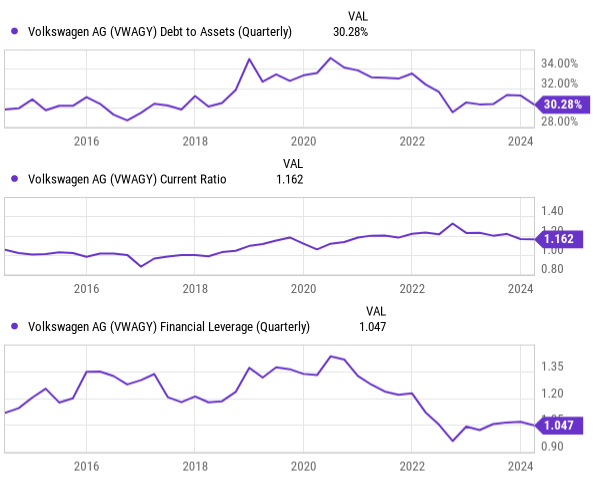
Broadly speaking, the company is doing well in terms of operating performance, while the balance sheet is in good enough shape to keep the company going through the electric vehicle transition.
Valuation
The main problem we spot among most car manufacturers is that the market is clearly anticipating huge problems ahead. If we look at the PS ratio for a diverse set of manufacturers, we will see that companies positioned similarly to VW, like Stellantis, General Motors, and Ford, all have depressed PS ratios. These are traditional automakers which the market seems to be perceiving as the most exposed to disruption.
On the other hand, companies like BYD, Tesla, Ferrari, and Porsche seem to be perceived as more protected from the storm. BYD and Tesla likely because they are already producing a huge share of EVs. Porsche and Ferrari because their sports luxury niche is likely to be more resilient to the disruption going on in the rest of the industry.
YCharts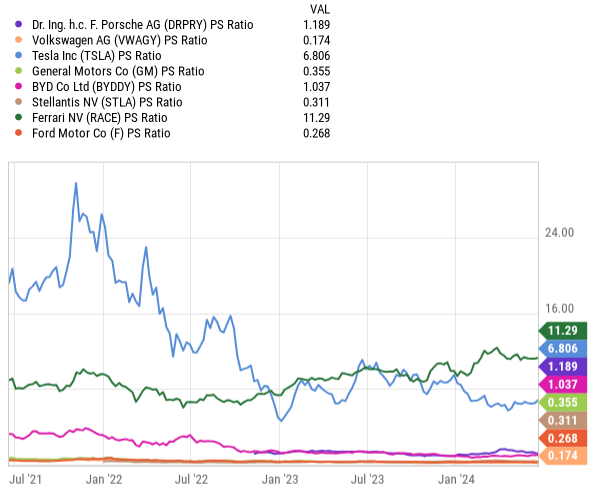
Therefore, although operating performance is still an important driver, expectations are also playing an important role. For instance, Stellantis and GM have higher profit margins than BYD, but valuations are very different.
YCharts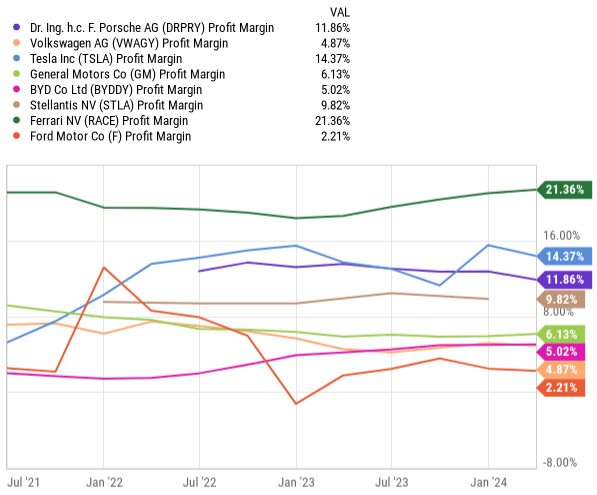
Not even debt levels offer a coherent explanation for the valuation gaps between the different manufacturers.
YCharts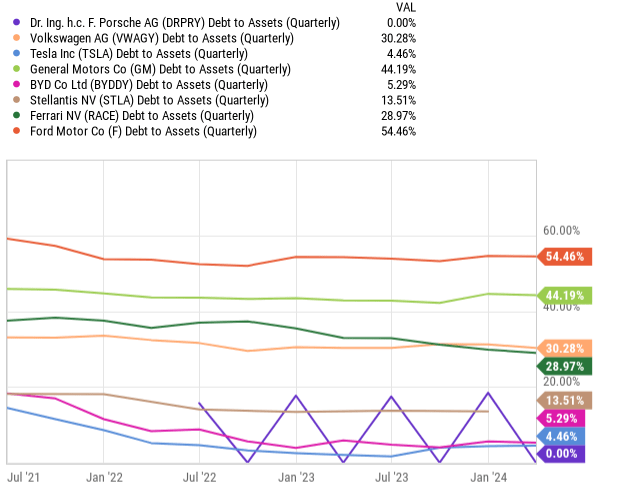
It seems that the only way for VW to have a re-pricing of its stock price is if the market perception changes. I think that for that to happen, the company will need to show clear signs of delivering on the EV transition front.
The company has a diverse set of brands; if they can create a small number of scalable and cost-efficient EV platforms (battery plus powertrain platform) that can be shared by its brands, it can take advantage of its higher value brands like Porsche and Audi to extract higher profit margins.
Signs that they might accomplish this will likely set a re-pricing movement on the stock price. For instance, if the market revalued it to 0.4 times sales, closer to the value of GM or Mercedes, using the 2023 revenues as a reference, the company could be worth around $142 billion. That would mean 2.4 times the current valuation close to $59 billion.
Risks
Nevertheless, this investment thesis is plagued with obvious execution risks that are very hard to determine. On the one hand, auto manufacturers are very used to having to deal with logistical and engineering nightmares. However, that doesn’t mean that they are always capable of overcoming such challenges. The industry is by nature cost-intensive, and the transition to EV platforms will only make it worse.
In that regard, VW does not seem overburdened with debt, but with the debt-to-assets ratio at 30%, it has already used a good portion of its leeway.
Conclusion
At the current juncture, we are watching a replay of what happened to carriage makers at the turn of the century. Most knew what was coming but couldn’t execute, even Studebaker ended up folding in the 1960s. I believe that investors are weighing exactly that. Additionally, VW still has to carry the stain from the diesel gate and that is reflected in the valuation. When we look at a set of similar companies, we can see that VW carries almost half the sales multiples of other very similar companies.
YCharts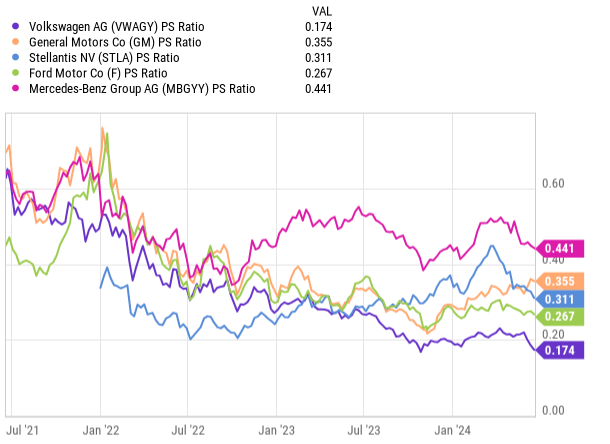
Nevertheless, I feel we need more clarity regarding VW execution going forward. It’s true that the current valuation suggests opportunity, but it might also be a classic value trap if the company cannot execute properly.
At this moment, I am rating it a hold. I will keep an eye on Audi’s sales of EVs based on the new PPE platform and I intend to revisit it later.
Editor’s Note: This article discusses one or more securities that do not trade on a major U.S. exchange. Please be aware of the risks associated with these stocks.
Credit: Source link