santirf/iStock Editorial via Getty Images
Just as one bubble may be in full swing, another may have ended. I was skeptical about the stock of VICI Properties Inc. (NYSE:VICI) just over a year ago due to valuation and lower appeal relative to tech stocks, but after sizable underperformance, the value proposition has improved dramatically.
VICI remains highly concentrated to a handful of tenants and in the casino industry overall, but at least for now, this concentration has not hurt the credit quality of its portfolio. The company maintains a reasonably leveraged balance sheet and should benefit from elevated annual lease escalators. While it remains difficult to make a case for significant multiple expansion, I can see a clear path to market-beating returns from here based on reasonable assumptions. I am upgrading VICI stock to buy.
VICI Stock Price
I last covered VICI in January 2023, when I recommended avoiding the stock due to a “potential casino REIT bubble.” That call has paid off, as the stock has underperformed the market by over 40% since then.
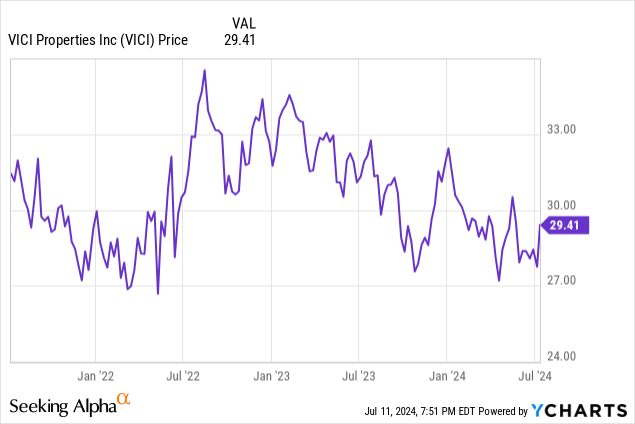
This kind of relative underperformance has quelled any prior concerns that I have had on valuation.
VICI Stock Key Metrics
VICI is the largest publicly traded net lease REIT focused on casino properties. Net leases mean that the tenant is responsible for real estate taxes, insurance, and maintenance expenses. These leases allow the landlords to show higher cash flow margins than typical REIT peers. VICI has a high concentration in the casino industry, with Caesars Entertainment, Inc. (CZR) and MGM Resorts International (MGM) together making up over 80% of annualized rent.
2024 Q1 Presentation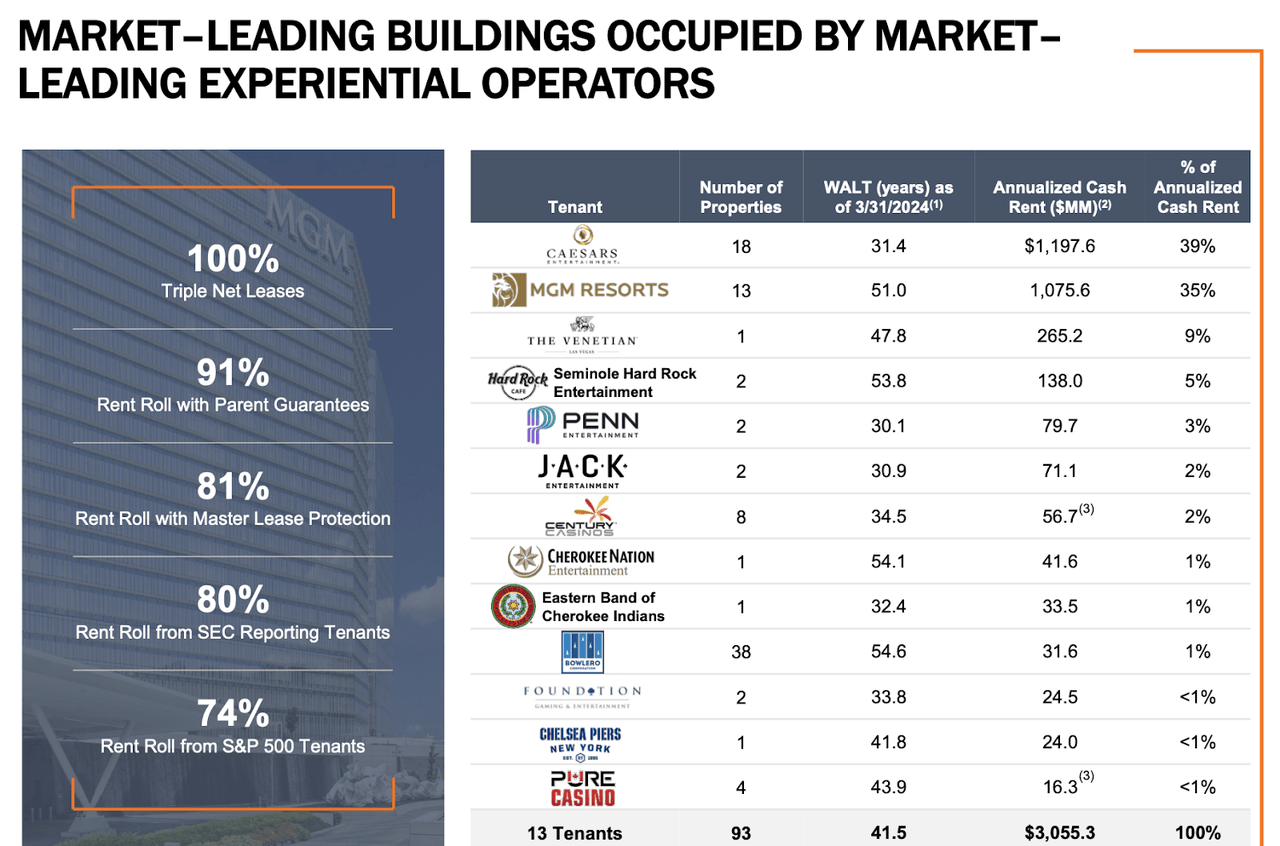
Besides the distinct tenant base, these leases tend to have unique characteristics relative to conventional triple-net leases. The positives include higher annual lease escalators at around 1.7% and longer lease terms at around 42 years.
One often overlooked negative is the high amount of value invested in each asset, with the average rent per asset being around 8x that of conventional NNN REIT peers. While VICI has not yet suffered from a significant degree of tenant difficulties, the traditionally smaller asset sizes of conventional NNN REIT peers may be helpful in maximizing recovery rates. This is due to the ease of re-tenanting and higher liquidity in the event of disposition. Again, this is an important distinction that, I believe, is typically overlooked in analysis covering the casino REIT landscape but remains important all the same.
2024 Q1 Presentation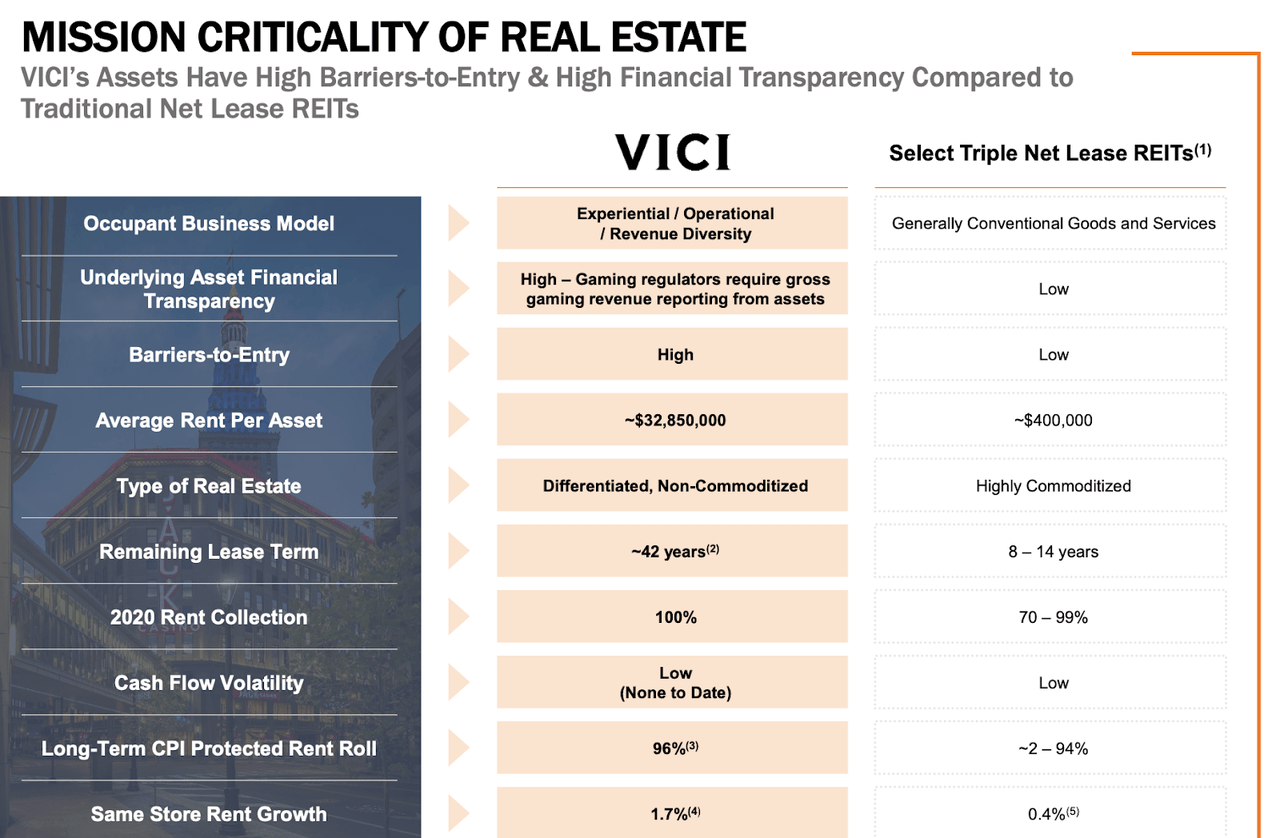
In the latest quarter, VICI generated 8.4% YoY revenue growth to $951.5 million, with adjusted funds from operations (“AFFO”) growing even faster at 10.3% YoY (6.1% on a per-share basis). For the full year, management has guided for up to 4.6% YoY growth in AFFO per share to $2.25.
2024 Q1 Press Release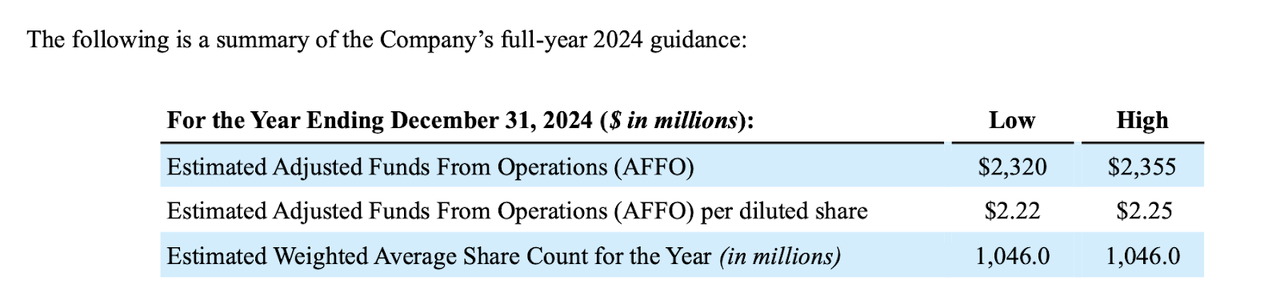
Over the past few years, VICI has shown stronger growth than conventional NNN REIT peers, and this may explain some of the love it seems to get among the retail investing community. Some of this stronger growth makes sense — I have already mentioned the higher annual lease escalators, and the acquisition cap rates are also slightly higher. But these two factors, while significant by REIT standards, should only amount to around 1% to 2% of relative outperformance over the long term.
One mustn’t overlook that VICI has also benefited from not having to pay down a material amount of maturing debt — debt refinancing has proven to be a significant headwind for most REITs due to the higher interest rate environment. That is set to change beginning in 2025 when the company has $2 billion of debt coming due. These notes carry a coupon rate of around 4.3%. Assuming VICI refinances these notes at the same 5.9% rate that it received in March of this year, that would imply around $32.8 million of drag on the bottom line or roughly 1.4% of AFFO guidance for the full year.
I expect the 4.6% projected AFFO growth rate for this year to be a high watermark moving forward, as investors have little reason to expect an acceleration to the double-digit growth rates shown in past years.
2024 Q1 Presentation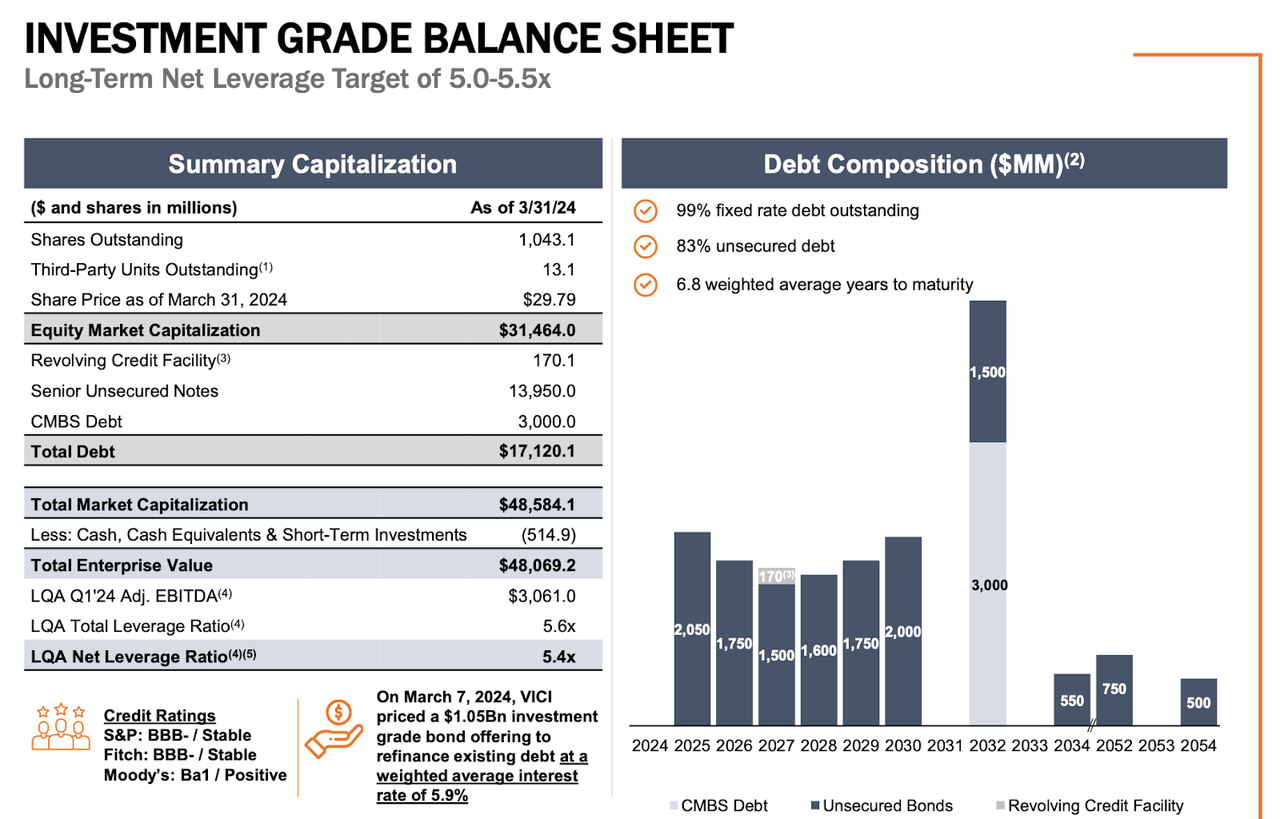
On the conference call, management discussed their rationale for agreeing to invest up to $700 million at a 7.25% yield to help fund reinvestment projects in the Venetian Resort.
2024 Q1 Presentation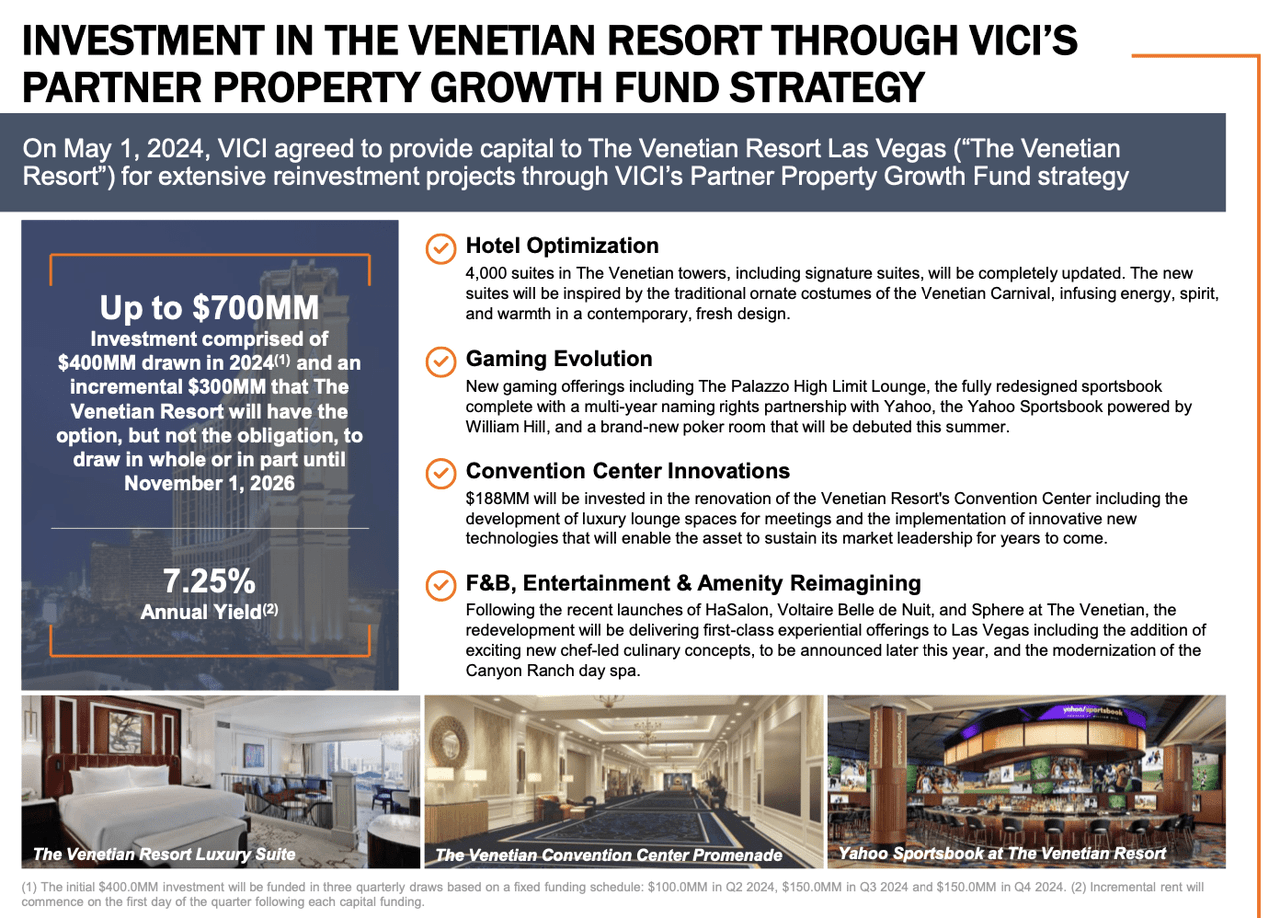
Management framed it as an opportunity to invest more money in one of their higher-performing properties, but I do not share the same optimism. As I hinted at earlier, a key differentiating feature between NNN REITs and shopping centers and mall REITs is the smaller property sizes, which is useful in the event of re-tenanting or selling off underperforming assets.
Innovative Industrial Properties, Inc. (IIPR), a cannabis REIT, has seen its stock trade discounted over the recent years in part due to the same phenomenon, as Wall Street began to question the replacement value of the assets (in addition to a general bear market in cannabis). VICI may be risking being subject to the same poor sentiment if investors begin wondering if re-investing in existing properties may be increasing the risk of lost rents if re-tenanting is needed. That said, the Venetian is clearly a stellar property that does not appear to have any present risk.
Is VICI Stock A Buy, Sell, or Hold?
I assume that part of the appeal of VICI stock has been that it owns “trophy assets” on the Las Vegas Strip, including names like Caesar’s Palace and Mandalay Bay.
2024 Q1 Presentation
That might help to explain how the stock traded at a nosebleed sub-5% dividend yield for many years before 2024.
Seeking Alpha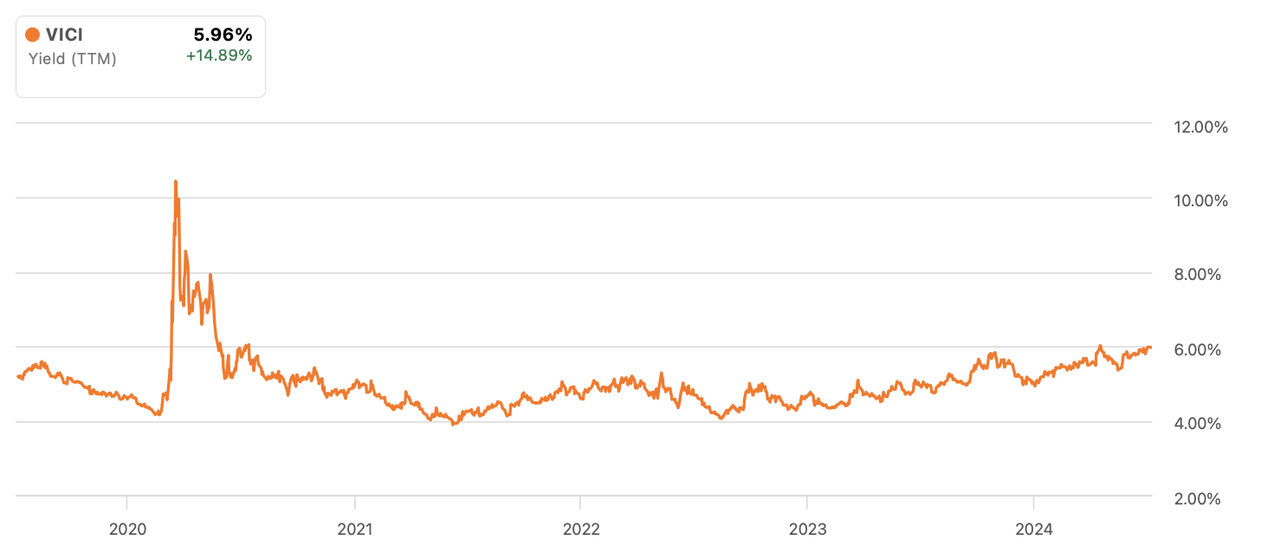
Back then, I didn’t understand why VICI traded at a premium to conventional NNN REIT peers like Realty Income Corporation (O), but that premium has since flipped to a relative discount. This relative discount makes more sense, as the higher same-store growth potential is offset by the concentration risk.
At current prices, VICI trades at a 6% dividend yield and at around 11x FFO. One could estimate the potential total return by adding the 9.1% FFO yield (this more or less bakes in growth from external acquisitions) with the 1.7% annual lease escalators and subtracting debt refinancing headwinds of around 1.4%, arriving at around 9.5% forward return potential.
Sometimes NNN REITs can drive higher returns on reinvested cash, but I am skeptical of the magnitude of such outperformance given the higher interest rate environment. Because I am expecting lower potential for multiple expansion elsewhere in the market, that 9.5% projected forward return looks quite attractive with the potential to beat the market.
VICI Stock Risks
I see two key risks for VICI. The first risk is that of unexpected tenant troubles. As discussed earlier, re-tenanting casino properties may be more difficult than conventional assets due to the large size of these properties. Gambling and tourism do not currently appear to be facing any immediate issues, but it remains unclear if the rise of online gambling may pose the same risks to land-based casinos as e-commerce has to malls and shopping centers.
Another risk is that of long-term underperformance. I expect forward growth to be constrained due to the higher interest rate environment, meaning that there is not much room for surprise besides the 6% dividend yield and 2% to 5% near-term growth rate. If the rest of the market continues to benefit from, for example, generative AI tailwinds, then VICI stock might continue to underperform indefinitely.
VICI Stock Conclusion
While I caution investors to dial back their optimism for VICI stock, I see the stock as being highly buyable and offering a solid likelihood of outperforming the market from here. Even if growth rates were to slow as projected, I can still see the stock delivering around 9.5% annual returns, and that is not assuming any multiple expansion. I am wary of the higher property sizes of the casino REIT industry, but the company is not currently facing any tenant difficulties. I am upgrading VICI Properties Inc. stock to buy.
Credit: Source link