

tadamichi
In today’s analysis, we dial in on the Vanguard Intermediate-Term Treasury Index Fund ETF Shares (NASDAQ:VGIT), which is a treasury bond vehicle constructed by Vanguard. The ETF presents intermediate-term treasury exposure by tracking the Bloomberg U.S. Treasury 3-10 Year Index to provide a liquid fixed-income option to investors.
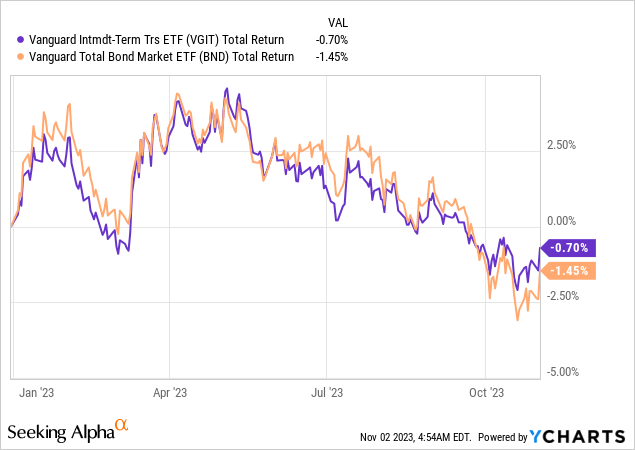
Intermediate-term bonds are often unpredictable in uncertain interest rate environments due to a lack of consistency in the yield curve. Moreover, portfolio managers often implement active duration management when the curve moves abruptly, which has a significant influence on intermediate bonds as they rely on the belly of the curve.
Today’s article outlines some of the key elements that may dictate the risk premiums embedded in VGIT ETF.
Let’s traverse into the main analysis.
Fund Characteristics
Firstly, let’s affirm the fund’s basic characteristics.
The fund is fully invested with intermediate-term exposure. Its duration of 5.1 years echoes its mandate quite clearly. Moreover, the ETF’s near 100% allocation to treasuries affirms its positioning as an intermediate-term vehicle.
Exhibit 1 (Vanguard)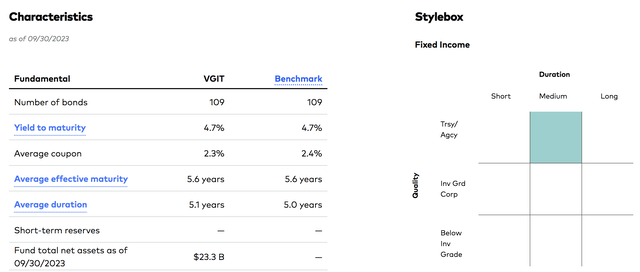
Treasuries pay fixed rates, which allows the fund to capture high income at the peak of the interest rate cycle. In addition, unlike corporate bonds, treasuries avoid credit risk typically embedded in rising interest rates.
However, despite avoiding credit risk, the fund has other risks attached to it, such as liquidity risk of its off-the-run constituents and a term premium. Therefore, it is of the essence to assess the yield curve’s effect and everything that may influence the curve as it will dictate the feasibility of the fund’s embedded risk premiums.
Influencing Variables To Look Out For
A bird’s eye view of the yield curve shows that the belly dropped around the 5-year mark in the past month, which possibly explains the moderate month-over-month uptick in VGIT ETF’s price. Ideally, as VGIT ETF investors, you want the level and the belly to drop so that lower implied discount rates can enter the fray and up the valuation of the underlying bonds. However, despite the curve’s month-over-month move, we think further adjustments are in order, which could relay into other premiums such as term and liquidity.
Exhibit 2 (worldgovernmentbonds.com)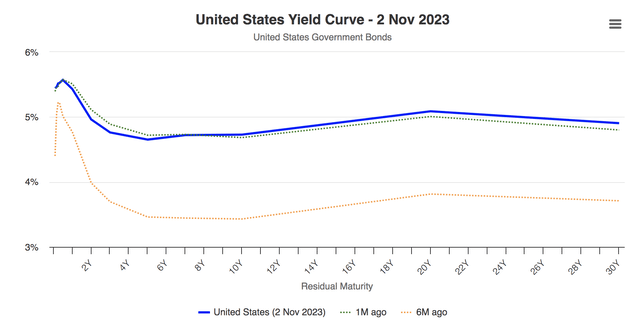
Let’s look ahead.
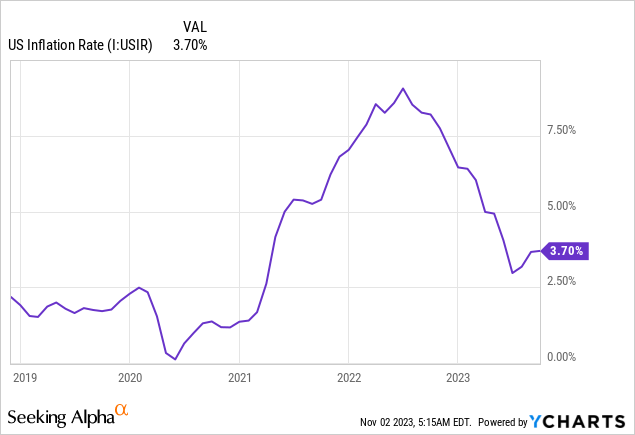
As most of you might know by now, the Federal Reserve left rates unchanged on Wednesday at the 5.25% to 5.50% range. In our opinion, the Fed wants to see whether the rise in non-core inflation (especially energy) is sustained. Moreover, it likely wants to see whether the rise in oil & gas traverses into core inflation or whether it leads to weakening consumer sentiment.
We believe inflation will continue to soften in the longer term, with sporadic spikes occurring due to the volatile nature of non-core inflation. As such, we are weighing in a probable rate decrease in 2024. Well, we certainly don’t think rates will increase.
If interest rates decrease in 2024, we’ll likely see the level of the bond yield drop, which could be beneficial to all bonds. In addition, the short-end might curtail as the curve starts to steepen amid a contractionary economic phase that may trigger rising real rates due to the anticipation that fiscal policy could become supportive.
Although merely a prediction, such an event would provide significant support to intermediate-term bonds due to the decline in the belly of the curve.
Furthermore, we expect term and liquidity premiums to act favorably to intermediate-term bonds once interest rates settle lower. We base this on the thought that a better shape to the yield curve (a more upward slope) will lead to the latest rise in the term premium being captured by the market, whereby holding intermediate bonds will present higher returns than short-dated bonds.
As for liquidity, a premium could surface once the yield curve stabilizes. In our view, off-the-run securities will be less marketable in the event of yield curve stabilization due to lower active management, providing long-term investors with additional risk premiums to take advantage of.
Exhibit 3 – Term Premium (St. Louis Fed)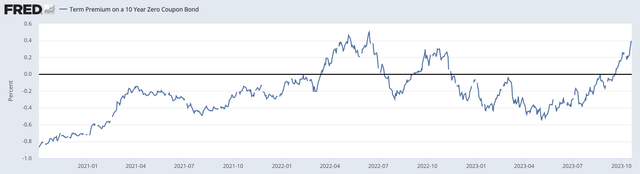
Distributions
VGIT ETF’s distribution composition is quite decent. Firstly, it depends on which portfolio you locate this asset in, as it may be taxable to foreign investors and at federal level for U.S. investors. Therefore, I suggest you do additional research on your jurisdictional tax regulations before considering the vehicle as part of your income-seeking portfolio.
Nevertheless, the ETF’s gross distribution prospects are sound, as a trailing twelve-month yield of 2.68% is supported by consistent growth, providing investors with an opportunity to gradually reduce their cost basis. Although the ETF’s distributions may be procyclical, we believe long-term investors will benefit from sustainable income.
Exhibit 4 (Seeking Alpha)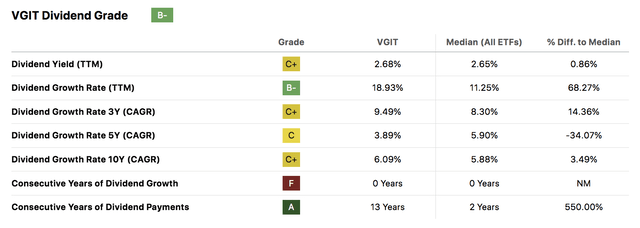
Noteworthy Risks
Let’s run through a few risks.
Careful readers might be aware by now that this analysis is based on the assumption that interest rates will retreat and cause the shape of the yield curve to align in a certain manner. However, that might not be the case. In fact, we could be completely wrong about the U.S.’s interest rate roadmap. Therefore, we suggest considering our analysis as part of your decision-making framework instead of as the ground truth.
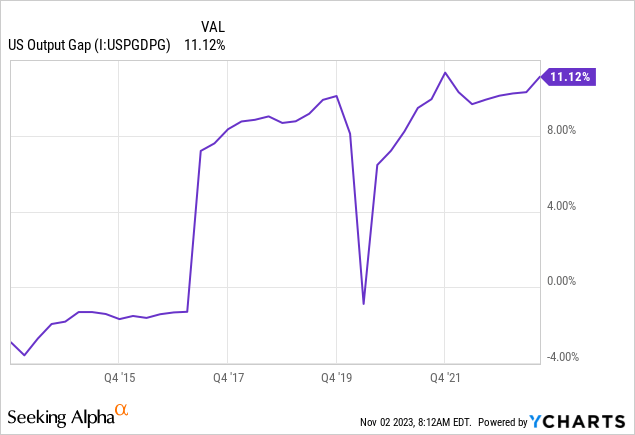
Furthermore, the U.S. output gap, which is generally mean-reverting, is positive. In addition, this data point is met with waning consumer sentiment and pressuring unemployment data. Collectively, such risk factors could deter the prospects of Treasuries as the market could devalue their safe haven attributes.
Final Word
It might not be a bad time to load up on intermediate-term Treasuries via the Vanguard Intermediate-Term Treasury Index Fund ETF Shares ETF.
We predict the belly of the curve to act favorably in the coming year, which could add significant systematic support to VGIT ETF. Moreover, our analysis tells us that risk factors such as liquidity and term premiums could come into action, leading to respectable gains for the ETF’s investors.
Lastly, VGIT ETF’s distribution composition is solid despite various macroeconomic risks being of concern.
Consensus: Buy Rating Assigned
Credit: Source link