
Mike Coppola/Getty Images Entertainment
High yielding stocks with moderate risk profiles can be hard to come by, even in this higher interest rate environment. Verizon (NYSE:VZ) is offering an 8.3% dividend yield in spite of a clear path to deleveraging and solid progress on expanding its 5G home internet product. While there remains great uncertainty with regards to potential lead liabilities, management has noted that lead cables make up only a tiny fraction of their total asset base. Growth rates may be muted over the near term in large part due to the higher interest rate environment, but I can see a case for multiple expansion on account of the improving safety of the dividend yield. I reiterate my strong buy rating for the stock.
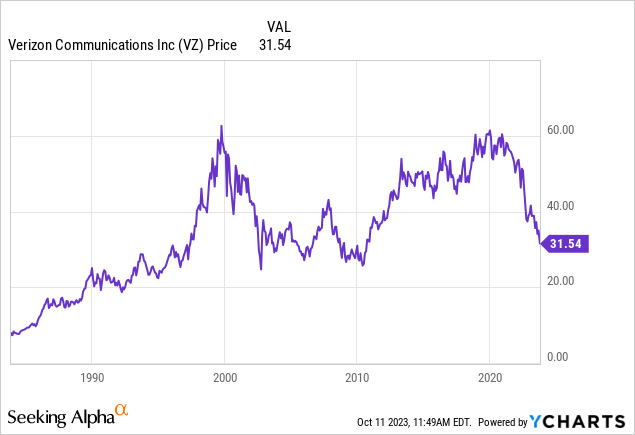
VZ Stock Price
VZ has been an underwhelming stock over the last three decades, though that underperformance has resulted in an attractive dividend yield.
I last covered VZ in July where I explained why I was buying only VZ and not AT&T (T) despite both falling on lead liability news. VZ continues to execute towards deleveraging and eventually returning more of its free cash flow to shareholders. With the stock trading at a double-digit free cash flow yield, it’s time to pounce.
VZ Stock Key Metrics
In its most recent quarter, VZ once again saw its strongest financial results being led by broadband, with broadband net adds. I note that the vast majority of broadband net adds are from “fixed wireless access” subscribers, which refers to the company’s 5G Home Internet product offering.
2023 Q2 Presentation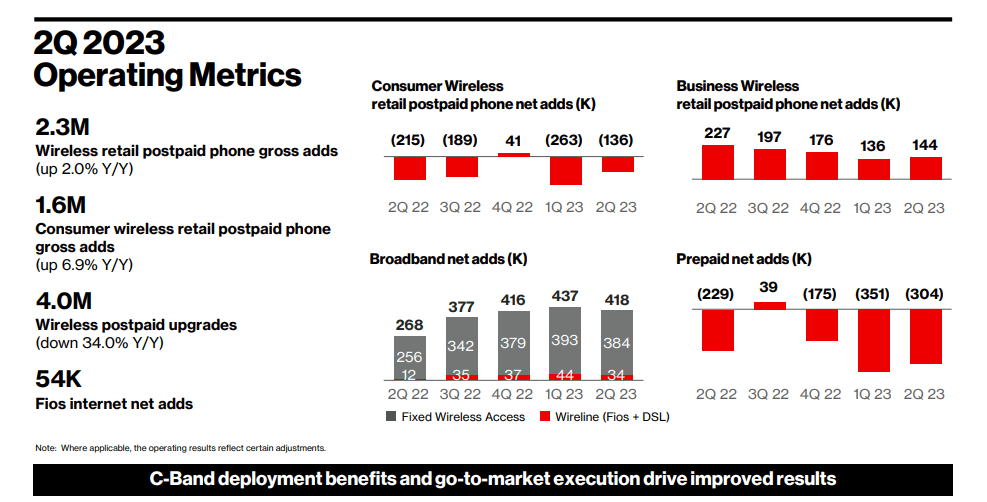
On a consolidated basis, VZ saw revenues decline 3.5% YOY, but service revenues were slightly up YOY. Wireless equipment revenues declined, but those carry negative gross margins.
2023 Q2 Presentation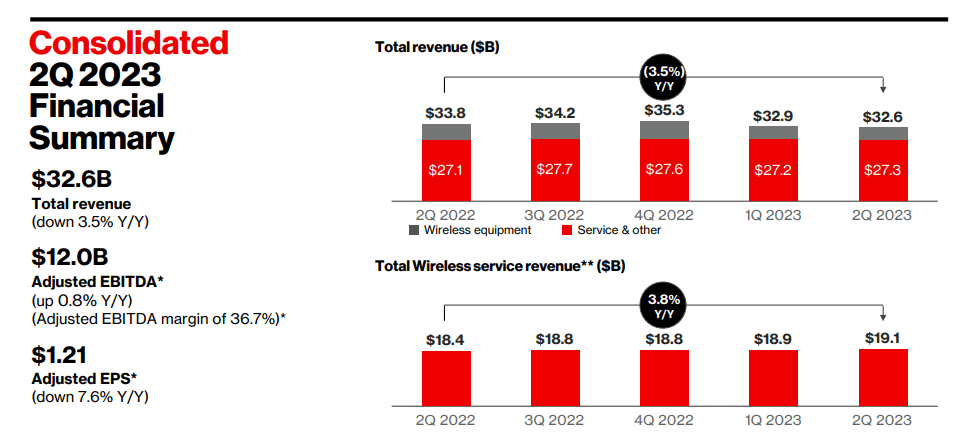
VZ nonetheless saw net income decline YOY, largely driven by an increase in interest expenses and slightly by increased SG&A expenses.
2023 Q2 10-Q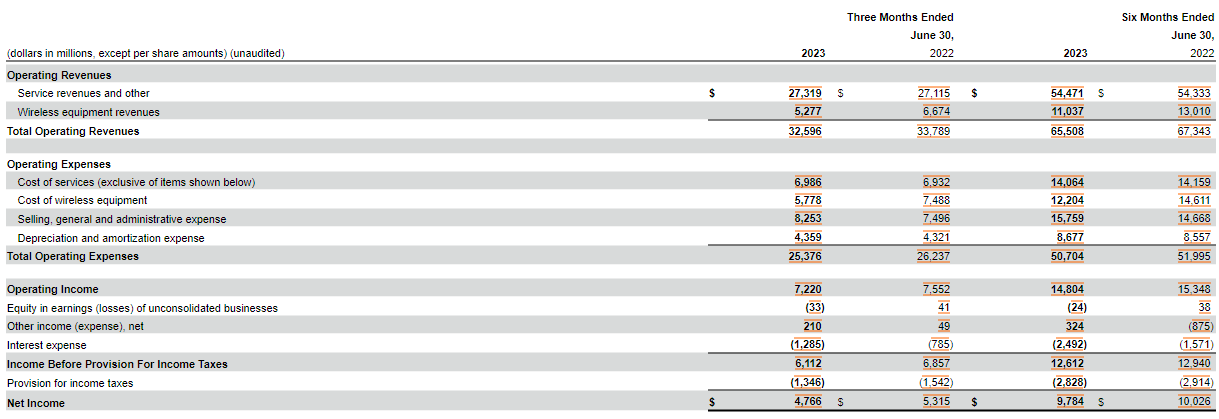
VZ ended the quarter with a net unsecured debt to adjusted EBITDA ratio of 2.6x, representing solid progress from 2022 levels.
2023 Q2 Presentation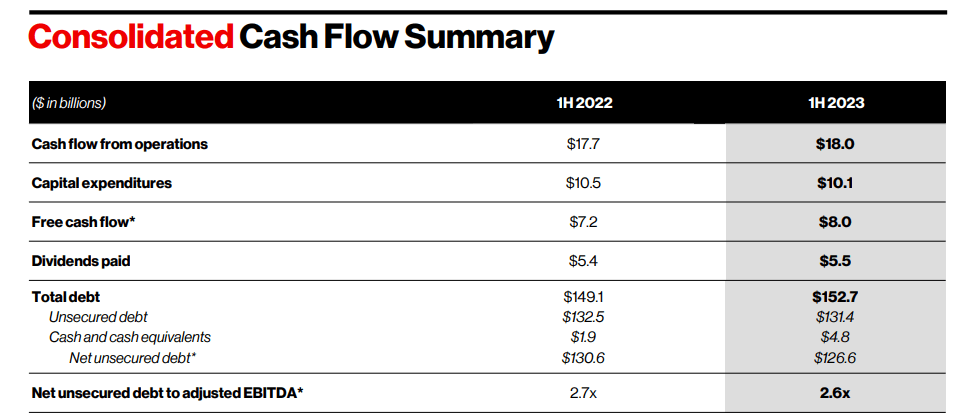
To refresh our memories, VZ management has targeted net unsecured debt to adjusted EBITDA to reach 2x by the end of 2025 with 1.75x to 2x being their target range. VZ intends to reach that target through ramping up free cash flow as well as paying down debt with that free cash flow. Once the company achieves that target, management intends to redirect free cash flow towards repurchasing stock. This is the most visible near term catalyst for the stock.
2022 Investor Day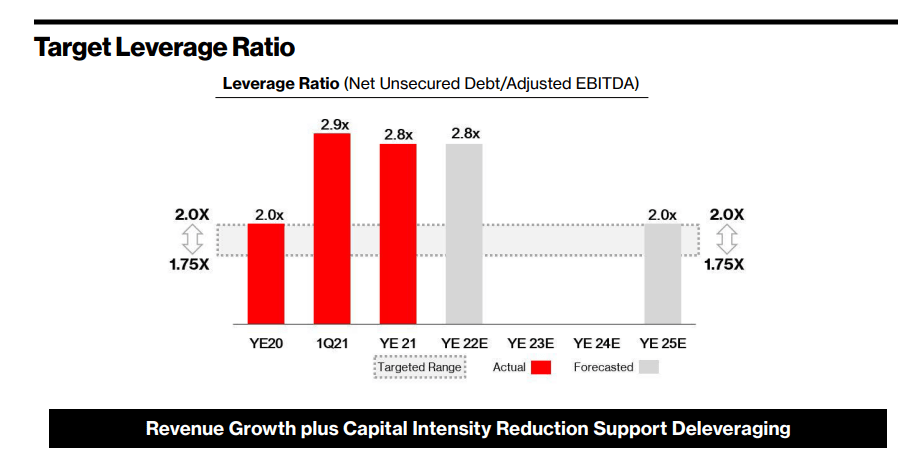
On the conference call, management expressed confidence in delivering on full-year guidance. They had previously given full-year guidance for up to $19.25 billion of CapEx, wireless service revenue growth of between 2.5% to 4.5%, adjusted EBITDA of between $47.0 billion to $48.5 billion, adjusted earnings per share of between $4.55 to $4.85, and $17 billion of free cash flow. After many years of elevated CapEx due to C-band spend, management expects the reduced CapEx to continue in 2024 and beyond.
Management has tried to communicate to investors that its fixed wireless access product is a “proven competitive broadband product.” It is ironic that names like Comcast (CMCSA) continually trade at value-stock multiples due to potential disruption, yet VZ as the perceived disruptor is trading at an even larger discount. Management noted that they have nearly 2.3 million customers on their FWA product and expect growth to continue at a similar pace in the third quarter.
Management spent considerable time discussing their views on potential lead liabilities, stating that lead infrastructure makes up only a small percentage of their copper network and that they “began phasing away from installing new lead cable by the 1950s.” I am doubtful that the financial impact will be as big as feared, but until these issues are resolved, I wouldn’t be surprised for a valuation overhang to remain on the stock.
Management reiterated expectations to achieve $2 billion to $3 billion of annual savings by 2025 and appeared to prefer dividend growth as being their first objective after achieving consistent free cash flow. I note that the $17 billion in projected free cash flows comfortably covers the roughly $11 billion in annual dividend payments.
Management also answered a question regarding whether or not the company’s MVNO deals with the cable providers are on the table for renegotiation, pricing wise. These contracts were initially thought to be perennial, but there was some speculation that VZ might be able to increase their prices on these wholesale “re-sell” wireless services. Unfortunately, management appeared to refute these hopes, only reiterating their common response that the agreements are mutually beneficial.
Is VZ Stock A Buy, Sell, or Hold?
At recent prices, VZ was trading at around an 8.3% dividend yield and well under 7x earnings.
Seeking Alpha
Earnings aren’t expected to grow anything close to rapidly over the coming years, but with the stock at its highest dividend yield in over a decade, does it matter?
Seeking Alpha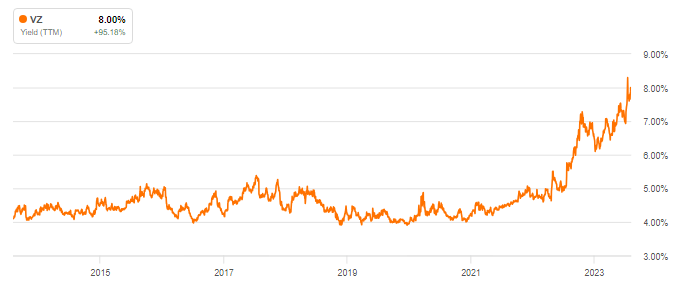
It might. In this higher interest rate environment, higher yield stocks are more plentiful and higher yielding bonds are yielding even more than before. I do not intend to name any examples, but in a recent screen I noticed that there were a great deal of bonds yielding 8% to 10% coming from well known companies (just 5 years ago, bonds of a similar yield might have only been from unknown risky names). We must weigh every stock against the opportunity cost, including VZ. Still though, given that VZ is generating effectively a 12% FCF yield, with much of that set to be returned to shareholders once the company achieves its leverage target by 2025, perhaps the stock is cheap enough. I can see the stock eventually re-rating to a 6% to 6.5% dividend yield once the company begins returning much of its free cash flow to shareholders through share repurchases. There might be some delay, and it might be 2026 instead of 2025, but in the meantime the dividend looks safe and shareholders are being generously rewarded.
What are the key risks? In the near term, the company’s highly leveraged balance sheet is likely to weigh on growth rates. VZ will have to refinance maturing debt at higher interest rates, which are likely to offset much of any organic growth from the business level.
2022 10-K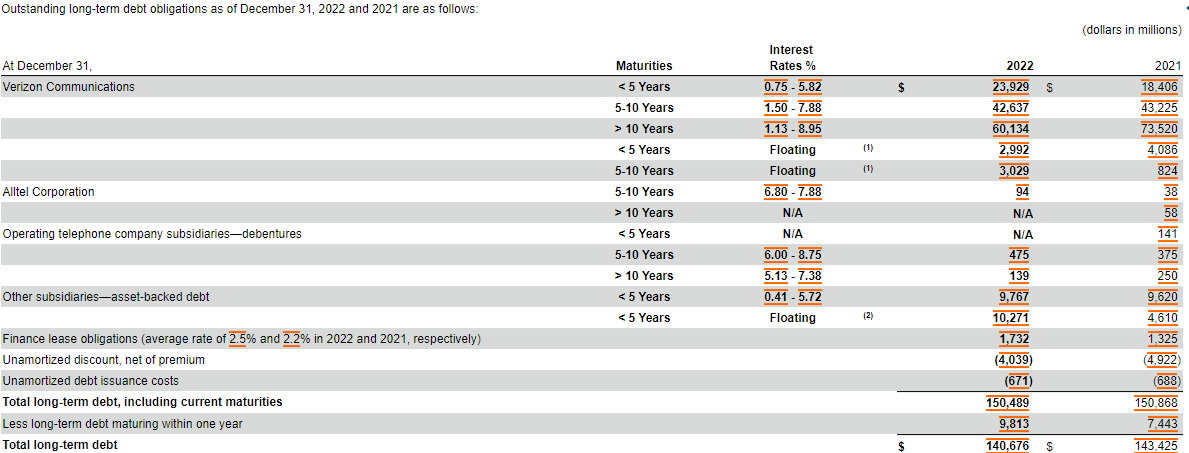
That issue may eventually be resolved as the company executes against reducing leverage, and I wouldn’t rule out eventual credit rating upgrades at that point. I note that the stock might not be able to beat the market unless it delivers on these deleveraging promises and experiences the projected multiple expansion. Otherwise, it is not immediately clear if the 8.3% dividend yield would prove enough to beat the market, especially given that growth rates are likely to remain mild until leverage comes down.
It is possible that the lead liability issue proves more dire than expected – but even if it doesn’t, I wouldn’t be surprised if the stock continues to experience a valuation overhang until the issue is fully resolved. Finally, we mustn’t ignore the possibility that the wireless business is just a long term pricing war in an eventual race to the bottom. It is possible that satellite connectivity eventually disrupts the cellular business model, though it still remains to be seen if satellite connectivity will eventually prove fast enough to fully displace everyday use.
I reiterate my strong buy rating for the stock. While the stock is not offering breathtaking return potential, I view the dividend yield as being safe, and I see a clear catalyst for multiple expansion as the company executes on deleveraging efforts.
Credit: Source link