

MarsBars
Most stocks are almost never fairly valued, going through periods of unfounded investor exuberance and unwarranted pessimism. That’s why I tend to avoid names that are trading at or near all-time highs, as what we’ve seen with a number of popular tech stocks at the moment.
Some novice investors fall for great companies that make for bad stocks due to gross overvaluation. Patient long-term investors may be better served by layering into quality value names that pay a decent dividend yield, and that brings me to Ventas (NYSE:VTR). As shown below, VTR now trades toward the low end of its range since the start of the year.
VTR Stock (Seeking Alpha)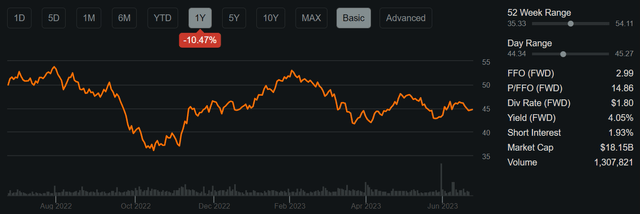
I last covered VTR here back in February, highlighting its growth opportunities ahead. In this article, I provide an update on the business and discuss why now may be a great time to layer into this quality stock.
Why VTR?
Ventas is one of the big 3 diversified healthcare REITs, alongside peers Welltower (WELL) and Healthpeak Properties (PEAK), and is a member of the S&P 500 (SPY). At present, it owns over 1,200 properties across the U.S., Canada, and the United Kingdom. As shown below, it generates 36% of its net operating income from its senior housing operating portfolio (SHOP), 31% from life science/medical office buildings, 30% from triple-net leased properties, and the remaining 3% from loans.
Investor Presentation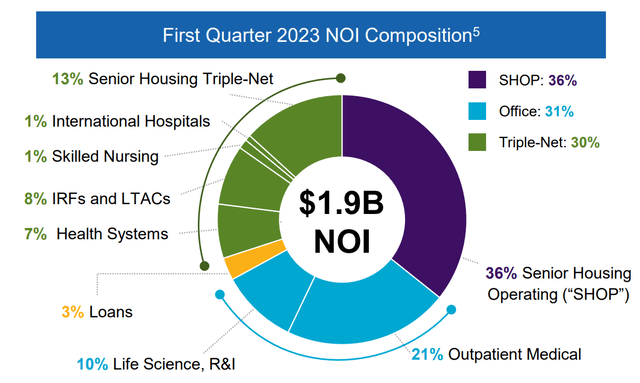
VTR continues to generate respectable growth, with total company NOI growing by 5.8% YoY during the first quarter, excluding $33 million of net U.S. HHS (Health and Human Services) funds received in the prior year period, and same-store cash NOI grew by a robust 8.1% YoY.
This was largely driven by a solid rebound in the SHOP portfolio, whose cash NOI grew by 17% driven by 8% revenue growth and 200 bps of margin expansion. Occupancy grew by 80 bps YoY to 81.3%, while operating expenses grew slower than revenue growth at 5% YoY. This was due to easing labor conditions as permanent employees increased, replacing more expensive contract workers. Encouragingly, contract labor has reduced by 59% YoY and represents the sixth consecutive quarter of declines.
Looking ahead to Q2 results and beyond, VTR should be able to sustain its recent growth trend, as key SHOP selling season is currently underway, with leading indicators remaining strong in May, led by significant pricing power particularly in assisted living. Long-term, healthcare assets remain poised to benefit due to the large and growing aging population, with national health expenditures projected to grow by 5.1% annually through 2030.
VTR also well-positioned to consolidate healthcare real estate, as publicly-traded REITs are generally considered to be the most efficient owners due to scale and transparency. Meanwhile, many leveraged private buyers remain on the sidelines due to higher interest rates and may be net sellers as rates go higher later this year, thereby reducing new construction and creating potential opportunities for VTR down the road.
This is supported by a strong BBB+ credit rating, which is one of the best in the healthcare REIT sector, enabling VTR to tap credit markets at relatively lower interest rates. It also carries a reasonable 3.5x fixed charge coverage ratio and low 37% total debt-to-gross asset value ratio. While the net debt to EBITDA ratio is somewhat elevated at 6.9x, management expects for this ratio to trend down to a safe 5.9x after SHOP returns to an 88% occupancy rate.
Longtime CEO Debra Cafaro provided an update on favorable trends, including limited competition, that may help VTR to get to this occupancy ratio, as noted during this month’s NAREIT conference call:
There is $1 billion of NOI that we can get to just by getting back to 88% occupancy and 30% margins, which is what we had going into the pandemic. And there’s an opportunity to get beyond that because of supply and demand, and I do want to touch on that.
In 99% of our markets, there’s no new construction. Construction is at really all-time lows as a percent of inventory. We think starts are going to continue to be absolutely constrained because of liquidity and available capital.
And so the combination of that really low supply coupled with 23% growth in the over 80 population is what gives us the tailwinds that Justin was talking about and this three-to-five-year runway of a multi-year internal organic growth opportunity.
Importantly for income investors, while the dividend has been maintained flat since being cut in 2020, I see potential for raises down the road due to continued improvements in operating fundamentals. Meanwhile, the current 4.1% dividend yield is well-covered by a 60% payout ratio.
Turning to valuation, VTR appears to be an attractive buy at the current price of $44.47 with a forward P/FFO of 14.9. This is considering the upward momentum in fundamentals, with analysts expecting 7% to 9% annual FFO/share growth over the next 2 years, which I don’t find to be unreasonable. Considering all the above, I believe VTR is deserving of a P/FFO valuation in the 16 to 18 range, representing potentially strong double-digit total returns over the next 12 to 18 months.
Investor Takeaway
Ventas continues to see a strong rebound in its SHOP portfolio and is solidly in position to benefit from reduced competition from higher leveraged private buyers. Long-term growth drivers including the fragmented nature of the healthcare real estate industry and the fast-growing aging population remain intact. With a reasonably attractive valuation and a well-covered dividend that’s positioned to grow, long-term value investors may want to take a hard look at VTR at the current price.
Credit: Source link