
staticnak1983
Boy oh boy, what a few years Upstart (NASDAQ:UPST) has had.
After conducting its IPO in late 2020, Upstart (and its stock) went on to benefit from a convergence of three massive monetary and fiscal trends that caused an explosion in the company’s stock price.
First off, the fiscal stimulus of 2020 and 2021 caused consumer credit quality to jump, as more and more people had more and more cash lying around.
Second, demand for loans skyrocketed as interest rates declined, causing UPST’s revenue to ~3.8x after only one year.
Finally, record-low interest rates drove investment capital into the most speculative parts of the market, inflating UPST’s fast-growing business to a 54x top-line sales multiple(!!).
As a result, the stock went on a run of absolutely epic proportions, up 1,400% in less than a year:
TradingView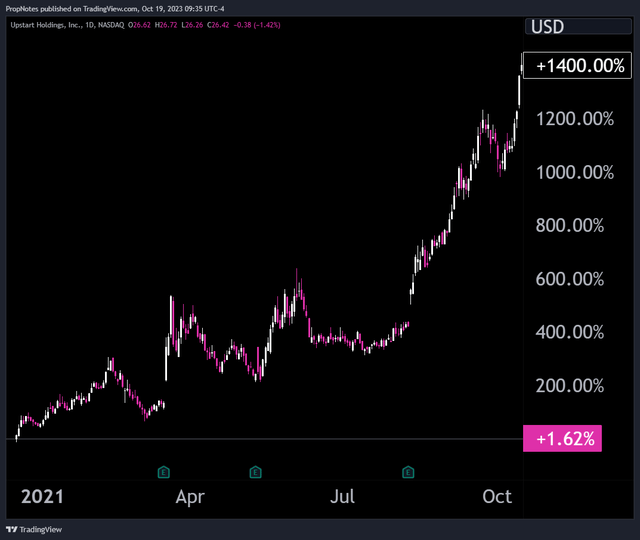
However, as is the case with all things, the easy monetary policy that defined 2020 and 2021 came to an end with the onset of inflation in early 2022.
Interest rates went up, which hampered loan generation as well as the company’s multiple.
In the year and a half following its massive run, the stock fell more than 95% back to where it came from and then some, leaving shareholders in tatters:
TradingView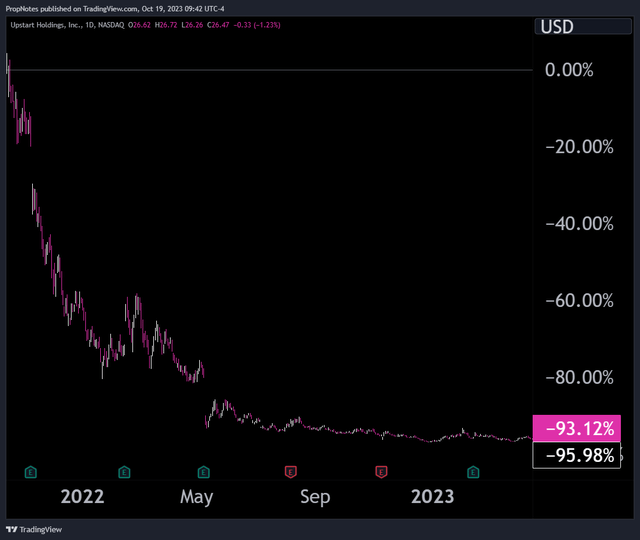
At the present moment, the stock has stabilized somewhat following a recent rally that has re-invigorated interest in the name.
Our question is simple: is this company a good investment at the current juncture?
Today, we’re going to take a look at the company, its prospects, its valuation, and the risks involved in order to determine whether or not Upstart deserves some of your hard-earned capital. Sound good? Let’s jump in.
The Risks
Before we jump into UPST’s financials (which is what we would normally do), it’s important to get this out of the way right up front:
Upstart is a risky bet.
There’s no shame in saying it – there are a lot of risks present here that we can see. And, before we get to the good stuff, it’s crucial not to forget about the many issues present in the stock.
Let’s lay those out.
- The company operates in an incredibly competitive environment.
- The company competes at the riskiest end of the credit spectrum.
- The company has less-than-ideal lending partner quality.
- The company originates some loans itself.
- The company is extremely exposed to interest rates.
Let’s break these down in more detail.
First up, number 1: The company operates in an incredibly competitive environment.
This is a key issue that has been talked about for some time here on Seeking Alpha and elsewhere, but Upstart is one of many, many companies that are using AI and other modeling techniques to determine credit risk and suggest appropriate interest rates for personal & auto loans.
Competitors include Zest – which is what Discover (DFS) and Truist (TFC) use – and Payaga, which is what Ally Bank (ALLY) and SoFi (SOFI) use.
Sure, some Upstart-powered loans are originated directly via partners (through a white label experience), but the majority of loans still go through Upstart.com, which drives up CAC:
Consumers can obtain Upstart-powered loans in one of two ways: either by referral from Upstart.com to one of our lending partners, or directly through our lending partners’ own websites, where our lending technology and experience is bank-branded. Our direct lending partner channel represents a small portion of our overall volume.
Some of this has been mitigated due to UPST’s strong retargeting/retention efforts, but it’s still an issue that’s not going away any time soon.
Investor Presentation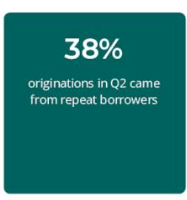
This leads to issue number 2; UPST mainly competes at the lower end of the credit spectrum.
The aforementioned CAC dynamics mean that higher costs prevent UPST from targeting the larger upmarket opportunity where borrowers have credit scores of 700+.
This is still dominated by the larger banks which have more to spend and more developed acquisition channels.
This could be cured with a better B2B strategy, where UPST partners with higher-tier banks and takes a cut of those originations, but the third issue here is that UPST has a less-than-stellar list of lending partners.
It’s true that UPST has increased its number of lending partners from 10 to 100 since its IPO only 3 years ago, but they have yet to score a big fish.
If the company is able to do this, then it could cause a cascade of upper-crust regional banks to potentially follow suit, which would be a massive boon to UPST’s fortunes. This is difficult to envision though, as many banks, especially those with resources, want to keep as much origination as possible for themselves.
This lack of partners leads to problem number 4: the company still originates some of its own loans.
Here’s a quick excerpt from UPST’s recent 10Q:
“Our lending partners can retain loans that align with their business and risk objectives. For loans that are not retained by our lending partners, we sell to a broad base of institutional investors that invest in Upstart-powered loans.
In the six months ended June 30, 2023, 38% of the loans funded through our platform were retained by originating lending partners, 50% of loans were purchased by institutional investors through our loan funding programs and the remaining 12% were funded through our balance sheet.”
In short, the company doesn’t have adequate loan supply to meet demand, which is similar to a problem that Lending Club had back in the day.
UPST claims that these are “R&D loans”, but 12% is a much higher proportion than needed to get insights into the customer experience:
“Starting in 2022, we have increased the utilization of our balance sheet to fund and retain loans to fill gaps in investor demand and to aid in price discovery and to hold R&D Loans on our balance sheet for research and development purposes, including to test and evaluate the accuracy of our AI models for these loans.
R&D Loans are primarily our auto refinance and auto retail loan products, personal loan products issued to new categories of borrowers, and other new unsecured loan products. R&D Loans are not yet part of our established capital markets programs or other loan funding programs with institutional investors.”
All in all, these first four risks are really just emblematic of the problems that any company would face when trying to start spinning a new marketplace/flywheel. The value proposition to both sides of the market isn’t strong enough yet where borrowers and lenders are willing to forgo some cost advantages in favor of incredible convenience.
Finally, we mentioned that the fifth risk has to do with interest rates. As one can see from the stock price action we laid out at the start, UPST might be one of the highest-levered companies to interest rates, in terms of the underlying business, as well as the speculative nature of the stock.
This may change over time as the company gets bigger and stabilizes more, but it will always be baked in to some degree.
Prospects
Alright, that’s the risks out of the way – and there’s a lot of them. What about the upsides?
Well, financials aren’t amazing, but they’re far from dismal.
TTM Revenue has been declining as a result of decreased loan demand, but FCF has actually been climbing as a result of operational streamlining and decreased operating expenses, which were down 35% YoY in the most recent quarter:
TradingView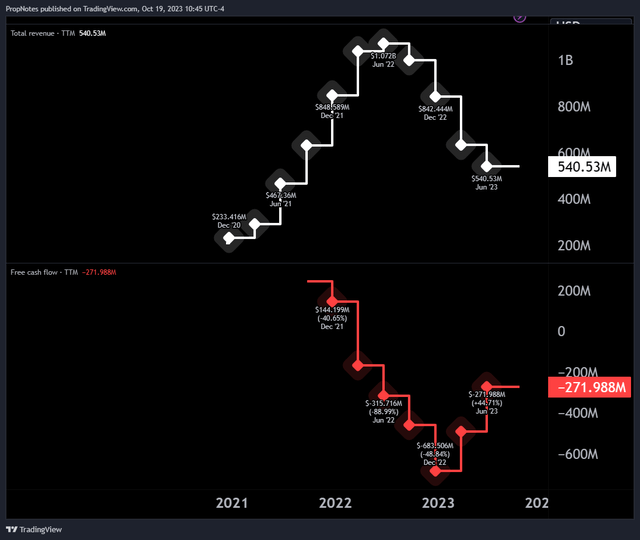
Plus, the balance sheet is in good shape.
Some have highlighted the tail risks associated with the self-origination business, but from a liquidity perspective, the company seems to be fine. There’s more than $440 million in cash on hand and less than $70 million in current expenses.
Sure, there is $930 million in long-term debt, but assuming the company can right the ship and at least produce a little cash flow in the coming years, we don’t see it as an immediate threat.
Finally, UPST has been making great progress in rolling out its auto lending initiatives. Up significantly from a few years ago, the company has increased the number of auto lenders it works with from 200 to 800, a significant increase in a new addressable market.
We see two paths before UPST.
Either the company will reach critical mass at some point and begin working its way up the consumer credit spectrum to the larger and more lucrative 700+ FICO tier, either through partnered direct lending or via referral, or it will flame out as it fails to find serious traction.
While the company has had a few issues from a strategy perspective in our opinion, we believe that the first option is more likely. Being a public company is a serious advantage when it comes to both financing and brand recognition. If the sales team can get things in order and begin improving the B2B GTM strategy, then we’re bullish that UPST’s upstart marketplace could grow significantly in size.
The Trade
We think the chances of UPST making it big long term are better than 50-50, but the current price in the stock, at around $26 per share, or 4.1x top-line sales is far too generous in our view.
What then, is the best way to trade the stock?
One could surely place a bid order for shares at a lower price than they are today.
Or, one could simply sell put options.
When you sell a put option, you’re agreeing to purchase a stock at a given price within a fixed period of time, if the stock drops below that given price.
In return, the put seller collects a cash premium for their troubles. In this case, we like the $15 strike put options expiring 12/15/2023:
TradingView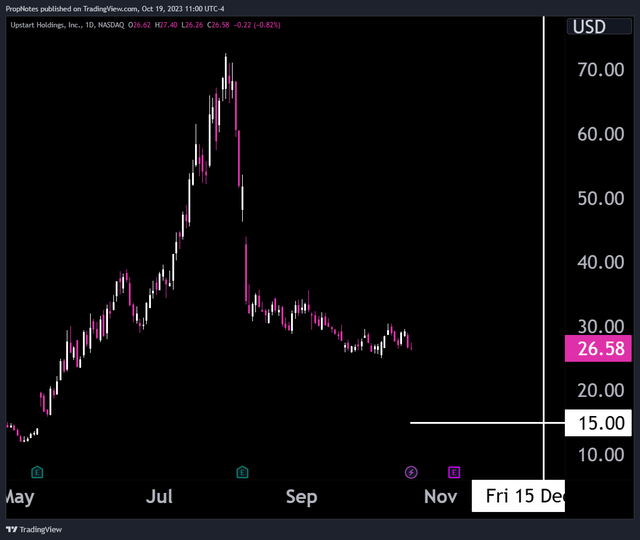
If these put options expire worthless, then the seller gets to keep $37 per contract, which turns out to be a 2.53% cash-on-cash return over 57 days, which annualizes to a ~16% return.
If these put options do not expire worthless, then put sellers still get to keep the 16% annualized cash-on-cash return but will be required to purchase the stock at $15.
While this would likely mean a short-term unrealized loss, $15 represents a -45% breakeven to today’s market price, which is a massive margin of error for buyers at that price, compared with what is on offer at today’s going rate.
Summary
All in all, we’re cautiously optimistic when it comes to Upstart and its efforts to kickstart its flywheel, but we think that a better entry into this volatile stock would serve new investors well.
Why not get paid to wait to purchase shares in the meantime?
That’s why we like shorting the 12/15 put options which yield 16% cash-on-cash on an annualized basis.
Enjoy this article? Be sure to give us a follow and share it with a friend who may enjoy it.
Cheers!
Credit: Source link