















• bitcoinBitcoin(BTC)$84,057.00-0.36%
  • ethereumEthereum(ETH)$2,673.26-0.75%
  • tetherTether(USDT)$1.000.00%
  • binancecoinBNB(BNB)$778.480.76%
  • rippleXRP(XRP)$1.51-0.15%
  • usd-coinUSDC(USDC)$1.000.00%
  • solanaSolana(SOL)$121.930.91%
  • tronTRON(TRX)$0.3343560.54%
  • zcashZcash(ZEC)$1,576.64-4.07%
  • Figure HelocFigure Heloc(FIGR_HELOC)$1.06-0.38%
  • HyperliquidHyperliquid(HYPE)$90.42-2.83%
  • dogecoinDogecoin(DOGE)$0.0966530.61%
  • chainlinkChainlink(LINK)$14.090.11%
  • moneroMonero(XMR)$550.70-0.81%
  • whitebitWhiteBIT Coin(WBT)$83.91-0.40%
  • USDSUSDS(USDS)$1.00-0.01%
  • cardanoCardano(ADA)$0.2558881.96%
  • RainRain(RAIN)$0.012620-1.07%
  • leo-tokenLEO Token(LEO)$9.061.18%
  • stellarStellar(XLM)$0.2183601.66%
  • nearNEAR Protocol(NEAR)$5.346.05%
  • bitcoin-cashBitcoin Cash(BCH)$328.76-1.45%
  • uniswapUniswap(UNI)$9.64-1.82%
  • CantonCanton(CC)$0.1403523.25%
  • litecoinLitecoin(LTC)$70.24-2.30%
  • suiSui(SUI)$1.279.58%
  • Ethena USDeEthena USDe(USDE)$1.000.01%
  • avalanche-2Avalanche(AVAX)$10.901.11%
  • daiDai(DAI)$1.00-0.01%
  • the-open-networkGram (prev. Toncoin)(GRAM)$1.61-0.25%
  • USD1USD1(USD1)$1.00-0.01%
  • hedera-hashgraphHedera(HBAR)$0.0969814.79%
  • quant-networkQuant(QNT)$246.1838.61%
  • BittensorBittensor(TAO)$314.90-0.83%
  • shiba-inuShiba Inu(SHIB)$0.0000060.80%
  • BitwayBitway(BTW)$1.2221.35%
  • crypto-com-chainCronos(CRO)$0.066060-2.34%
  • Global DollarGlobal Dollar(USDG)$1.000.00%
  • tether-goldTether Gold(XAUT)$4,223.07-1.32%
  • paypal-usdPayPal USD(PYUSD)$1.000.00%
  • OndoOndo(ONDO)$0.575.78%
  • EthenaEthena(ENA)$0.2722891.76%
  • MemeCoreMemeCore(M)$1.18-4.49%
  • okbOKB(OKB)$120.51-0.24%
  • Ripple USDRipple USD(RLUSD)$1.000.01%
  • Circle USYCCircle USYC(USYC)$1.140.00%
  • Pump.funPump.fun(PUMP)$0.00514517.28%
  • aaveAave(AAVE)$153.87-0.77%
  • BlackRock USD Institutional Digital Liquidity FundBlackRock USD Institutional Digital Liquidity Fund(BUIDL)$1.000.00%
  • Ondo US Dollar YieldOndo US Dollar Yield(USDY)$1.15-0.09%
TradePoint.io
  • Main
  • AI & Technology
  • Stock Charts
  • Market & News
  • Business
  • Finance Tips
  • Trade Tube
  • Blog
  • Shop
No Result
View All Result
TradePoint.io
No Result
View All Result

Unveiling Hidden PII Risks: How Dynamic Language Model Training Triggers Privacy Ripple Effects

March 3, 2025
in AI & Technology
Reading Time: 5 mins read
A A
Unveiling Hidden PII Risks: How Dynamic Language Model Training Triggers Privacy Ripple Effects
ShareShareShareShareShare

Handling personally identifiable information (PII) in large language models (LLMs) is especially difficult for privacy. Such models are trained on enormous datasets with sensitive data, resulting in memorization risks and accidental disclosure. Managing PII is complex because datasets are constantly updated with new information, and some users may request data removal. In fields like healthcare, eliminating PII is not always feasible. Fine-tuning models for specific tasks further increases the risk of retaining sensitive data. Even after training, there can be residual information, which needs specialized techniques for deletion, and privacy protection is a never-ending challenge.

Currently, methods to reduce PII memorization rely on filtering sensitive data and machine unlearning, where models retrain without certain information. These approaches face major issues, especially in constantly changing datasets. Fine-tuning increases the risk of memorization, and unlearning may unintentionally expose data instead of removing it completely. Membership inference attacks, which attempt to determine if specific data was used in training, remain a serious concern. Even when models forget certain data over time, they retain hidden patterns that can be extracted. Existing techniques lack a full understanding of how memorization happens during training, making privacy risks harder to control.

YOU MAY ALSO LIKE

Which Is Better To Use?

Bill Gates Says It’s ‘Completely Irresponsible’ For AI To Not Have Safeguards

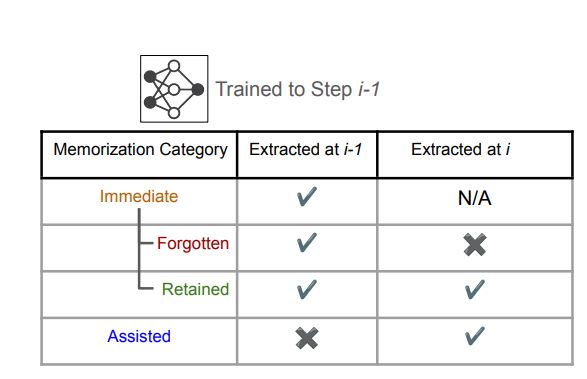
To address these challenges, researchers from Northeastern University, Google DeepMind, and the University of Washington proposed “assisted memorization,” analyzing how personal data is retained in LLMs over time. Unlike existing methods focused solely on whether memorization occurs, this approach examines when and why it happens. Researchers categorized different types of PII memorization-immediate, retained, forgotten, and assisted—to understand these risks better. Results indicated that PII is not necessarily memorized instantly but may become extractable later, especially when overlapping new training data with earlier information. This undermines current data deletion strategies that ignore long-term memorization implications.
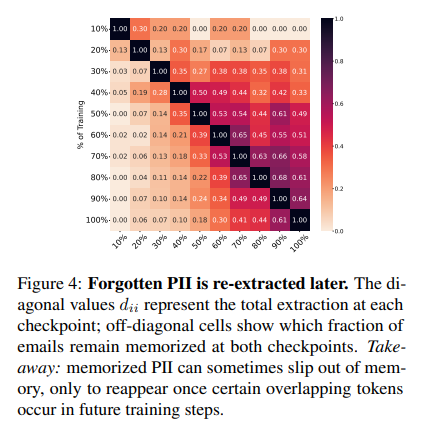
The framework exhaustively tracked PII memorization throughout continuous training through experiments on diverse models and datasets. It analyzed the impact of different training approaches on memorization and extraction risks, demonstrating that adding new data could raise the likelihood of PII extraction. Efforts to reduce memorization for one individual sometimes inadvertently heightened risks for others. Researchers evaluated fine-tuning, retraining, and unlearning techniques using GPT-2-XL, Llama 3 8B, and Gemma 2B models trained on modified WikiText-2 and Pile of Law datasets containing unique emails. Extraction tests assessed memorization, revealing that assisted memorization occurred in 35.7% of cases, indicating it was influenced by training dynamics rather than inevitable.
Further experiments examined how increasing PII in fine-tuning datasets affected extraction risks by training ten models on datasets with varying PII percentages. Results confirmed that higher PII content led to greater extraction risks, with a superlinear increase in extraction under top-k sampling. Additionally, iterative unlearning introduced the “Onion Effect,” where removing extracted PII caused previously unmemorized PII to become extractable. This confirmed that the effect results from systematic exposure of borderline-memorized information rather than random variation. The findings highlight the challenges of adding and removing PII, showing the complexities of privacy protection in language models.
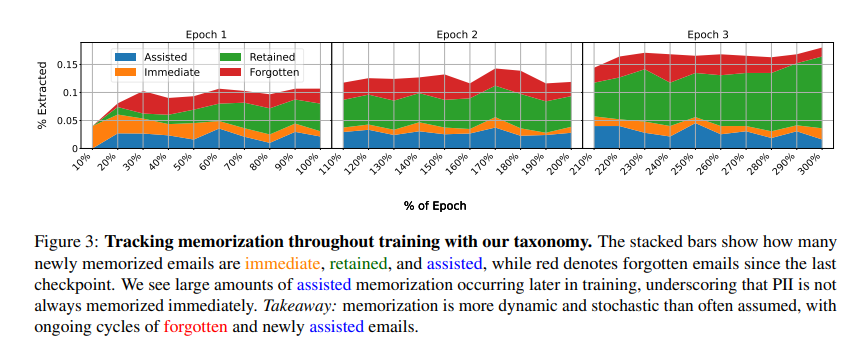
In conclusion, the proposed method highlighted privacy risks in large language models, showing how fine-tuning, retraining, and unlearning can unintentionally expose personally identifiable information (PII). Assisted memorization was identified, where PII that was not initially extracted could later become accessible. Increased PII in training data raised risks of extraction, and removal of specific PII at times unveiled other information. These findings lay a basis for improving privacy-preserving techniques and unlearning methods, providing stronger protection for data in machine learning models.


Check out the Paper. All credit for this research goes to the researchers of this project. Also, feel free to follow us on Twitter and don’t forget to join our 80k+ ML SubReddit.

🚨 Recommended Read- LG AI Research Releases NEXUS: An Advanced System Integrating Agent AI System and Data Compliance Standards to Address Legal Concerns in AI Datasets


Divyesh is a consulting intern at Marktechpost. He is pursuing a BTech in Agricultural and Food Engineering from the Indian Institute of Technology, Kharagpur. He is a Data Science and Machine learning enthusiast who wants to integrate these leading technologies into the agricultural domain and solve challenges.

🚨 Recommended Open-Source AI Platform: ‘IntellAgent is a An Open-Source Multi-Agent Framework to Evaluate Complex Conversational AI System’ (Promoted)

Credit: Source link

ShareTweetSendSharePin

Related Posts

Which Is Better To Use?
AI & Technology

Which Is Better To Use?

September 28, 2026
Bill Gates Says It’s ‘Completely Irresponsible’ For AI To Not Have Safeguards
AI & Technology

Bill Gates Says It’s ‘Completely Irresponsible’ For AI To Not Have Safeguards

September 27, 2026
Should You Ditch Your Tablet For A Foldable Phone?
AI & Technology

Should You Ditch Your Tablet For A Foldable Phone?

September 27, 2026
Why The iPhone Duo Could Be Beneficial For Samsung’s Galaxy Z Fold 8
AI & Technology

Why The iPhone Duo Could Be Beneficial For Samsung’s Galaxy Z Fold 8

September 27, 2026
Next Post
Nightly News Full Episode (March 1st)

Nightly News Full Episode (March 1st)

Leave a Reply Cancel reply

Your email address will not be published. Required fields are marked *

Search

No Result
View All Result
Compass Therapeutics: A Promising, But Shrinking, Window Of Opportunity

Compass Therapeutics: A Promising, But Shrinking, Window Of Opportunity

September 23, 2026
Fei-Fei Li: AI’s Future Is ‘About Humans’

Fei-Fei Li: AI’s Future Is ‘About Humans’

September 24, 2026
,000,000 Of Debt On A Failed Vending Machine

$1,000,000 Of Debt On A Failed Vending Machine

September 22, 2026

About

Learn more

Our Services

Legal

Privacy Policy

Terms of Use

Bloggers

Learn more

Article Links

Contact

Advertise

Ask us anything

©2020- TradePoint.io - All rights reserved!

Tradepoint.io, being just a publishing and technology platform, is not a registered broker-dealer or investment adviser. So we do not provide investment advice. Rather, brokerage services are provided to clients of Tradepoint.io by independent SEC-registered broker-dealers and members of FINRA/SIPC. Every form of investing carries some risk and past performance is not a guarantee of future results. “Tradepoint.io“, “Instant Investing” and “My Trading Tools” are registered trademarks of Apperbuild, LLC.

This website is operated by Apperbuild, LLC. We have no link to any brokerage firm and we do not provide investment advice. Every information and resource we provide is solely for the education of our readers. © 2020 Apperbuild, LLC. All rights reserved.

No Result
View All Result
  • Main
  • AI & Technology
  • Stock Charts
  • Market & News
  • Business
  • Finance Tips
  • Trade Tube
  • Blog
  • Shop

© 2023 - TradePoint.io - All Rights Reserved!