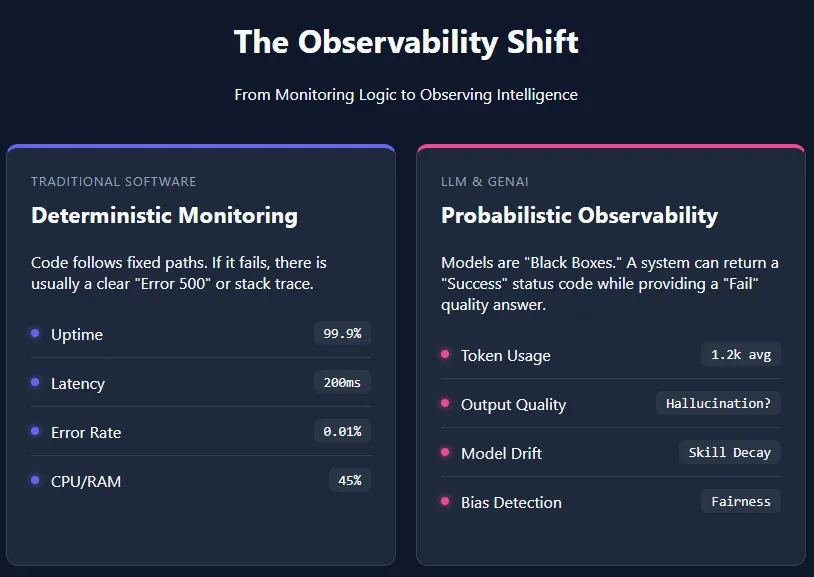

Artificial intelligence (AI) observability refers to the ability to understand, monitor, and evaluate AI systems by tracking their unique metrics—such as token usage, response quality, latency, and model drift. Unlike traditional software, large language models (LLMs) and other generative AI applications are probabilistic in nature. They do not follow fixed, transparent execution paths, which makes their decision-making difficult to trace and reason about. This “black box” behavior creates challenges for trust, especially in high-stakes or production-critical environments.
AI systems are no longer experimental demos—they are production software. And like any production system, they need observability. Traditional software engineering has long relied on logging, metrics, and distributed tracing to understand system behavior at scale. As LLM-powered applications move into real user workflows, the same discipline is becoming essential. To operate these systems reliably, teams need visibility into what happens at each step of the AI pipeline, from inputs and model responses to downstream actions and failures.
Let us now understand the different layers of AI observability with the help of an example.
Observability Layers in an AI Pipeline
Think of an AI resume screening system as a sequence of steps rather than a single black box. A recruiter uploads a resume, the system processes it through multiple components, and finally returns a shortlist score or recommendation. Each step takes time, has a cost associated with it, and can also fail separately. Just looking at the final recommendation might not reveal the entire picture, as the finer details might be missed.
This is why traces and spans are important.
Traces
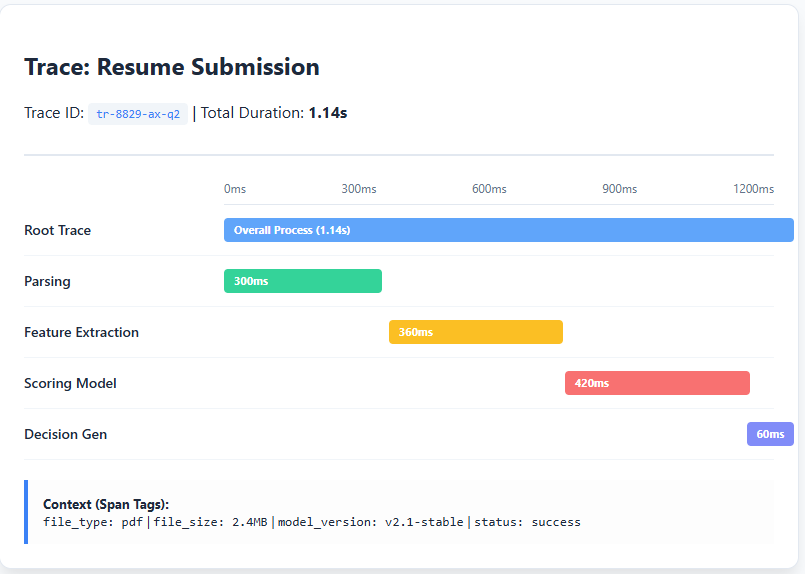
A trace represents the complete lifecycle of a single resume submission—from the moment the file is uploaded to the moment the final score is returned. You can think of it as one continuous timeline that captures everything that happens for that request. Every trace has a unique Trace ID, which ties all related operations together.
Spans
Each major operation inside the pipeline is captured as a span. These spans are nested within the trace and represent specific pieces of work.
Here’s what those spans look like in this system:
Upload Span
The resume is uploaded by the recruiter. This span records the timestamp, file size, format, and basic metadata. This is where the trace begins.
Parsing Span
The document is converted into structured text. This span captures parsing time and errors. If resumes fail to parse correctly or formatting breaks, the issue shows up here.
Feature Extraction Span
The parsed text is analyzed to extract skills, experience, and keywords. This span tracks latency and intermediate outputs. Poor extraction quality becomes visible at this stage.
Scoring Span
The extracted features are passed into a scoring model. This span logs model latency, confidence scores, and any fallback logic. This is often the most compute-intensive step.
Decision Span
The system generates a final recommendation (shortlist, reject, or review). This span records the output decision and response time.
Why Span-Level Observability Matters
Without span-level tracing, all you know is that the final recommendation was wrong—you have no visibility into whether the resume failed to parse correctly, key skills were missed during extraction, or the scoring model behaved unexpectedly. Span-level observability makes each of these failure modes explicit and debuggable.
It also reveals where time and money are actually being spent, such as whether parsing latency is increasing or scoring is dominating compute costs. Over time, as resume formats evolve, new skills emerge, and job requirements change, AI systems can quietly degrade. Monitoring spans independently allows teams to detect this drift early and fix specific components without retraining or redesigning the entire system.
What are the benefits of AI Observability?
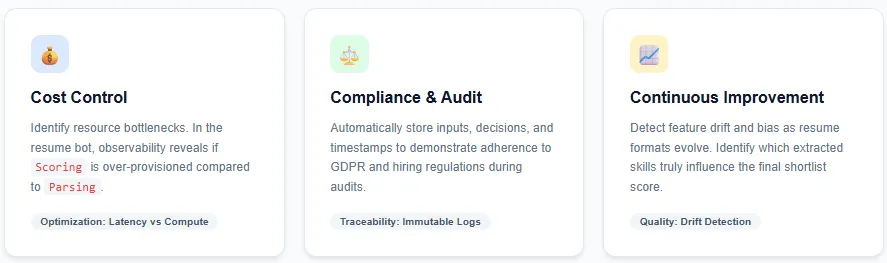
AI observability provides three core benefits: cost control, compliance, and continuous model improvement. By gaining visibility into how AI components interact with the broader system, teams can quickly spot wasted resources—for example, in the resume screening bot, observability might reveal that document parsing is lightweight while candidate scoring consumes most of the compute, allowing teams to optimize or scale resources accordingly.
Observability tools also simplify compliance by automatically collecting and storing telemetry such as inputs, decisions, and timestamps; in the resume bot, this makes it easier to audit how candidate data was processed and demonstrate adherence to data protection and hiring regulations.
Finally, the rich telemetry captured at each step helps model developers maintain integrity over time by detecting drift as resume formats and skills evolve, identifying which features actually influence decisions, and surfacing potential bias or fairness issues before they become systemic problems.
What are some of the open-source AI Observability tools?
Langfuse
Langfuse is a popular open-source LLMOps and observability tool that has grown rapidly since its launch in June 2023. It is model- and framework-agnostic, supports self-hosting, and integrates easily with tools like OpenTelemetry, LangChain, and the OpenAI SDK.
At a high level, Langfuse gives teams end-to-end visibility into their AI systems. It offers tracing of LLM calls, tools to evaluate model outputs using human or AI feedback, centralized prompt management, and dashboards for performance and cost monitoring. Because it works across different models and frameworks, it can be added to existing AI workflows with minimal friction.
Arize Phoenix
Arize is an ML and LLM observability platform that helps teams monitor, evaluate, and analyze models in production. It supports both traditional ML models and LLM-based systems, and integrates well with tools like LangChain, LlamaIndex, and OpenAI-based agents, making it suitable for modern AI pipelines.
Phoenix, Arize’s open-source offering (licensed under ELv2), focuses on LLM observability. It includes built-in hallucination detection, detailed tracing using OpenTelemetry standards, and tools to inspect and debug model behavior. Phoenix is designed for teams that want transparent, self-hosted observability for LLM applications without relying on managed services.
Trulens
TruLens is an observability tool that focuses primarily on the qualitative evaluation of LLM responses. Instead of emphasizing infrastructure-level metrics, TruLens attaches feedback functions to each LLM call and evaluates the generated response after it is produced. These feedback functions behave like models themselves, scoring or assessing aspects such as relevance, coherence, or alignment with expectations.
TruLens is Python-only and is available as free and open-source software under the MIT License, making it easy to adopt for teams that want lightweight, response-level evaluation without a full LLMOps platform.
The post Understanding the Layers of AI Observability in the Age of LLMs appeared first on MarkTechPost.
Credit: Source link