










• bitcoinBitcoin(BTC)$84,765.000.93%
  • ethereumEthereum(ETH)$2,693.090.36%
  • tetherTether(USDT)$1.000.00%
  • binancecoinBNB(BNB)$778.280.99%
  • rippleXRP(XRP)$1.530.57%
  • usd-coinUSDC(USDC)$1.000.00%
  • solanaSolana(SOL)$123.181.75%
  • tronTRON(TRX)$0.333823-0.66%
  • zcashZcash(ZEC)$1,606.602.75%
  • Figure HelocFigure Heloc(FIGR_HELOC)$1.063.32%
  • HyperliquidHyperliquid(HYPE)$91.790.19%
  • dogecoinDogecoin(DOGE)$0.0971650.14%
  • chainlinkChainlink(LINK)$14.06-0.51%
  • moneroMonero(XMR)$548.06-0.26%
  • whitebitWhiteBIT Coin(WBT)$84.490.81%
  • USDSUSDS(USDS)$1.00-0.01%
  • cardanoCardano(ADA)$0.2551880.25%
  • RainRain(RAIN)$0.012584-3.25%
  • leo-tokenLEO Token(LEO)$9.010.52%
  • stellarStellar(XLM)$0.216410-0.63%
  • nearNEAR Protocol(NEAR)$5.4212.33%
  • bitcoin-cashBitcoin Cash(BCH)$334.84-0.62%
  • uniswapUniswap(UNI)$9.742.17%
  • litecoinLitecoin(LTC)$71.11-0.92%
  • CantonCanton(CC)$0.1378602.32%
  • suiSui(SUI)$1.279.42%
  • Ethena USDeEthena USDe(USDE)$1.000.02%
  • avalanche-2Avalanche(AVAX)$11.002.47%
  • the-open-networkGram (prev. Toncoin)(GRAM)$1.654.90%
  • daiDai(DAI)$1.00-0.01%
  • USD1USD1(USD1)$1.00-0.01%
  • hedera-hashgraphHedera(HBAR)$0.0948661.64%
  • BittensorBittensor(TAO)$328.302.11%
  • shiba-inuShiba Inu(SHIB)$0.000006-0.10%
  • crypto-com-chainCronos(CRO)$0.0670981.42%
  • BitwayBitway(BTW)$1.2015.31%
  • Global DollarGlobal Dollar(USDG)$1.00-0.01%
  • EthenaEthena(ENA)$0.2861664.99%
  • paypal-usdPayPal USD(PYUSD)$1.000.00%
  • MemeCoreMemeCore(M)$1.20-0.58%
  • quant-networkQuant(QNT)$186.1150.76%
  • OndoOndo(ONDO)$0.552.62%
  • tether-goldTether Gold(XAUT)$4,279.44-0.02%
  • okbOKB(OKB)$121.460.54%
  • Ripple USDRipple USD(RLUSD)$1.000.01%
  • Circle USYCCircle USYC(USYC)$1.140.00%
  • aaveAave(AAVE)$154.680.09%
  • Pump.funPump.fun(PUMP)$0.00493212.04%
  • BlackRock USD Institutional Digital Liquidity FundBlackRock USD Institutional Digital Liquidity Fund(BUIDL)$1.000.00%
  • Ondo US Dollar YieldOndo US Dollar Yield(USDY)$1.150.06%
TradePoint.io
  • Main
  • AI & Technology
  • Stock Charts
  • Market & News
  • Business
  • Finance Tips
  • Trade Tube
  • Blog
  • Shop
No Result
View All Result
TradePoint.io
No Result
View All Result

Understanding OAuth 2.1 for MCP (Model Context Protocol) Servers: Discovery, Authorization, and Access Phases

August 31, 2025
in AI & Technology
Reading Time: 4 mins read
A A
Understanding OAuth 2.1 for MCP (Model Context Protocol) Servers: Discovery, Authorization, and Access Phases
ShareShareShareShareShare

OAuth 2.1 is the officially mandated authorization standard in the Model Context Protocol (MCP) specifications. According to the official documentation, authorization servers must implement OAuth 2.1 with proper security measures for both confidential and public clients.

MCP provides authorization at the transport level, allowing clients to securely access restricted servers on behalf of resource owners. OAuth 2.1 was chosen as the framework for MCP because it offers a modern, secure, and standardized approach to managing authorization.

YOU MAY ALSO LIKE

Why The iPhone Duo Could Be Beneficial For Samsung’s Galaxy Z Fold 8

How To Improve Your Router’s Security In 10 Minutes

How the Authorization Flow Works

The MCP authorization flow is designed to ensure secure and controlled access to protected servers. It happens in three main phases:

Discovery Phase

When an MCP client tries to connect to a protected server, the server responds with a 401 Unauthorized status along with a WWW-Authenticate header that points to its authorization server. The client then uses the metadata provided by the authorization server to discover its capabilities and understand how to proceed with authentication.

Authorization Phase

Once the client understands how the server handles authorization, it begins the registration and authorization process.

If Dynamic Client Registration is supported, the client can automatically register itself with the authorization server without needing manual setup. During this step, the client provides basic details like its name, type, redirect URLs, and desired scopes. In response, the authorization server issues client credentials — typically a client_id and client_secret — which the client will use in subsequent requests. This process makes onboarding new clients faster and more scalable, especially in large or automated environments.

After registration, the client starts the appropriate OAuth flow:

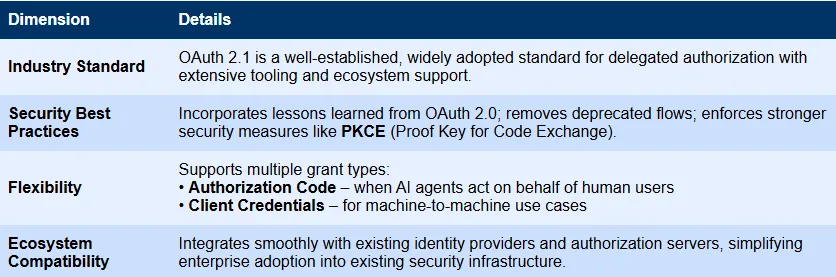
  • Authorization Code flow – Used when acting on behalf of a human user.
  • Client Credentials flow – Used for secure machine-to-machine communication.

In the Authorization Code flow, the user is asked to grant consent. Once approved, the authorization server issues an access token with the appropriate scopes for the client to use.

Access Phase

With the access token in hand, the client sends it along with its requests to the MCP server. The server validates the token, checks the scopes, and only then processes the request and returns the response. Every interaction during this process is logged for auditing and compliance, ensuring security and traceability.
Understanding OAuth 2.1 for MCP (Model Context Protocol) Servers: Discovery, Authorization, and Access Phases
Source: https://modelcontextprotocol.io/specification/draft/basic/authorization

Key Security Enhancements in MCP OAuth 2.1

The MCP authorization specification includes several important security upgrades to make the process safer and more reliable:

Mandatory PKCE

All MCP clients must use PKCE (Proof Key for Code Exchange) as defined in OAuth 2.1. PKCE adds a layer of protection by creating a secret “verifier-challenge” pair, ensuring that only the original client that started the request can exchange the authorization code for tokens. This prevents attacks like code interception or injection.

Strict Redirect URI Validation

Clients have to pre-register their exact redirect URIs with the authorization server. When authorization happens, the server checks for an exact match. This stops attackers from redirecting tokens to unauthorized locations.

Short-Lived Tokens

Authorization servers are encouraged to issue short-lived access tokens. If a token is accidentally exposed or stolen, its short lifespan reduces the risk of misuse.

Granular Scope Model

MCP OAuth 2.1 allows fine-grained permissions using scopes, so clients only get access to what they need. Examples include:

mcp:tools:weather – Access to weather tools only.

mcp:resources:customer-data:read – Read-only access to customer data.

mcp:exec:workflows:* – Permission to run any workflow.

Dynamic Client Registration

MCP clients and servers can support automatic client registration. This lets new clients get their credentials (like client IDs) without manual setup, making it faster and easier to onboard new AI agents securely.

How to Implement OAuth 2.1 for MCP Servers

In the next section of the article, we will dive deep into how to implement OAuth 2.1 for MCP Servers. We will create a simple finance sentiment analysis server and implement authorization using Scalekit which simplifies the entire process.

The post Understanding OAuth 2.1 for MCP (Model Context Protocol) Servers: Discovery, Authorization, and Access Phases appeared first on MarkTechPost.

Credit: Source link

ShareTweetSendSharePin

Related Posts

Why The iPhone Duo Could Be Beneficial For Samsung’s Galaxy Z Fold 8
AI & Technology

Why The iPhone Duo Could Be Beneficial For Samsung’s Galaxy Z Fold 8

September 27, 2026
How To Improve Your Router’s Security In 10 Minutes
AI & Technology

How To Improve Your Router’s Security In 10 Minutes

September 27, 2026
Humanoid Robots Are Getting Even Creepier (This One Can Cry On Command)
AI & Technology

Humanoid Robots Are Getting Even Creepier (This One Can Cry On Command)

September 27, 2026
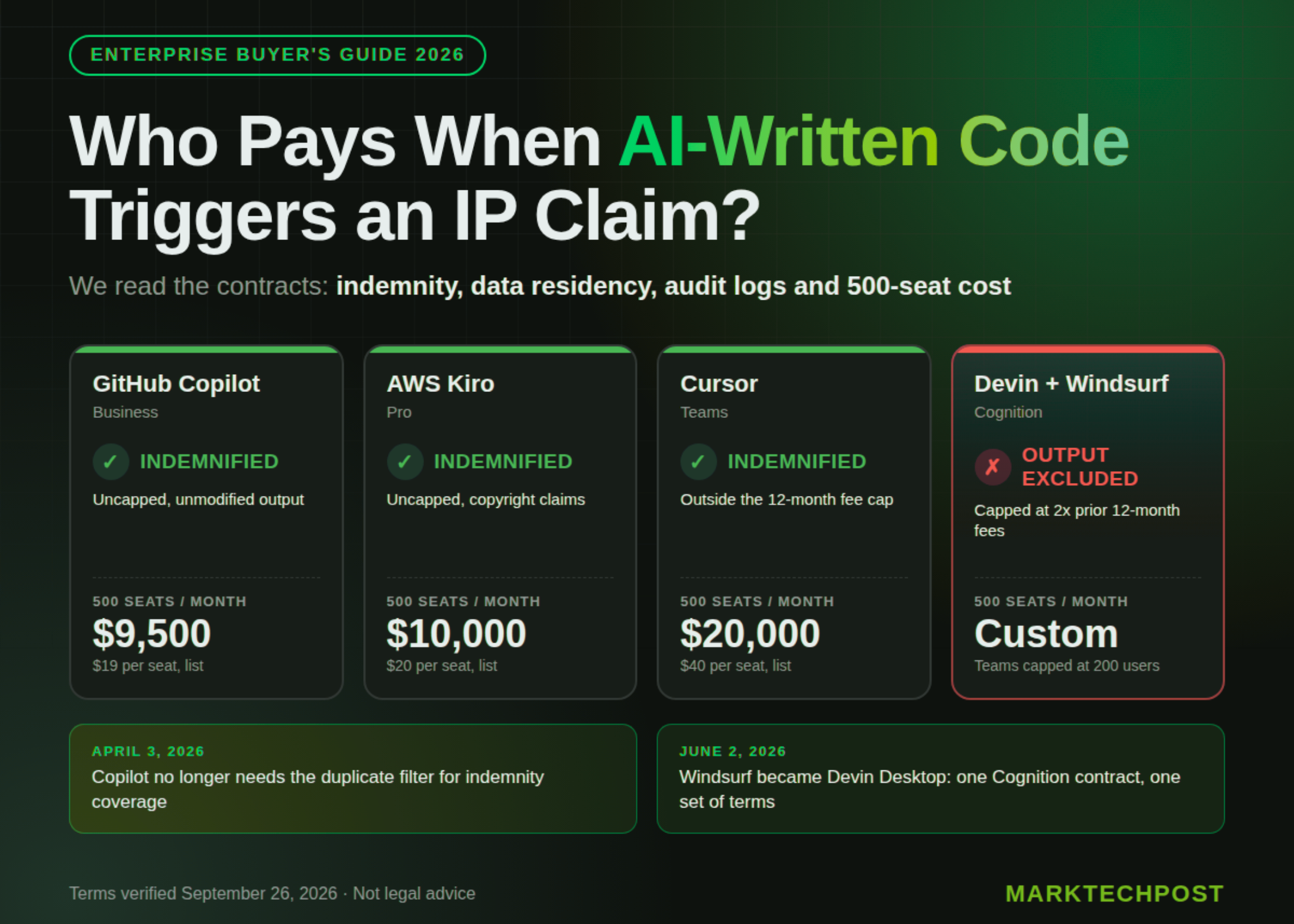
AI Coding Agents for Enterprise: IP Indemnity, Data Residency and 500-Seat Cost Compared
AI & Technology

AI Coding Agents for Enterprise: IP Indemnity, Data Residency and 500-Seat Cost Compared

September 27, 2026
Next Post
The Mortal Kombat II movie is postponed to a spring 2026 release

The Mortal Kombat II movie is postponed to a spring 2026 release

Leave a Reply Cancel reply

Your email address will not be published. Required fields are marked *

Search

No Result
View All Result
Truck spills 40,000 pounds of cheese near Arizona highway

Truck spills 40,000 pounds of cheese near Arizona highway

September 22, 2026
House nearly engulfed by Nepal floodwaters

House nearly engulfed by Nepal floodwaters

September 21, 2026
Current with Christine Romans – Aug. 24 | NBC News NOW

Current with Christine Romans – Aug. 24 | NBC News NOW

September 25, 2026

About

Learn more

Our Services

Legal

Privacy Policy

Terms of Use

Bloggers

Learn more

Article Links

Contact

Advertise

Ask us anything

©2020- TradePoint.io - All rights reserved!

Tradepoint.io, being just a publishing and technology platform, is not a registered broker-dealer or investment adviser. So we do not provide investment advice. Rather, brokerage services are provided to clients of Tradepoint.io by independent SEC-registered broker-dealers and members of FINRA/SIPC. Every form of investing carries some risk and past performance is not a guarantee of future results. “Tradepoint.io“, “Instant Investing” and “My Trading Tools” are registered trademarks of Apperbuild, LLC.

This website is operated by Apperbuild, LLC. We have no link to any brokerage firm and we do not provide investment advice. Every information and resource we provide is solely for the education of our readers. © 2020 Apperbuild, LLC. All rights reserved.

No Result
View All Result
  • Main
  • AI & Technology
  • Stock Charts
  • Market & News
  • Business
  • Finance Tips
  • Trade Tube
  • Blog
  • Shop

© 2023 - TradePoint.io - All Rights Reserved!