sturti
While the U.S. and Europe continue to address climate change, supporting alternative and renewable fuels and inhibiting traditional hydrocarbons, crude oil is the energy commodity powering the world. Gasoline is the most ubiquitous oil product, powering vehicles in the United States, Europe, and worldwide.
Gasoline is a seasonal commodity, as drivers tend to put more clicks on odometers during summer vacations. In July 2024, gasoline is in the heart of the peak demand season, and prices have been trending higher since early June. Gasoline’s rally could continue over the coming weeks, but the November U.S. election will determine crude oil and gasoline fundamentals for the coming years. The bottom line is that the trend favors a long exposure to gasoline over the coming weeks, but all bets are off in the fall. The United States Gasoline Fund, LP ETF (NYSEARCA:UGA) follows NYMEX gasoline futures prices.
Gasoline demand increases during the summer
Gasoline demand tends to rise during spring and summer as drivers put more mileage on vehicles.
Ten-Year NYMEX Gasoline Futures Chart (Barchart)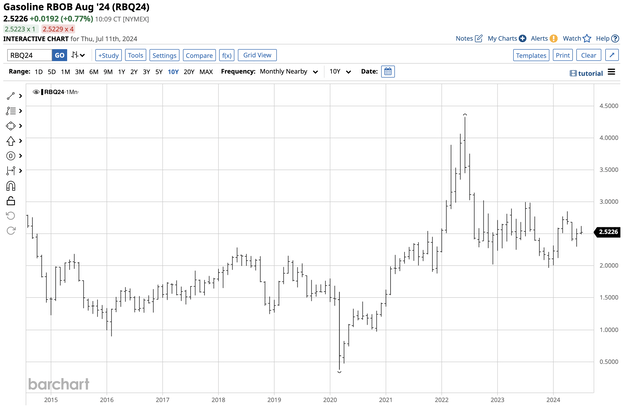
The ten-year RBOB gasoline futures chart shows that seasonal highs tend to occur during summer, with seasonal lows occurring during the coldest months. In summer, people often hop in cars for vacations, increasing gasoline demand.
A bullish trend since early June
In 2024, gasoline prices have been trending higher since early June.
Three-Month NYMEX Gasoline Futures Chart (Barchart)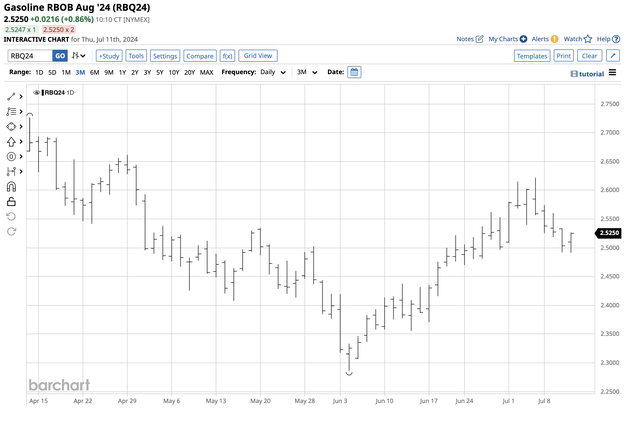
The three-month chart highlights gasoline’s bullish trend that has taken the fuel futures for August delivery 14.7% higher from $2.2865 on June 4 to the most recent $2.6217 high on July 5. Gasoline futures have made higher lows and higher highs over the past six weeks.
The November election will determine U.S. energy policy
While seasonality will begin to weigh on gasoline futures towards the end of summer, the November 2024 U.S. election is the most critical factor for fuel prices for the coming years.
Incumbent President Biden and Democrats favor addressing climate change with a greener path to energy production and consumption. The recent scorching temperatures will likely intensify calls to promote alternative and renewable fuels and curtail hydrocarbons. However, since China and India, the world’s most populous countries, are not cooperating with climate change initiatives and most vehicles still rely on oil product fuels, a second term for the Democrats will keep pricing power with the international oil cartel and its partner, Russia. A Democratic victory in November could cause oil and gasoline prices to remain elevated over the coming years.
Former President Trump and Republicans favor a “drill-baby-drill” and “frack-baby-frack” approach to fossil fuels to achieve energy independence, increase exports and revenues, and battle inflation through lower traditional energy prices. A Trump victory could cause crude oil to fall back toward the $40 per barrel level, leading gasoline prices well below the $2 per gallon level. Throughout most of his term from early 2017 through early 2021, aside from the volatility during the global pandemic, gasoline futures prices were below $2 per gallon.
The 2024 U.S. election will determine oil and gasoline prices for the coming years. While inflation data excludes volatile food and energy prices, oil is a critical factor in economic conditions as it is a core cost for most goods and services.
Long exposure to gasoline is a short-term trade for two reasons
The trend is always your best friend in markets, and in July 2024, it remains higher in the gasoline futures arena. However, seasonality will eventually cause the bullish trend to bend, and the election will determine if the highs and lows over the coming years remain elevated. Seasonality and U.S. energy policy are the two factors making long exposure to gasoline a short-term trade.
In 2020, when nearby NYMEX crude oil futures fell below zero during the early days of the global pandemic, the NYMEX gasoline futures plunged to 37.60 per gallon, the lowest price of this century. In June 2022, after crude oil prices exploded to the highest level since 2008 at over $130 per barrel, gasoline futures reached a record $4.3260 per gallon high. Crude oil and gasoline prices exploded higher after Russia invaded Ukraine. The Biden administration sold unprecedented crude oil from the U.S. Strategic Petroleum Reserve. After rising to a 656 million barrel high in June 2020, the SPR was below the 375 million barrel level in early July 2024.
The bottom line is the 2024 U.S. election that determines U.S. energy policy is critical for the path of least resistance of crude oil and gasoline prices for the coming years. The geopolitical landscape favors higher prices if the U.S. does not increase petroleum output.
UGA is the gasoline ETF product that tracks the futures
Nearby NYMEX RBOB gasoline prices rose 14.7% from early June through July 5.
Three-Month Chart of the UGA ETF Product (Barchart)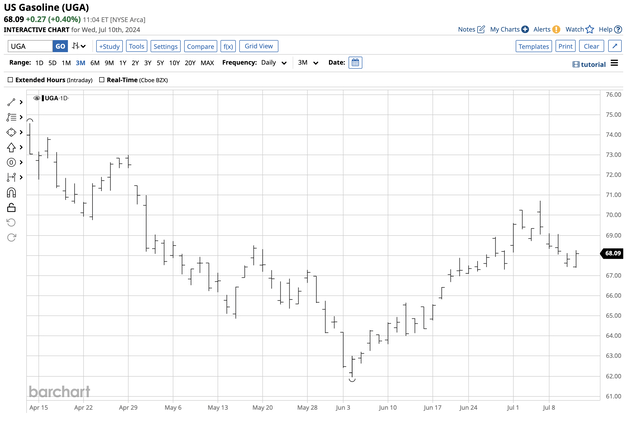
Over the same period, the United States Gasoline Fund, LP ETF rose 14.2% from $61.95 to $70.72 per share. UGA did an excellent job tracking the August NYMEX gasoline futures price. At $68.09 per share on July 11, UGA had $101.42 million in assets under management. UGA trades an average of 22,458 shares daily and charges around a 1% management fee.
Gasoline prices will likely become highly volatile as the 2024 U.S. election approaches. While the most direct route for a risk position in the oil product is the futures and futures options on the CME’s NYMEX division, UGA can be a valuable trading tool. It allows you to take advantage of wide price swings over the coming weeks and months. As of July 11, gasoline remains in a bullish trend. Expect lots of volatility as seasonality is not the only factor impacting the fuel’s price during the second half of 2024.
Credit: Source link