• bitcoinBitcoin(BTC)$81,602.001.07%
  • ethereumEthereum(ETH)$2,638.782.25%
  • tetherTether(USDT)$1.000.02%
  • binancecoinBNB(BNB)$767.371.47%
  • rippleXRP(XRP)$1.433.69%
  • usd-coinUSDC(USDC)$1.000.01%
  • solanaSolana(SOL)$111.540.88%
  • tronTRON(TRX)$0.337957-0.45%
  • zcashZcash(ZEC)$1,523.783.10%
  • Figure HelocFigure Heloc(FIGR_HELOC)$1.030.19%
  • HyperliquidHyperliquid(HYPE)$93.171.90%
  • dogecoinDogecoin(DOGE)$0.0886071.39%
  • moneroMonero(XMR)$572.002.68%
  • whitebitWhiteBIT Coin(WBT)$83.340.68%
  • RainRain(RAIN)$0.0139677.52%
  • USDSUSDS(USDS)$1.00-0.01%
  • chainlinkChainlink(LINK)$12.553.11%
  • cardanoCardano(ADA)$0.2263873.41%
  • leo-tokenLEO Token(LEO)$8.940.69%
  • stellarStellar(XLM)$0.1982713.61%
  • uniswapUniswap(UNI)$8.881.80%
  • bitcoin-cashBitcoin Cash(BCH)$254.560.88%
  • Ethena USDeEthena USDe(USDE)$1.000.01%
  • nearNEAR Protocol(NEAR)$3.56-3.68%
  • daiDai(DAI)$1.000.00%
  • litecoinLitecoin(LTC)$57.923.69%
  • CantonCanton(CC)$0.1110722.71%
  • USD1USD1(USD1)$1.000.02%
  • avalanche-2Avalanche(AVAX)$9.3715.48%
  • the-open-networkGram (prev. Toncoin)(GRAM)$1.391.47%
  • hedera-hashgraphHedera(HBAR)$0.0810802.53%
  • suiSui(SUI)$0.844.83%
  • Global DollarGlobal Dollar(USDG)$1.00-0.01%
  • shiba-inuShiba Inu(SHIB)$0.0000050.44%
  • BittensorBittensor(TAO)$271.898.41%
  • crypto-com-chainCronos(CRO)$0.0597740.45%
  • MemeCoreMemeCore(M)$1.28-3.58%
  • paypal-usdPayPal USD(PYUSD)$1.00-0.01%
  • tether-goldTether Gold(XAUT)$4,373.510.37%
  • okbOKB(OKB)$120.674.06%
  • Circle USYCCircle USYC(USYC)$1.140.00%
  • Ripple USDRipple USD(RLUSD)$1.00-0.01%
  • BlackRock USD Institutional Digital Liquidity FundBlackRock USD Institutional Digital Liquidity Fund(BUIDL)$1.000.00%
  • Ondo US Dollar YieldOndo US Dollar Yield(USDY)$1.140.32%
  • aaveAave(AAVE)$142.163.26%
  • OndoOndo(ONDO)$0.43777911.46%
  • mantleMantle(MNT)$0.635.75%
  • AsterAster(ASTER)$0.761.33%
  • EthenaEthena(ENA)$0.19558918.85%
  • Pump.funPump.fun(PUMP)$0.004106-4.27%
TradePoint.io
  • Main
  • AI & Technology
  • Stock Charts
  • Market & News
  • Business
  • Finance Tips
  • Trade Tube
  • Blog
  • Shop
No Result
View All Result
TradePoint.io
No Result
View All Result

UC Berkeley Researchers Introduce Learnable Latent Codes as Bridges (LCB): A Novel AI Approach that Combines the Abstract Reasoning Capabilities of Large Language Models with Low-Level Action Policies

May 12, 2024
in AI & Technology
Reading Time: 5 mins read
A A
UC Berkeley Researchers Introduce Learnable Latent Codes as Bridges (LCB): A Novel AI Approach that Combines the Abstract Reasoning Capabilities of Large Language Models with Low-Level Action Policies
ShareShareShareShareShare

The robotics field has historically vacillated between two primary architectural paradigms: modular hierarchical policies and end-to-end policies. Modular hierarchies employ rigid layers such as symbolic planning, trajectory generation, and tracking, while end-to-end policies utilize high-capacity neural networks to map sensory input directly to actions. The emergence of large language models (LLMs) has renewed interest in hierarchical control architectures, with recent studies utilizing LLMs to replace symbolic planners, achieving significant feats like mobile object rearrangement based on open-vocabulary instructions. However, hierarchical architectures still face challenges in defining control primitives and establishing interfaces between layers, particularly in coordinating diverse human-like movements beyond semantic action verbs.

The rise of LLMs has sparked interest in their application to robotics, particularly in hierarchical control architectures. Previous studies have demonstrated utilizing LLMs for high-level reasoning through various approaches such as few-shot prompts, function coding, and interaction with humans via language. Integrating LLMs into task planning and reasoning requires calling lower-level skills, achievable through language-conditioned policies. Also, there’s a growing trend in repurposing large models originally trained for vision or language tasks for robotics applications.

Researchers from the University of California, Berkeley, introduced Latent Codes as Bridges (LCB), a robust policy architecture for control. LCB combines the strengths of modular hierarchical architectures with end-to-end learning. It allows direct utilization of LLMs for high-level reasoning alongside pre-trained skills for low-level control, enhancing them through end-to-end learning. By incorporating a <ACT> token at the interface layer to modulate low-level policies, LCB surpasses the limitations of relying solely on language, which struggles to describe certain behaviors. Also, by employing a separate <ACT> token, LCB preserves the core language generation and reasoning capabilities of LLMs during fine-tuning.

The proposed architecture, LCB, integrates the advantages of modular hierarchical architectures and end-to-end learning. It employs an additional latent code to bridge high-level reasoning with low-level language-conditioned policy, preserving both abstract goals and language embedding space. This approach addresses the limitations of existing methods, offering improved flexibility and preservation of language understanding during fine-tuning. The architecture comprises a pretrained Multimodal LLM and a pretrained policy, facilitating multimodal understanding and action output based on environment observations and conditioning latent. Data processing involves generating conversational-style interactions to train the model for language-guided action execution.
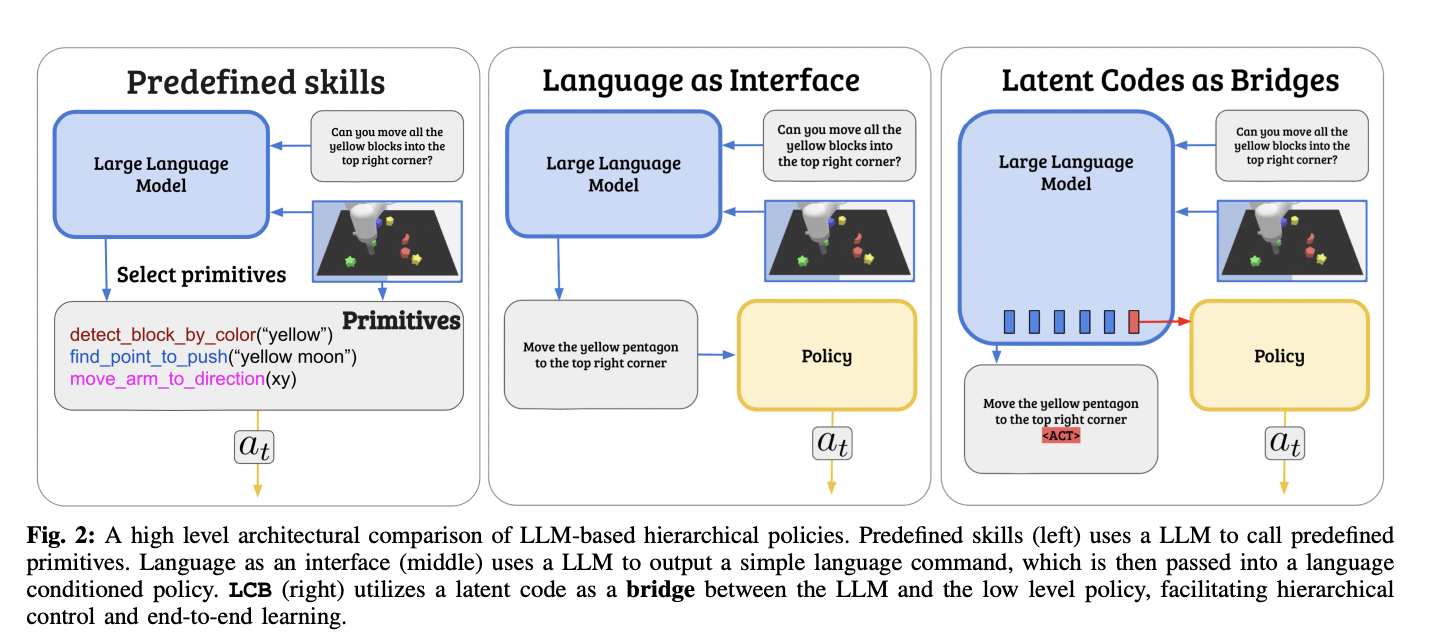
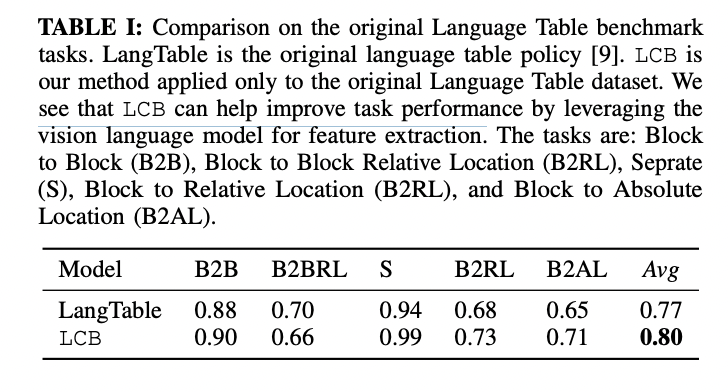
Experiments on Language Table and CALVIN benchmarks reveal LCB’s superiority over baselines, including those with GPT-4V, in tasks necessitating reasoning and multi-step behaviors. LCB’s integration of the vision language model enhances task performance by extracting features effectively.
Summary

  • This work presents LCB, a robust method merging large language model reasoning with low-level action policies. 
  • Unlike prior approaches, LCB integrates these capabilities seamlessly through a learned latent interface. 
  • Evaluation on Language Table and CALVIN benchmarks demonstrate LCB’s proficiency in interpreting and executing diverse reasoning and long-horizon tasks. 
  • The hierarchical flexibility enabled by LCB holds potential for practical applications in robotics.

Check out the Paper and Project. All credit for this research goes to the researchers of this project. Also, don’t forget to follow us on Twitter. Join our Telegram Channel, Discord Channel, and LinkedIn Group.

If you like our work, you will love our newsletter..

Don’t Forget to join our 42k+ ML SubReddit


YOU MAY ALSO LIKE

How To Block And Unblock A Number On Your Android Phone

Google Gemini Also Escaped Its Testing Environment And Hacked Three Companies

Asjad is an intern consultant at Marktechpost. He is persuing B.Tech in mechanical engineering at the Indian Institute of Technology, Kharagpur. Asjad is a Machine learning and deep learning enthusiast who is always researching the applications of machine learning in healthcare.


[Recommended Read] Rightsify’s GCX: Your Go-To Source for High-Quality, Ethically Sourced, Copyright-Cleared AI Music Training Datasets with Rich Metadata


Credit: Source link

ShareTweetSendSharePin

Related Posts

How To Block And Unblock A Number On Your Android Phone
AI & Technology

How To Block And Unblock A Number On Your Android Phone

September 19, 2026
Google Gemini Also Escaped Its Testing Environment And Hacked Three Companies
AI & Technology

Google Gemini Also Escaped Its Testing Environment And Hacked Three Companies

September 19, 2026
What Is AI Agent Memory? Short-Term, Long-Term, Episodic, and Semantic Memory Explained – Unite.AI
AI & Technology

What Is AI Agent Memory? Short-Term, Long-Term, Episodic, and Semantic Memory Explained – Unite.AI

September 19, 2026
Linkup Research Releases SPARSEUP: A 149M-Parameter Open-Source Sparse Embedding Model
AI & Technology

Linkup Research Releases SPARSEUP: A 149M-Parameter Open-Source Sparse Embedding Model

September 19, 2026
Next Post
Iran’s U.N Ambassador: Extended Interview (Part 1)

Iran’s U.N Ambassador: Extended Interview (Part 1)

Leave a Reply Cancel reply

Your email address will not be published. Required fields are marked *

Search

No Result
View All Result
Full Episode: TODAY Show – Sept. 2

Full Episode: TODAY Show – Sept. 2

September 19, 2026
Feminist and activist Gloria Steinem dies at 92

Feminist and activist Gloria Steinem dies at 92

September 18, 2026
Steve Kornacki breaks down a new poll on data centers and AI

Steve Kornacki breaks down a new poll on data centers and AI

September 16, 2026

About

Learn more

Our Services

Legal

Privacy Policy

Terms of Use

Bloggers

Learn more

Article Links

Contact

Advertise

Ask us anything

©2020- TradePoint.io - All rights reserved!

Tradepoint.io, being just a publishing and technology platform, is not a registered broker-dealer or investment adviser. So we do not provide investment advice. Rather, brokerage services are provided to clients of Tradepoint.io by independent SEC-registered broker-dealers and members of FINRA/SIPC. Every form of investing carries some risk and past performance is not a guarantee of future results. “Tradepoint.io“, “Instant Investing” and “My Trading Tools” are registered trademarks of Apperbuild, LLC.

This website is operated by Apperbuild, LLC. We have no link to any brokerage firm and we do not provide investment advice. Every information and resource we provide is solely for the education of our readers. © 2020 Apperbuild, LLC. All rights reserved.

No Result
View All Result
  • Main
  • AI & Technology
  • Stock Charts
  • Market & News
  • Business
  • Finance Tips
  • Trade Tube
  • Blog
  • Shop

© 2023 - TradePoint.io - All Rights Reserved!