• bitcoinBitcoin(BTC)$75,915.00-1.40%
  • ethereumEthereum(ETH)$2,403.98-2.96%
  • tetherTether(USDT)$1.00-0.04%
  • binancecoinBNB(BNB)$710.26-1.07%
  • rippleXRP(XRP)$1.29-8.08%
  • usd-coinUSDC(USDC)$1.00-0.01%
  • solanaSolana(SOL)$97.26-3.64%
  • tronTRON(TRX)$0.334845-1.23%
  • Figure HelocFigure Heloc(FIGR_HELOC)$1.000.00%
  • zcashZcash(ZEC)$1,212.196.08%
  • HyperliquidHyperliquid(HYPE)$77.75-1.94%
  • dogecoinDogecoin(DOGE)$0.079887-3.43%
  • RainRain(RAIN)$0.0137703.36%
  • USDSUSDS(USDS)$1.00-0.03%
  • moneroMonero(XMR)$502.28-3.15%
  • whitebitWhiteBIT Coin(WBT)$78.03-2.07%
  • leo-tokenLEO Token(LEO)$8.88-1.23%
  • chainlinkChainlink(LINK)$10.84-4.93%
  • cardanoCardano(ADA)$0.194496-5.11%
  • stellarStellar(XLM)$0.175710-9.50%
  • Ethena USDeEthena USDe(USDE)$1.00-0.06%
  • daiDai(DAI)$1.000.04%
  • bitcoin-cashBitcoin Cash(BCH)$218.74-1.64%
  • USD1USD1(USD1)$1.00-0.03%
  • uniswapUniswap(UNI)$6.36-4.41%
  • litecoinLitecoin(LTC)$50.91-3.20%
  • the-open-networkGram (prev. Toncoin)(GRAM)$1.31-2.11%
  • CantonCanton(CC)$0.090996-4.79%
  • Global DollarGlobal Dollar(USDG)$1.000.00%
  • hedera-hashgraphHedera(HBAR)$0.074441-4.08%
  • avalanche-2Avalanche(AVAX)$7.28-3.26%
  • nearNEAR Protocol(NEAR)$2.431.09%
  • shiba-inuShiba Inu(SHIB)$0.000005-5.71%
  • suiSui(SUI)$0.69-3.14%
  • paypal-usdPayPal USD(PYUSD)$1.00-0.01%
  • crypto-com-chainCronos(CRO)$0.055649-3.57%
  • BlackRock USD Institutional Digital Liquidity FundBlackRock USD Institutional Digital Liquidity Fund(BUIDL)$1.000.00%
  • tether-goldTether Gold(XAUT)$4,331.841.42%
  • Circle USYCCircle USYC(USYC)$1.140.01%
  • MemeCoreMemeCore(M)$1.10-1.01%
  • BittensorBittensor(TAO)$216.25-4.80%
  • Ripple USDRipple USD(RLUSD)$1.000.01%
  • okbOKB(OKB)$110.26-2.10%
  • Ondo US Dollar YieldOndo US Dollar Yield(USDY)$1.14-0.05%
  • BitwayBitway(BTW)$0.788.51%
  • pax-goldPAX Gold(PAXG)$4,336.901.48%
  • aaveAave(AAVE)$119.66-6.29%
  • AsterAster(ASTER)$0.67-2.67%
  • World Liberty FinancialWorld Liberty Financial(WLFI)$0.056907-0.52%
  • mantleMantle(MNT)$0.54-2.69%
TradePoint.io
  • Main
  • AI & Technology
  • Stock Charts
  • Market & News
  • Business
  • Finance Tips
  • Trade Tube
  • Blog
  • Shop
No Result
View All Result
TradePoint.io
No Result
View All Result

UC Berkeley and Microsoft Research Redefine Visual Understanding: How Scaling on Scales Outperforms Larger Models with Efficiency and Elegance

March 23, 2024
in AI & Technology
Reading Time: 5 mins read
A A
UC Berkeley and Microsoft Research Redefine Visual Understanding: How Scaling on Scales Outperforms Larger Models with Efficiency and Elegance
ShareShareShareShareShare

In the dynamic realm of computer vision and artificial intelligence, a new approach challenges the traditional trend of building larger models for advanced visual understanding. The approach in the current research, underpinned by the belief that larger models yield more powerful representations, has led to the development of gigantic vision models. 

Central to this exploration lies a critical examination of the prevailing practice of model upscaling. This scrutiny brings to light the significant resource expenditure and the diminishing returns on performance enhancements associated with continuously enlarging model architectures. It raises a pertinent question about the sustainability and efficiency of this approach, especially in a domain where computational resources are invaluable.

UC Berkeley and Microsoft Research introduced an innovative technique called Scaling on Scales (S2). This method represents a paradigm shift, proposing a strategy that diverges from the traditional model scaling. By applying a pre-trained, smaller vision model across various image scales, S2 aims to extract multi-scale representations, offering a new lens through which visual understanding can be enhanced without necessarily increasing the model’s size.

Leveraging multiple image scales produces a composite representation that rivals or surpasses the output of much larger models. The research showcases the S2 technique’s prowess across several benchmarks, where it consistently outperforms its larger counterparts in tasks including but not limited to classification, semantic segmentation, and depth estimation. It sets a new state-of-the-art in multimodal LLM (MLLM) visual detail understanding on the V* benchmark, outstripping even commercial models like Gemini Pro and GPT-4V, with significantly fewer parameters and comparable or reduced computational demands.

For instance, in robotic manipulation tasks, the S2 scaling method on a base-size model improved the success rate by about 20%, demonstrating its superiority over mere model-size scaling. The detailed understanding capability of LLaVA-1.5, with S2 scaling, achieved remarkable accuracies, with V* Attention and V* Spatial scoring 76.3% and 63.2%, respectively. These figures underscore the effectiveness of S2 and highlight its efficiency and the potential for reducing computational resource expenditure.

This research sheds light on the increasingly pertinent question of whether the relentless scaling of model sizes is truly necessary for advancing visual understanding. Through the lens of the S2 technique, it becomes evident that alternative scaling methods, particularly those focusing on exploiting the multi-scale nature of visual data, can provide equally compelling, if not superior, performance outcomes. This approach challenges the existing paradigm and opens up new avenues for resource-efficient and scalable model development in computer vision.
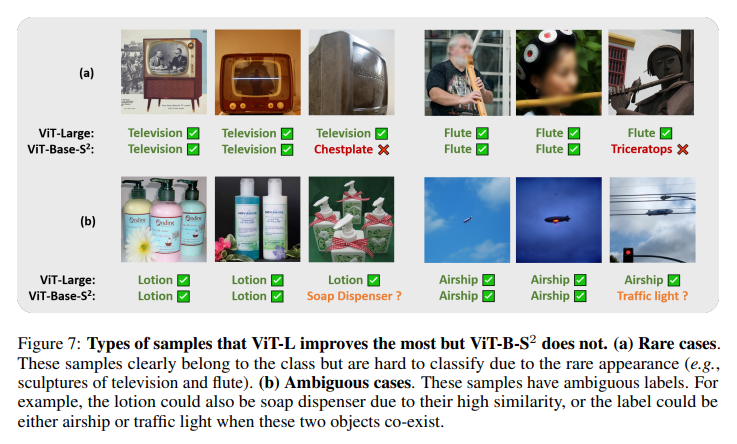
In conclusion, introducing and validating the Scaling on Scales (S2) method represents a significant breakthrough in computer vision and artificial intelligence. This research compellingly argues for a departure from the prevalent model size expansion towards a more nuanced and efficient scaling strategy that leverages multi-scale image representations. Doing so demonstrates the potential for achieving state-of-the-art performance across visual tasks. It underscores the importance of innovative scaling techniques in promoting computational efficiency and resource sustainability in AI development. The S2 method, with its ability to rival or even surpass the output of much larger models, offers a promising alternative to traditional model scaling, highlighting its potential to revolutionize the field.


Check out the Paper and Github. All credit for this research goes to the researchers of this project. Also, don’t forget to follow us on Twitter. Join our Telegram Channel, Discord Channel, and LinkedIn Group.

If you like our work, you will love our newsletter..

Don’t Forget to join our 39k+ ML SubReddit


YOU MAY ALSO LIKE

Roblox Pushes Deeper Into AI-Powered Gaming

AI Leaders Debate Slowing the Frontier

Sana Hassan, a consulting intern at Marktechpost and dual-degree student at IIT Madras, is passionate about applying technology and AI to address real-world challenges. With a keen interest in solving practical problems, he brings a fresh perspective to the intersection of AI and real-life solutions.


🐝 Join the Fastest Growing AI Research Newsletter Read by Researchers from Google + NVIDIA + Meta + Stanford + MIT + Microsoft and many others…


Credit: Source link

ShareTweetSendSharePin

Related Posts

Roblox Pushes Deeper Into AI-Powered Gaming
AI & Technology

Roblox Pushes Deeper Into AI-Powered Gaming

September 16, 2026
AI Leaders Debate Slowing the Frontier
AI & Technology

AI Leaders Debate Slowing the Frontier

September 16, 2026
Can Independent Testing Make AI Safer?
AI & Technology

Can Independent Testing Make AI Safer?

September 16, 2026
AI Needs a Full Stop, Not a Slowdown: Parmy Olson
AI & Technology

AI Needs a Full Stop, Not a Slowdown: Parmy Olson

September 16, 2026
Next Post
‘Revenge blocking’ is becoming a popular trend in dating apps

'Revenge blocking' is becoming a popular trend in dating apps

Leave a Reply Cancel reply

Your email address will not be published. Required fields are marked *

Search

No Result
View All Result
Struggling Denny’s bets on major comeback with ‘Project Grand Slam’

Struggling Denny’s bets on major comeback with ‘Project Grand Slam’

September 14, 2026
Charlie Kirk memorial to be held one year after his death at Utah Valley University

Charlie Kirk memorial to be held one year after his death at Utah Valley University

September 14, 2026
9/11 first responders push for coverage of dementia

9/11 first responders push for coverage of dementia

September 13, 2026

About

Learn more

Our Services

Legal

Privacy Policy

Terms of Use

Bloggers

Learn more

Article Links

Contact

Advertise

Ask us anything

©2020- TradePoint.io - All rights reserved!

Tradepoint.io, being just a publishing and technology platform, is not a registered broker-dealer or investment adviser. So we do not provide investment advice. Rather, brokerage services are provided to clients of Tradepoint.io by independent SEC-registered broker-dealers and members of FINRA/SIPC. Every form of investing carries some risk and past performance is not a guarantee of future results. “Tradepoint.io“, “Instant Investing” and “My Trading Tools” are registered trademarks of Apperbuild, LLC.

This website is operated by Apperbuild, LLC. We have no link to any brokerage firm and we do not provide investment advice. Every information and resource we provide is solely for the education of our readers. © 2020 Apperbuild, LLC. All rights reserved.

No Result
View All Result
  • Main
  • AI & Technology
  • Stock Charts
  • Market & News
  • Business
  • Finance Tips
  • Trade Tube
  • Blog
  • Shop

© 2023 - TradePoint.io - All Rights Reserved!