
Ceri Breeze
Investment Thesis
Last mile delivery has emerged as a standout solutions gap that is constantly requiring the need to be addressed, especially in a post-pandemic world. The solutions gap exists in both ends of the delivery market, namely the supply chain side as well as the consumer retail side where companies such as DoorDash (DASH) and UBER (NYSE:UBER) are heavily investing to expand infrastructure and network capacity to build ramps towards accretive growth.
Uber’s rapid investments in the delivery and retail fulfillment space have given it a massive leg up over its one-time peer Lyft. At the same time, Uber now lags DoorDash, a direct peer in the delivery space, by a marginal difference in volume of delivery-based gross bookings.
But what sets Uber apart from all its peers is its ability to deliver profitable growth while returning shareholder value to its investors at a rate that still remains to be matched by Uber’s peers.
The insights from a few investor conferences over the last few months have been enough to convince me that Uber will be a strong winner over the next few years, leading me to recommend a Strong Buy rating on the company.
Here’s Why Delivery is Uber’s Key Near-term Growth Driver
At its 2024 Investor Day conference earlier this year, Uber’s incoming CFO explained how the pandemic had helped boost growth in the Gross Bookings volume on Uber’s app platform. As shown in Exhibit A below, Uber’s Gross Bookings volume from its Delivery business, which accounted for slightly over a quarter of Uber’s total Gross Bookings in 2019, now accounts for slightly under half of Uber’s overall Gross Bookings volume, per its recent Q1 10-Q.
Between 2019 and 2023, Uber’s implied CAGR growth rate of 45% posted by Delivery Gross Bookings volume far outpaced its overall Gross Bookings volume CAGR of 21% during the same period. Uber positioned itself in a formidable position to benefit from the oncoming tailwinds that its Delivery business would see from the pandemic lockdowns.
Exhibit A: Uber’s Delivery business significantly outpaces the over compounded growth rate of its gross bookings (2024 Investor Day Conference, Uber)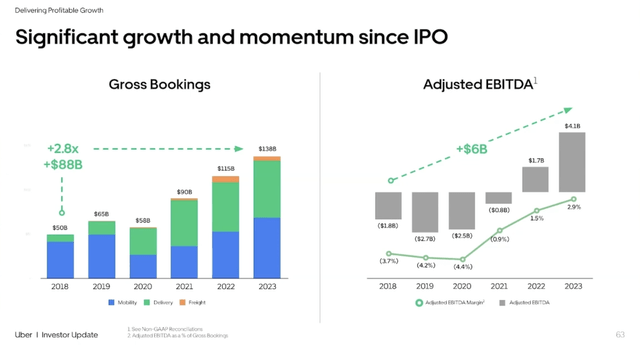
Uber demonstrated significant dexterity at the time to utilize its network capacity of drivers to expand its Delivery business and, at one time, also started leading its peers in Delivery Gross Bookings volume as seen in Exhibit B below.
Exhibit B: Gross bookings volume of Delivery segments of Uber versus its peers (Companies’ sources)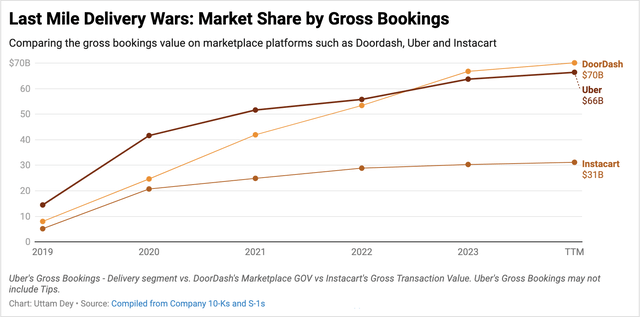
Currently, DoorDash continues to lead in Gross Bookings and is also rapidly investing in its Delivery business, more specifically in grocery deliveries, which I covered in recent coverage.
However, unlike DoorDash, what sets Uber miles apart is its ability to deliver profits while also rapidly growing its Delivery business. While Uber’s Delivery segment outpaced the company’s overall top line growth in terms of gross bookings and revenue, the Delivery segment also increased its EBITDA by 173% y/y in FY23 to $1.5 billion on an adjusted basis. At the same time, Uber’s Delivery segment also added an additional 37% to Uber’s FY23 adj. EBITDA, which ended last year at $4.1 billion. In a recent conference with Bernstein, Uber’s CFO explained how the company benefits from its Delivery business in further detail:
Beyond just the food delivery and groceries, we’re also now doing quite a bit in the retail space. And in areas that I think you may not as be as sort of directly aware of that is being done by Uber. If you order your iPhone from the Apple store for delivery, if you order Walmart to have it delivered from the Walmart website, it is our crew that is — it’s our earners that are delivering that. If you order McDonald’s from the app or from Uber Eats, it’s likely in both cases being delivered by Uber. So this allows us to drive the densification of the network.
And then lastly, I would highlight that, let’s go through some of the numbers here, right? Delivery grew 17% in the first quarter. And that’s on again, roughly half of our revenue. Of that growth, we saw almost just under 50% of that from new users coming on the platform. So increase in monthly actives.
The most interesting point from the excerpt above was the CFO’s insight on network density, where the company has already built out an extensive network of drivers via its Mobility segment, and Uber is benefiting from economies of scale from those prior investments. An example of dense networks can be seen in another slide that I have borrowed from its Investor Day conference in Exhibit C below.
Exhibit C: More countries generated profits for Uber in its Delivery business versus its Mobility business (2024 Investor Day Conference, Uber)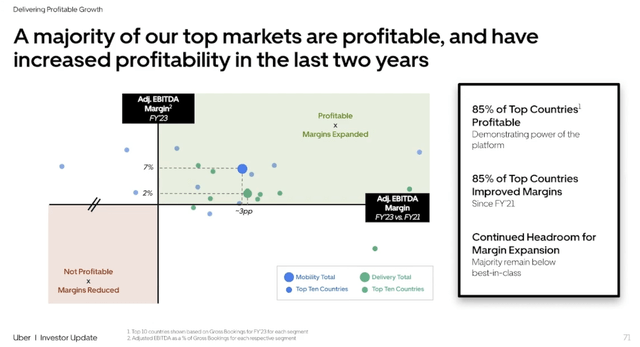
As can be seen in Exhibit C, Uber was able to generate ~4% midpoint EBITDA margins in the majority of countries that it operated in via its Delivery business versus its Mobility business.
And it does not appear the growth in delivery segment EBITDA is slowing relative to the company’s overall growth. In Q1 FY24, while Uber’s overall adjusted EBITDA grew 82% y/y to $1382 million in Q1, its Delivery segment grew adj. EBITDA by 83% to $528 million, still outpacing the overall adj. EBITDA.
In my opinion, Uber’s delivery business appears to be not just competing with its peers for Gross Bookings market share; the growth demonstrated by Uber’s Delivery segment looks solid and sustainable, giving the company strong legs to grow from here on. Uber appears to be doubling down on growing its Delivery business outside of organic growth rates by making some acquisitions in this space. Most recently, it acquired Delivery Hero’s foodpanda delivery business in Taiwan for $950 million in cash. In addition, Uber has also partnered with Waymo to allow residents in Phoenix to get their food delivered via Waymo’ fully autonomous vehicles.
While many market participants appear to be excited by Uber’s Mobility business and other edge technologies such as robotaxis, etc., I believe Uber’s Delivery business is already demonstrating robust top-line and bottom-line growth and will be the most important differentiator for Uber to stand out over the next 2-3 years.
Valuation Points To Robust Upside For Uber
My assumptions for building out Uber’s valuation model are based on the growth targets that were laid out in the 2024 Investor Day conference and were again categorically reiterated by the new CFO at the Bernstein conference I mentioned earlier. I have attached a screenshot of this below in Exhibit D.
Exhibit D: Uber’s 3 year operating model (2024 Investor Day Conference, Uber)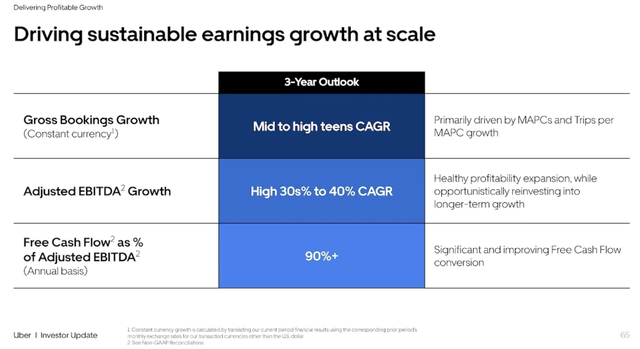
Based on the current growth rates and management projections, I expect Uber to grow their Gross Bookings on their platform by ~14.2% CAGR through FY26. Management has also indicated that they expect to maintain the current take rate on their platform, which I estimate at ~27.2% over the same time period, and therefore, revenue growth rates should be ~15% CAGR through FY26.
Over the same investment horizon, I estimate Uber’s adj. EBITDA will grow by ~35% CAGR. I believe this will be driven by the economies of scale and the network benefits that the company is already enjoying, as demonstrated by its Delivery business, which I have detailed earlier throughout this research note. This implies 5 points of margin expansion by next year or 8 points of expansion by FY26.
While Uber has announced a $7 billion share buyback program, I believe they will still need to hire talent and incentivize using stock-based compensation, so I am assuming the share buyback program will be offset by higher stock comps. Therefore, through FY26, I am assuming a ~2.5% share dilution rate. I am also assuming a 10% discount rate.
Exhibit E: Uber’s stock presents significant upside from current levels (Author)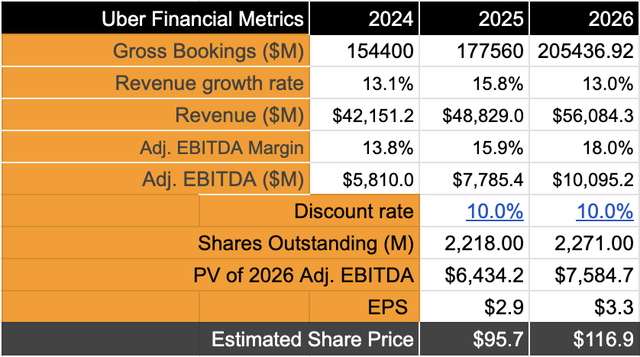
The implied growth rates in Uber’s earnings based on the assumptions in my model warrant a forward earnings multiple of 33–35x, since Uber would far outpace the long-term earnings growth rates of the S&P 500. My FY25 target price of ~$96 for Uber implies an upside of 35%, which is significant for investors.
Risks & Other Factors To Consider
An important risk that continues to impact the stock from time to time is the implication of regulation in terms of labor costs. Most delivery and mobility companies, such as Uber, are subject to constant scrutiny from regulators regarding the hourly wages paid to their delivery drivers.
In the EU, lawmakers have voted to keep the current set of regulations for gig workers more or less unchanged, which actually benefits Uber.
But in the U.S., Uber has been busy managing relatively stronger regulatory headwinds than in the EU. For example, in NYC, Uber has slotted drivers from joining the platform at a pace that it would like to increase due to wage laws, which may lead to distortions in customer wait times to connect to delivery drivers and/or receive deliveries via the app.
In other extreme cases, Uber may even decide to exit markets entirely if the cost of managing regulations exceeds its costs of operations in that regulatory environment. For example, in April, Uber indicated that they would exit Minneapolis after a minimum wage rule for drivers was voted for in the city. However, that has been pushed out to July.
So far, Uber’s management has demonstrated that it can manage regulatory headwinds, but its inability to do so in the future would impact growth rates in its booking volumes, revenues, EBITDA, etc.
Takeaway
While Uber’s mobility business is continuing to grow, the company’s Delivery business is posting robust growth rates not only in terms of its gross bookings but also in terms of its adjusted EBITDA. This is unique for the company, since its peers are still struggling to operate their own delivery-based businesses profitably, while Uber generates strong profits as it benefits from the platform network infrastructure laid out by its Mobility business.
There is a significant runway in the performance that Uber can yet deliver in terms of earnings and bookings, which provides a compelling case for the company’s valuation. Based on my evaluation of Uber, I recommend it as a Strong Buy.
Credit: Source link