

Win McNamee
The YieldMax TSLA Option Income Strategy ETF (NYSEARCA:TSLY) is sold as an income product that also retaining a (capped) interest in the stock’s upside. The managers pursue this goal through selling Tesla calls. Initially, I was surprised these single-stock focused option writing products exist. But then I discovered there is a whole series (a few weeks ago I reviewed the Coinbase-focused version of this product).
I’m increasingly interested in these option-related ETFs because they can grow to very large sizes. This one holds $732M in assets under management. There are also levered funds. I’m curious if these funds could create mispricings in derivatives markets and want to look into these more.
This one charges a management fee of 0.99%. That would be an enormous fee for an ETF granting exposure to large, liquid U.S. traded companies. In this case, it’s just one company.
However, because of the option overlay, replicating this strategy yourself involves a great deal of perusing options markets, potentially on a daily basis. Depending on the sums involved, it can make a lot of sense to have someone else take care of that – if you want to execute this strategy to begin with.
I can imagine people are buying and holding this ETF because its current distributions are astronomical. The fund website advertises a distribution rate of 60%!
This distribution rate is the annual yield you would pick up if the most recently declared distribution remained the same going forward. In practice, this always moves around, but it could be achieved when the share price remains stable and the volatility remains similar to the period when the distribution gains were generated. Most of the distributions with this type of product are derived from the call premia. With volatile stocks, especially with meme potential, like Tesla, the option premiums can be very high. TSLY launched in November 2022 at around ~$40 and has declined to the current $16.21:
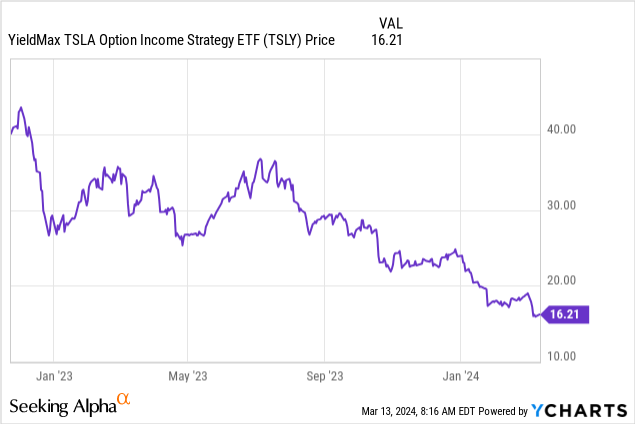
But along the way, dividend payouts so far have been very high:
| DISTRIBUTION PER SHARE | DECLARED DATE | EX DATE | RECORD DATE | PAYABLE DATE |
|---|---|---|---|---|
| 0.8109 | 03/05/2024 | 03/06/2024 | 03/07/2024 | 03/08/2024 |
| 0.8092 | 02/06/2024 | 02/07/2024 | 02/08/2024 | 02/09/2024 |
| 1.1130 | 01/04/2024 | 01/05/2024 | 01/08/2024 | 01/09/2024 |
| 1.2078 | 12/06/2023 | 12/07/2023 | 12/08/2023 | 12/13/2023 |
| 1.1692 | 11/07/2023 | 11/08/2023 | 11/09/2023 | 11/16/2023 |
| 1.1538 | 10/05/2023 | 10/06/2023 | 10/10/2023 | 10/16/2023 |
| 1.1698 | 09/07/2023 | 09/08/2023 | 09/11/2023 | 09/18/2023 |
| 1.6606 | 08/03/2023 | 08/04/2023 | 08/07/2023 | 08/14/2023 |
| 2.1322 | 07/06/2023 | 07/07/2023 | 07/10/2023 | 07/17/2023 |
| 1.6066 | 06/06/2023 | 06/07/2023 | 06/08/2023 | 06/15/2023 |
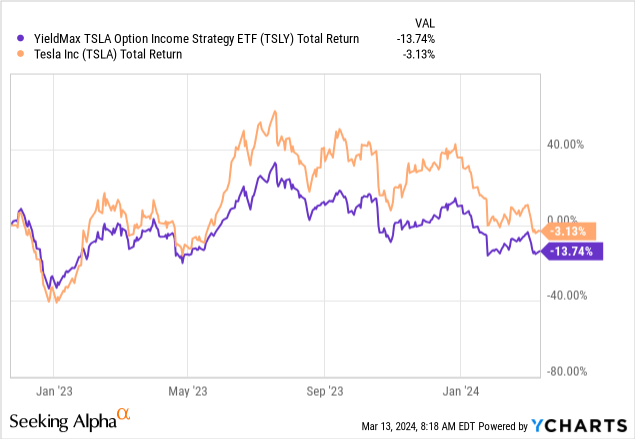
Which still resulted in negative total returns, slightly lagging Tesla stock itself:
So, how is this yield achieved?
The fund doesn’t actually buy Tesla stock. Instead, it sets up synthetic long positions. That means they’re using options positions that mimic the behavior of the stock. According to their summary prospectus, they do this by going long calls that expire in 6-months to 1-year and shorting a similar amount of 6-month puts that expire in 6-months to 1-year. It takes less capital to achieve exposure to Tesla this way, and the leftover capital can be invested in short-term treasuries. These currently have an attractive yield, which adds to the appeal of the strategy.
The call options the fund sells generally expire within one month or less. The fund aims to sell call options 5%-15% above the TSLA share price.
If I sell a TSLA call for $185 (5% up from $177) that’s $7. The $205 can be sold for $2.26 (15% up from $177). The $185 call translates into a 3.9% “yield” over the next 30 days. The $177 call translates into a 1.27% “yield” over the next 30 days. If you multiply the 3.9% forward yield by 12, that’s around ~46%. Add 4% treasury yield, and we’re getting quite close to the advertised distribution yield. Not entirely there, but the premia will vary depending on the implied volatility in TSLA’s stock.
It is somewhat surprising the ETF has underperformed TSLA stock since inception. Especially, because Tesla stock is down only 3% over that period. Intuitively, you would expect to make quite a bit of money selling call options on a stock that barely moves. I’m not going to reconstruct exactly how this happened. But if you look at the price graph of TSLY and TSLA featured above, you’ll notice the immediately deep drawdown after the ETF launched. Then Tesla went on a tear, and that’s a typical price path that’s very bad for covered-call sellers. The call selling barely protects against deep drawdowns in the short-term (the premium is negligible compared to a 40%+ drawdown. On the violent rebound, the call seller is, again, receiving negligible premia and capped upside, while the equity surges.
If you look at Tesla stock since the launch of this ETF, it repeats that pattern a few times. Violent rallies and steep selloffs. The stock spends very little time languishing around. The option premia compensates to an extent. A very calm stock will not yield 4% per month selling options that are 5% out-of-the money. But sometimes that’s not enough to compensate for the price path followed by the ETF. And please understand the risks of options before placing any trades.
Volatility nor implied volatility tend to be stable. The premium that can be generated selling options bounces around. Personally, I don’t love Tesla as an investment, but I’ve been wrong about that for so many years. If I loved Tesla as an investment, I’d rather simply own the stock.
Selling the 1-month covered-calls is something I’d be most interested if: 1) I thought the downside was limited from the current stock price (which I’m not convinced of); and 2) I figured the upside was limited and 3) I suspected excessive call buying from speculators.
Currently, implied volatility is around 47% for TSLA. Realized volatility is around 41.5% over the past 20-days. Tesla’s options have been one of the most traded options chain for quite some time. That’s still the case. However, the put volume is slightly above the call volume. The share price has been declining lately. Earnings (often accompanied by higher realized volatility) are already coming up in April.
Taking everything together, this doesn’t seem like a particular great time to sell covered calls on Tesla. Even if I was interested in this strategy, I’d likely pass for now and look for a better target.
Credit: Source link