




















Monty Rakusen/DigitalVision via Getty Images
It’s been just shy of three months since I wrote my latest cautionary piece on Trinity Industries Inc. (NYSE:TRN), and in that time the shares have returned about 11.5% against a gain of 2.8% for the S&P 500. So, had I thrown my caution to the wind in early June, I’d be up quite a bit. Never mind that the shares are still down about 15% since I sold the shares last December. It’s time to decide whether or not to buy back in today. Are the shares cheap, or are they expensive relative to what’s happening at the business? I’ll try to answer this question by looking at the latest financial figures and the valuation. Additionally, because everything’s contextual, I think it would be worthwhile to compare what an investor can earn by buying Trinity against the risk-free rate.
It’s “thesis statement” time again. I offer up a thesis statement near the beginning of each of my articles in order to give readers the opportunity to know my whole thesis in very broad strokes, so they can then decide whether or not they want to put up with my writing for an entire article. You’re welcome. While I think the business has improved massively from last year, there are some disturbing trends here in my view. Most particularly, the capital structure continues to deteriorate, which has led to a spike in interest expenses. Additionally, the level of profitability hasn’t yet returned to pre-pandemic levels. Finally, although the dividend yield is higher than it was when I last wrote about this name, it remains below the 20-year risk-free rate. Being paid less than the risk-free rate, while taking on more risk makes little sense to me. If there was room for the dividend to grow, that would be one thing. The problem is that the payout ratio is currently over 100%, though. In the relativistic world of investing, we seek the best risk-adjusted returns. In my view, investors who buy this stock today are making less return while taking on too much risk. I’ll be putting some more capital to work in long-dated government bonds, and I would recommend other investors do the same.
Financial Snapshot
The latest financial results have improved dramatically in my estimation. Revenue and net income are much higher now than they were last year, up 53.4%, and 613% respectively. The company managed this in spite of a 75% uptick in manufacturing costs and a 17% uptick in selling and administrative costs for leasing, and a 21% uptick in other selling and administrative costs. Additionally, this improvement in net income happened in spite of a 38.4% increase in interest expenses from last year to this.
Speaking of interest expenses, I think we need to think about the capital structure here. While the business has certainly improved, the balance sheet has not. There’s $293.5 million more debt outstanding today than there was this time last year, while cash has only increased by about $12.1 million. Things look even worse when we compare the current balance sheet to the pre-pandemic balance sheet. There’s about $1.217 billion more debt on the books today, but there’s about $11.1 million less cash. This company has a materially different, worse capital structure today than it had in 2019.
Writing of 2019, I absolutely couldn’t live with myself unless I compared the current year’s financial performance with the same period in 2019. Although revenue for the first six months of 2023 is higher by about 1.75%, net income has plummeted by about 68%. So, in my view, results are better than they were last year, but this company has not returned to pre-pandemic levels of profitability. In my view, less profitable, and more indebted is not a great combination, and I’d want to be compensated for taking on the risk of investing in such an enterprise. In my view, I’d be compensated by a cheap stock and/or high dividend.
Trinity Industries Financials (Trinity Industries investor relations)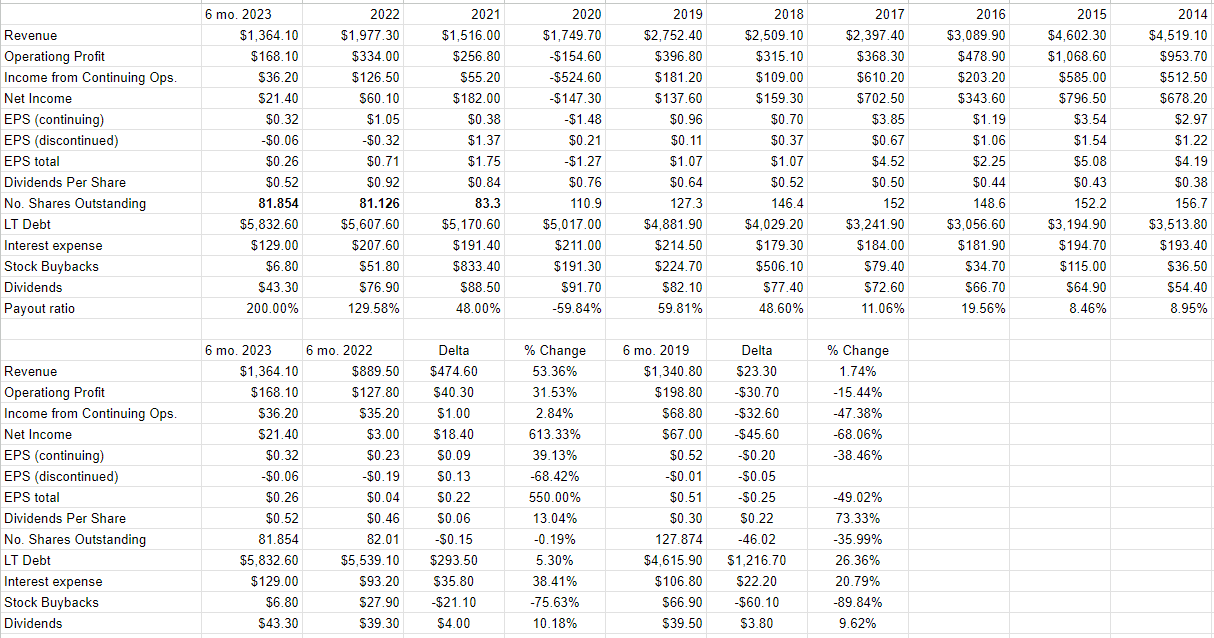
The Stock
As you know if you’re one of my regular readers, I’m about to drone on about the fact that I consider the business and the stock that supposedly represents the business to be two very different things. The business makes money by manufacturing rolling stock and then selling it or leasing it. The stock, on the other hand, is a piece of virtual paper that gets traded around in a public marketplace, and represents a claim on the future cash flows of the business. The stock moves up and down in price because the consensus on future cash flows changes rapidly. In addition, the stock is buffeted by forces that have little to do with the business such as a speech by a central banker. In case you’re still of the view that “we don’t buy stocks we buy businesses”, please consider the example of two investors. Investor “A” bought this stock on August 10, and Investor “B” bought the stock less than two weeks later, on August 23. As of this morning, poor old investor A is down about 6.4%, while investor B is basically flat on their investment. Since this all happened after the latest financial results were posted, nothing changed at the business to account for this 6.4% discrepancy in returns over such a short period of time. The difference came down to price paid. Since investor “B” bought the shares at a lower price, they did better.
I like lower priced stocks because they offer the greatest combination of higher returns at lower risk. They represent the potential for higher returns because any bit of good news may very well send shares higher when only bad news has been “priced in.” They represent lower risk because at some point, the market just expects terrible results, so the stock doesn’t have much farther to fall. This tendency on my part to buy when the crowd is most pessimistic is a way of playing against crowd expectations.
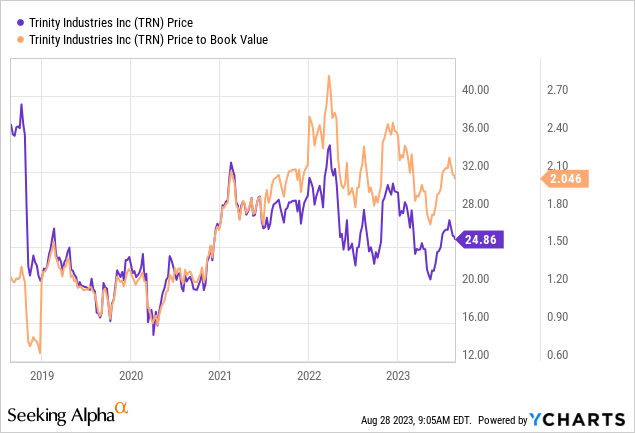
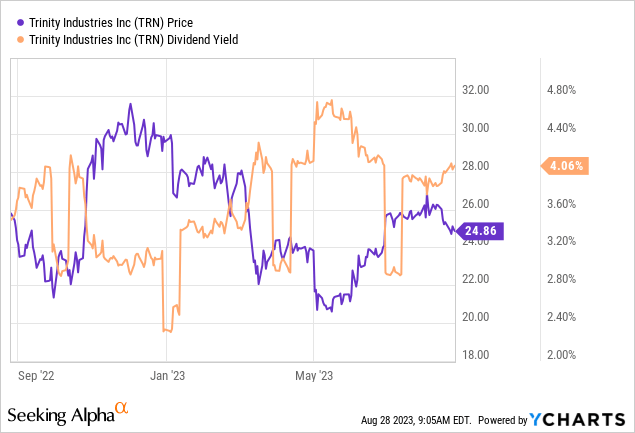
As my regular readers know, I measure “cheap” or “low expectations” in a few ways, ranging from the simple to the more complex. On the simple side, I like to look at the ratio of price to some measure of economic value, like sales, book value, and the like. I want to see a company trading at a discount to both its own history and the overall market. In case you don’t have your latest copy of “Doyle’s Almanac of Trades” in front of you, I’ll remind you that I bought Trinity when the shares were trading at a price to sales ratio of 1.28 times, a price to book value of 1.878 times, and was sporting a dividend yield of 3.94%. I then sold when the shares were trading at a price to sales ratio of 1.45 times, a price to book value of 2.49 and sporting a dividend yield of 2.99%.
Fast forward to the present, and here’s the lay of the land. The shares are now about 34% cheaper than my initial buy price on a price to sales basis, but about 9% more expensive on a price to book basis. Critically, the dividend yield is about 25% greater than it was when I sold, and is slightly higher than it was when I bought.
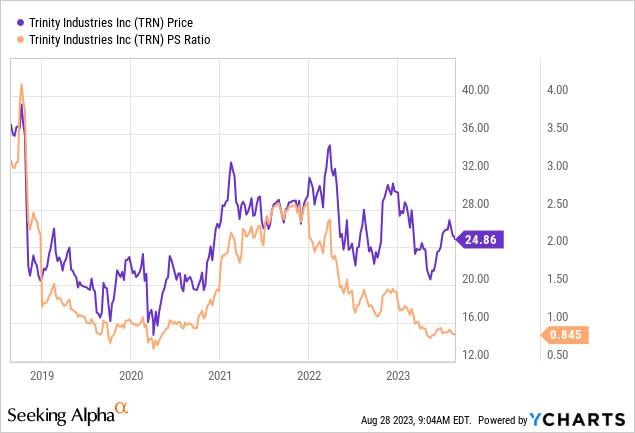
Source: YCharts
Source: YCharts
Source: YCharts
I like the fact that the dividend yield is much higher now than when I eschewed the shares, but it remains about 47 basis points below the 20-year Treasury Bond rate. Given that the current payout ratio is over 100%, I’m not very confident that the dividend has much more to grow from here. Although the dividend yield has improved markedly, it remains below the risk-free rate. Given the (in my view) unsustainable payout ratio, and given the high 20-year risk-free rate, I see no point in buying back into these shares yet. In my view, when an investor takes on the risk of owning a stock, they should make more money than they would from a government bond. At the moment, they don’t, so I see no relative value here. Thus, I’m going to continue to eschew these shares. If you were considering buying Trinity, I would recommend you consider a better risk-adjusted alternative like a government bond.
Credit: Source link