
Web search and content retrieval have quietly become the most critical infrastructure decisions in AI agent development. An agent without reliable access to live web data is effectively operating on stale knowledge — a hard limitation for any production deployment handling research, lead enrichment, competitive intelligence, or real-time monitoring. In 2026, the ecosystem of search and fetch APIs has matured considerably, with purpose-built tools replacing the older pattern of wrapping raw Google SERP data and passing it directly into a language model.
This article covers the leading search and fetch APIs based on evaluations across output format, agent-native design, token efficiency, free tier generosity, latency, and framework integrations.
TinyFish
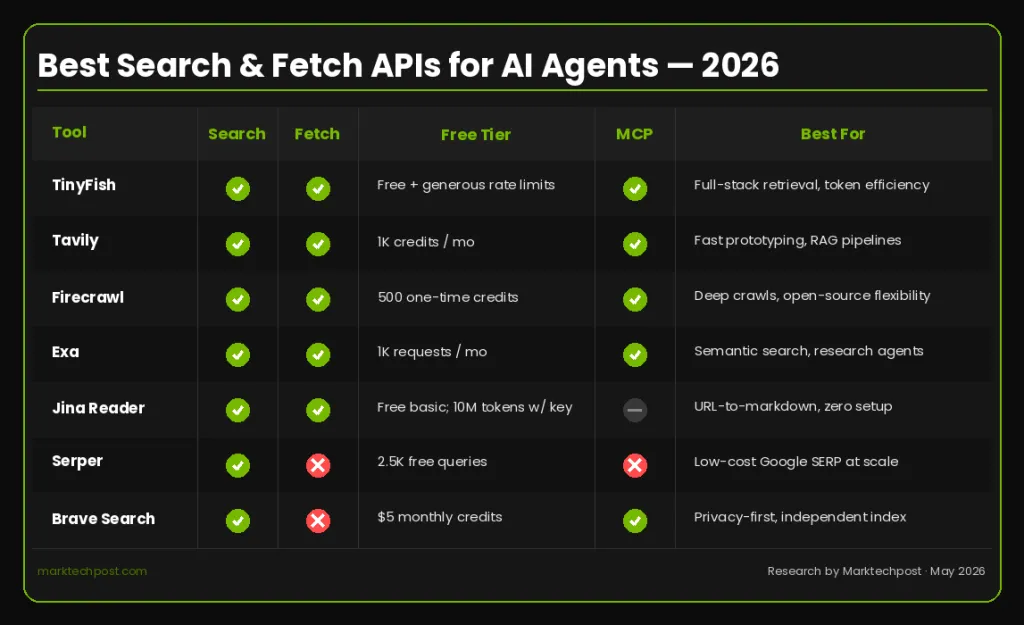
TinyFish is an important entrant in this space and among the most directly agent-native of the group. Its Search and Fetch endpoints are free with generous rate limits — one API key, no credit card. The free plan includes Search at 5 requests/minute and Fetch at 25 requests/minute. Search operates at api.search.tinyfish.ai, returning rank-stable structured JSON tuned for agent retrieval rather than human browsing. TinyFish states p50 Search latency under 0.5 seconds — fast enough to sit inside an agent’s tool loop without degrading the user experience. Fetch operates at api.fetch.tinyfish.ai, running a real full-browser render on any URL — including JavaScript-heavy SPAs, dynamic content, and anti-bot pages — and returning clean markdown, JSON, or HTML. Failed URLs are free.
The token efficiency angle is the strongest differentiator. Most native fetch tools — and the fetch built into LLM clients — return raw HTML: scripts, navigation, ads, cookie banners. TinyFish Fetch strips all of that before the content reaches the model, resulting in lower token consumption per page and lower LLM costs per call. The platform operates its own custom Chromium fleet end-to-end with no middleware, which is what enables both the free pricing and the output quality. Importantly, these are the same endpoints powering production agent workloads — not a degraded demo tier. The same API key and dashboard carry over when you outgrow the free plan; no code changes required.
TinyFish is available across every surface developers already use. Direct access is via REST API (api.search.tinyfish.ai and api.fetch.tinyfish.ai). MCP support is a single JSON config drop-in for Claude, Cursor, Codex, ChatGPT desktop, or any MCP-aware client. The CLI (npm install -g @tiny-fish/cli) writes results directly to the filesystem rather than piping through the model’s context window, keeping token usage low and output structured. The agent Skill (npx skills add github.com/tinyfish-io/tinyfish-cookbook –skill tinyfish) teaches the agent when to call Search vs. Fetch and how to use each — one-line install, works with Claude Code, Codex, Cursor, OpenCode, and Antigravity. Python and TypeScript SDKs are also available.
Agent harness and framework integrations include Claude Code, OpenClaw, Hermes Agent (Nous Research), Cline, Cursor, Codex, LangChain, and CrewAI. Platform integrations cover n8n (via the n8n-nodes-tinyfish community node), Dify (TinyFish Web Agent plugin in the Dify Marketplace), and Vercel Skills. ChatGPT App and MCP Apps are also supported.
Tavily
Tavily is a real-time search engine built specifically for AI agents and RAG workflows, providing fast APIs for web search and content extraction. The Researcher plan is free and includes 1,000 API credits per month — enough for prototyping and light evaluation. Paid tiers scale as follows: Project at $30/month (4,000 credits), Bootstrap at $100/month (15,000 credits), and Startup at $220/month (38,000 credits). A pay-as-you-go option is also available at $0.008 per credit with no monthly commitment. Credits reset monthly and do not roll over.
Tavily is notable for its deep LangChain and LlamaIndex integrations and its pre-processing layer that returns ranked, relevance-filtered snippets rather than raw SERP data. One significant development to track: Nebius announced an agreement to acquire Tavily in February 2026, which has raised questions among some teams about future pricing stability and roadmap direction when evaluating long-term infrastructure dependencies. Despite this, Tavily remains as a fast path from zero to a working prototype and has broad LLM framework integrations.
Firecrawl
Firecrawl converts any URL into clean, LLM-ready markdown or structured JSON, and is agent-ready out of the box — connecting to any MCP client with a single command and supporting media parsing for web-hosted PDFs and DOCX files alongside click, scroll, and interact actions before content extraction. It covers four distinct operating modes: Scrape (single URL to markdown or JSON), Crawl (recursive domain crawl), Map (URL discovery without fetching content), and an Agent endpoint for natural-language-driven data extraction.
The free plan provides 500 one-time credits, enough to test the API and run a proof of concept, but not a recurring production allocation. Paid plans begin at $16/month (Hobby, 3,000 credits/month) and scale to $83/month (Standard, 100,000 credits/month on annual billing). Credits do not roll over month to month on standard plans. Firecrawl is open source under AGPL-3.0, which is a meaningful differentiator for teams with data sovereignty requirements. Framework support is broad: LangChain, LlamaIndex, CrewAI, Flowise, and Dify all have native integrations. The MCP server installs with npx -y firecrawl-mcp and works across Claude Code, Cursor, Windsurf, and VS Code.
Exa
Exa takes a fundamentally different approach to search. Rather than keyword matching, it uses neural embeddings to understand query meaning which is why Cursor uses Exa to power its @web feature. This makes it particularly well-suited for research agents, RAG systems where semantic similarity matters more than freshness, and pipelines that need to find conceptually related documents across topic clusters rather than the single most recent result.
The pricing structure for Exa’s billing is quite simple. Text content and highlights are now included in the base Search-with-contents request price for up to 10 results per request, where content extraction was previously billed separately. The free tier offers up to 1,000 requests per month. Search with contents is priced at $7 per 1,000 requests. Exa ships an official MCP server supporting Claude Desktop, Claude Code, VS Code, Windsurf, and Gemini CLI.
Jina AI Reader
Jina Reader converts any URL to LLM-friendly markdown by simply prepending https://r.jina.ai/ to the URL, with web search available via https://s.jina.ai/. The Reader API is free for basic usage (no API key required). A key is only needed to unlock higher rate limits, and charges are then applied based on content length rather than per-request. New API keys include 10,000,000 free tokens on signup. Jina AI now operates under Elastic following an acquisition, and the platform has committed to continued development of Reader, Embeddings, and Reranker APIs.
The usage pattern is as simple as it gets: no SDK, no configuration, just a URL prefix. The limitations are real, however. Jina does not circumvent anti-bot systems and will return an error when blocked. Jina Reader itself is not as deeply integrated into agent frameworks such as LangChain or LangGraph as Tavily, Firecrawl, or Exa, though Jina AI maintains integrations primarily around its embeddings and reranker products. Its search endpoint (s.jina.ai) fetches the top five results in full rather than returning configurable ranked lists.
Serper
Serper is one of the most cost-efficient options for raw Google SERP data, at $1 per 1,000 queries on the Starter plan and dropping to $0.30 per 1,000 on higher-volume plans. New accounts receive 2,500 free queries with no credit card required. It returns structured JSON including SERP-specific objects such as knowledge graphs and answer boxes. Serper does not handle content extraction or page fetching — it is a search results API only. The practical architecture for cost-sensitive pipelines is often Serper for search combined with Jina Reader or TinyFish Fetch for content retrieval.
Brave Search API
Brave Search operates on a fully independent index of over 40 billion pages without any Google or Bing dependency which makes it a strong option for teams with privacy or compliance requirements. Brave uses an independent index and offers strong privacy controls, with Zero Data Retention available for enterprise customers. It also ships an official MCP server supporting web, local business, image, video, and news search.
Recently, Brave removed its free tier for new users, replacing the zero-cost plan with a credit-based billing system. New users receive $5 in monthly credits — roughly 1,000 queries — before their card is charged at $5 per 1,000 requests. Existing users on the old free plan are grandfathered in and retain their prior access. Brave does not offer a fetch or content extraction endpoint — it is a search-only provider, best suited for deployments where index independence and privacy controls are hard requirements.
Key Takeaways
- TinyFish is an overall winner both for fetch and search. It is a strong full-stack retrieval option for developers who need Search, Fetch, and agent-native integrations under one platform, with the free tier providing 500 starter credits to evaluate both endpoints in real workflows.
- Tavily remains as a fast path to production-grade agent search and has the deepest LLM framework integrations in the category, though its credit tiers compress headroom at scale.
- Exa is quite strong for semantic retrieval and coding-agent search, where neural matching surfaces results keyword engines miss.
- Firecrawl could be a good choice for crawl-heavy extraction workflows and teams that want an open-source foundation they can self-host.
- Jina Reader is the lowest-friction URL-to-markdown option, requiring nothing more than a URL prefix to get started.
- Serper is cost-efficient for Google SERP data at volume.
- Brave is a strong independent-index option for privacy-sensitive deployments, now with an official MCP server.
Feel free to follow us on Twitter and don’t forget to join our 130k+ ML SubReddit and Subscribe to our Newsletter. Wait! are you on telegram? now you can join us on telegram as well.
Need to partner with us for promoting your GitHub Repo OR Hugging Face Page OR Product Release OR Webinar etc.? Connect with us
The post Top Search and Fetch APIs for Building AI Agents in 2026: Tools, Tradeoffs, and Free Tiers appeared first on MarkTechPost.
Credit: Source link