
Together AI on October 19, 2026, launched Together Post-Training, a service for building custom models through user-defined reinforcement learning and supervised fine-tuning loops, with introductory pricing of $9 per GPU-hour of B200 usage for the first six weeks.
Launch Models, Pricing, and Early Access
The service is designed for building custom models both from environment rewards via RL and from supervision data via SFT. Customers define the training loop, including data, environments, and agentic harnesses, and can add steps such as logging or external benchmarking, while Together co-optimizes the underlying systems and infrastructure for model quality and training speed. Together said it built the service because RL infrastructure is growing more complex and many companies that could benefit from post-training never start, or start and stall, under the infrastructure burden.
The service launches with open-weight models Muse Spark Open, GLM 5.3, Kimi K3, and Qwen 3.8-27B, and Together said it will expand the selection in the coming weeks to cover both frontier LLMs and efficient smaller models. For the first six weeks, the service is offered at a reduced price of $9 per GPU-hour of B200 usage.
Before the launch, Together granted early access to a select group of organizations over the past few months. Adit Jain, a researcher at Collinear AI, said his team had collaborated with the company since its Post-Training beta launched in April 2026.
Dedicated Model Resources and GPU-Minute Billing
All experiments run on what Together calls Model Resources: GPU allocations dedicated to a single customer, with no competition from other users’ requests for priority. Each Model Resource can hold one or several Training Sessions, with each session corresponding to a single experiment on the same base model, for example one set of LoRA adapters. Together said the dedicated allocations also make it possible to run full-weight fine-tuning beyond LoRA when adapting models to large knowledge-intensive tasks.
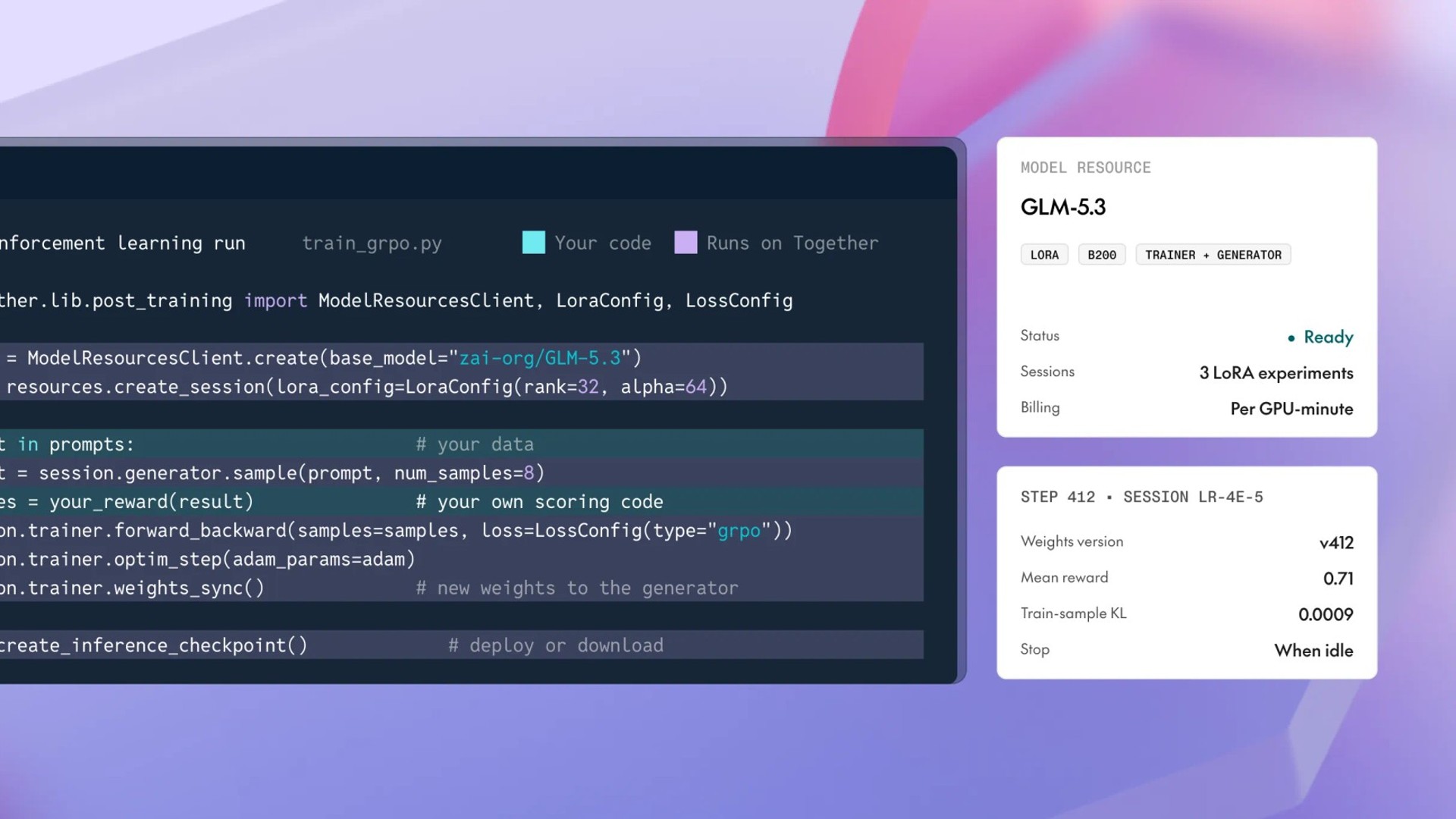
Each session contains a Trainer instance responsible for forward and backward steps and weight updates, alongside Generator instances that execute rollouts from the policy. For supervised fine-tuning, a model resource can start with zero generators to save costs. Users decide when trainer parameters are sent to the generator, and asynchronous RL is supported for high GPU utilization of both components, especially during long agentic rollouts.
Users can run LoRA training, including multiple LoRA adapters sharing the same GPU capacity, as well as full-weight experiments for select models. The service supports standard losses including cross-entropy, GRPO, CISPO, and DPPO, and users can also compute a custom training objective locally and send its gradients to the Trainer.
According to the post-training documentation, the main SDK surface consists of a create method that provisions a model resource (the billed unit) and a create_session method that attaches a training session to it, followed by per-step calls: sample_batch to generate completions for scoring, forward_backward to compute the loss and backpropagate gradients, optim_step to update weights, and weights_sync to publish new weights to generator replicas. SFT and DPO skip sample_batch and weights_sync because they do not sample completions.
Model resources are billed per GPU-minute, and Together said overall training costs drop below token-based pricing as soon as experiments scale up. The documentation contrasts the model with the company’s standard fine-tuning service, which bills per token processed and runs as a job that proceeds to completion without mid-run control; post-training users can inspect per-step metrics, change the learning rate, reshuffle data, or stop a run on their own logic.
Training Stability and the Deployment Path
Together said the service eliminates numerous sources of policy drift between training and inference engines, where slight numeric mismatches from identical weights can cause an RL run to underperform or collapse, using standard techniques such as Rollout Routing Replay alongside optimizations drawn from its training-stability research. The company said its rollout engines draw on the same optimizations as its serving stack, with intelligent caching and routing for multi-turn agents and optimized parallelism and sequence packing accelerating both SFT and RL steps.
After training, the company now supports multi-LoRA adapter serving in Dedicated Model Inference, letting users swap adapters within a single GPU deployment instead of starting a separate production deployment for each run. Together said each training checkpoint retains its quality in serving even after switching from multi-LoRA sampling to merged inference in FP4 precision.
The documentation lays out a train, evaluate, and productionize workflow: train several adapters against one frozen base model, attach the candidates to a single multi-LoRA deployment and compare them by naming a different adapter in each request, then deploy the winner in merged mode on its own deployment. For GLM-5.3 and Kimi-K3, adapters must first go through a preparation step for FP4 inference.
Onboarding, Tinker Migration, and Early Users
Getting started requires the latest Together SDK and the documentation. Together published cookbooks in a post-training-cookbook repository on GitHub covering GRPO training on the GSM8K benchmark, DPO implemented as a custom loss, and training multiple LoRA adapters within the same model resource; the documentation describes the cookbook as a Python library of ready-made loops whose notebooks walk through GRPO, SFT, and multi-adapter training on one model resource using the SDK’s asynchronous calls. For teams with an existing setup on the Tinker API, a migration path replaces one import line with import together.post_training.tinker as tinker, detailed in a migration guide.
Among the early-access users, Anthony Li, associate director of data science at Deel, said the platform’s control and flexibility let his team start running real RL experiments within a couple of hours and run up to five concurrent RL experiments on the same GPU capacity. Oliver Normand, founding engineer at Jack & Jill, said his team post-trained a model that predicts which candidates a hiring manager will want to meet, a core step in the search performed by the company’s Jill recruiting agent, and matched a closed-source model’s quality in offline evaluations using an open-source model that is significantly cheaper to serve; he said Together’s forward-deployed engineers wrote the scripts that produced the team’s first results.
Collinear AI’s Jain said seamless self-onboarding made it easy to launch full-scale agentic RL runs. Together’s forward-deployed engineers work alongside customers across the full post-training lifecycle, from selecting an open model and agent harness through data and training environments, evaluations, and shipping an optimized endpoint.
Credit: Source link