Recommender systems are essential in modern digital platforms, enabling personalized user experiences by predicting preferences based on interaction data. These systems help users navigate the vast online content by suggesting relevant items critical to addressing information overload. By analyzing user-item interactions, they generate recommendations that aim to be accurate and diverse. However, as the digital ecosystem evolves, so do user preferences, underscoring the need for methods that adapt to these changes while promoting personalization and diversity.
One major challenge in recommendation systems is the tendency to create information cocoons, where users are repeatedly exposed to similar content, limiting their exploration of new or diverse options. Balancing the exploration of fresh, unexpected items with the exploitation of known user preferences is complex but necessary. This balance requires sophisticated models capable of simultaneously managing hierarchical structures inherent in user-item relationships and aligning semantic relationships from textual data. Existing approaches, though effective to some extent, need more adaptability to address these intricacies.
Current methodologies include collaborative filtering, which focuses on user interaction data to predict preferences, and hyperbolic geometric models, which excel at capturing hierarchical relationships. Its inability to integrate semantic insights from textual descriptions limits collaborative filtering. While addressing some hierarchical challenges, hyperbolic models need help with semantic alignment due to their reliance on Euclidean encoders for text data. These limitations reduce the models’ robustness, adaptability, and ability to enhance diversity in recommendations.
The researchers, associated with Snap Inc., Yale University, and the University of Hong Kong, introduced HARec, a hyperbolic representation learning framework designed to tackle these challenges. HARec innovatively combines hyperbolic geometry with graph neural networks (GNNs) and large language models (LLMs). Using a hierarchical tree structure, HARec allows users to customize the balance between exploration and exploitation in recommendations. This user-adjustable mechanism ensures a dynamic and tailored approach, setting HARec apart from traditional systems.
HARec’s methodology is a comprehensive blend of hyperbolic graph collaborative filtering and semantic embedding integration. The framework begins by generating hyperbolic embeddings for user-item interactions using a Lorentz representation model, which excels at modeling tree-like, hierarchical structures. These embeddings are aligned with semantic embeddings derived from textual descriptions through pre-trained LLMs such as BERT. The semantic data undergoes dimensional adjustment and is projected into hyperbolic space to align with collaborative embeddings. This alignment is crucial to integrating both semantic and hierarchical insights seamlessly.
Further, the hierarchical tree structure organizes user-item preferences into layers, with higher layers representing broader interests and lower layers focusing on specific preferences. This setup facilitates dynamic navigation through user preferences. Exploration and exploitation are managed via parameters controlling the degree of recommendation diversity. For instance, temperature and hierarchy level parameters allow users to determine how many recommendations should include novel or familiar content. This flexibility empowers users to influence the trade-off between diversity and specificity in recommendations.
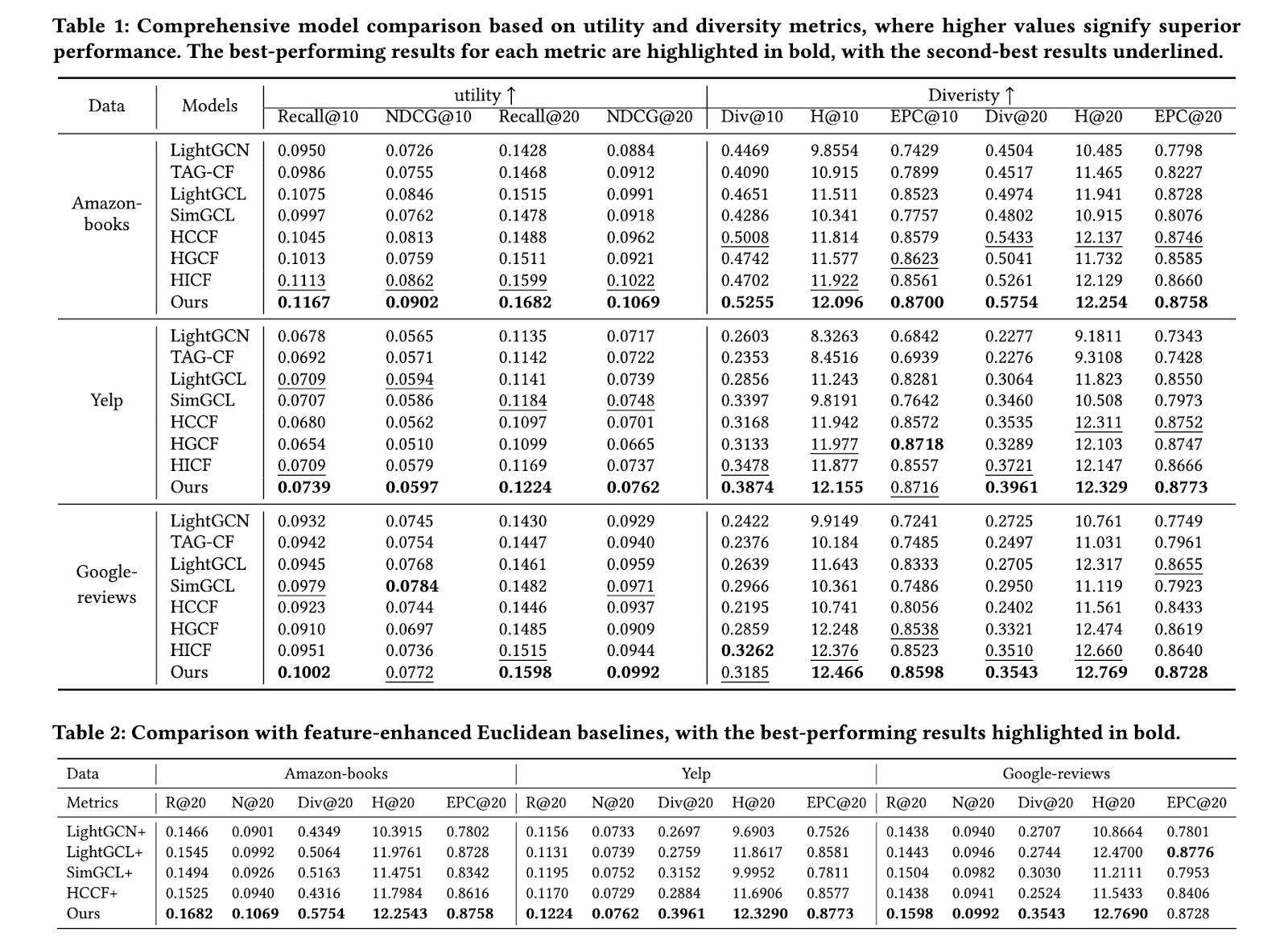
Extensive experiments validated HARec’s effectiveness. Using datasets like Amazon books, Yelp, and Google reviews, the researchers measured utility and diversity metrics, demonstrating HARec’s superiority over existing models. In utility metrics, HARec achieved a Recall@20 score of 16.82% for Amazon books, outperforming the best baseline (11.13%) by a significant margin. Similarly, the NDCG@20 score reached 10.69%, reflecting its ability to prioritize relevant recommendations effectively. Regarding diversity, HARec marked an 11.39% improvement in metrics such as Shannon Entropy and Expected Popularity Complement, highlighting its capability to enhance recommendation variety.
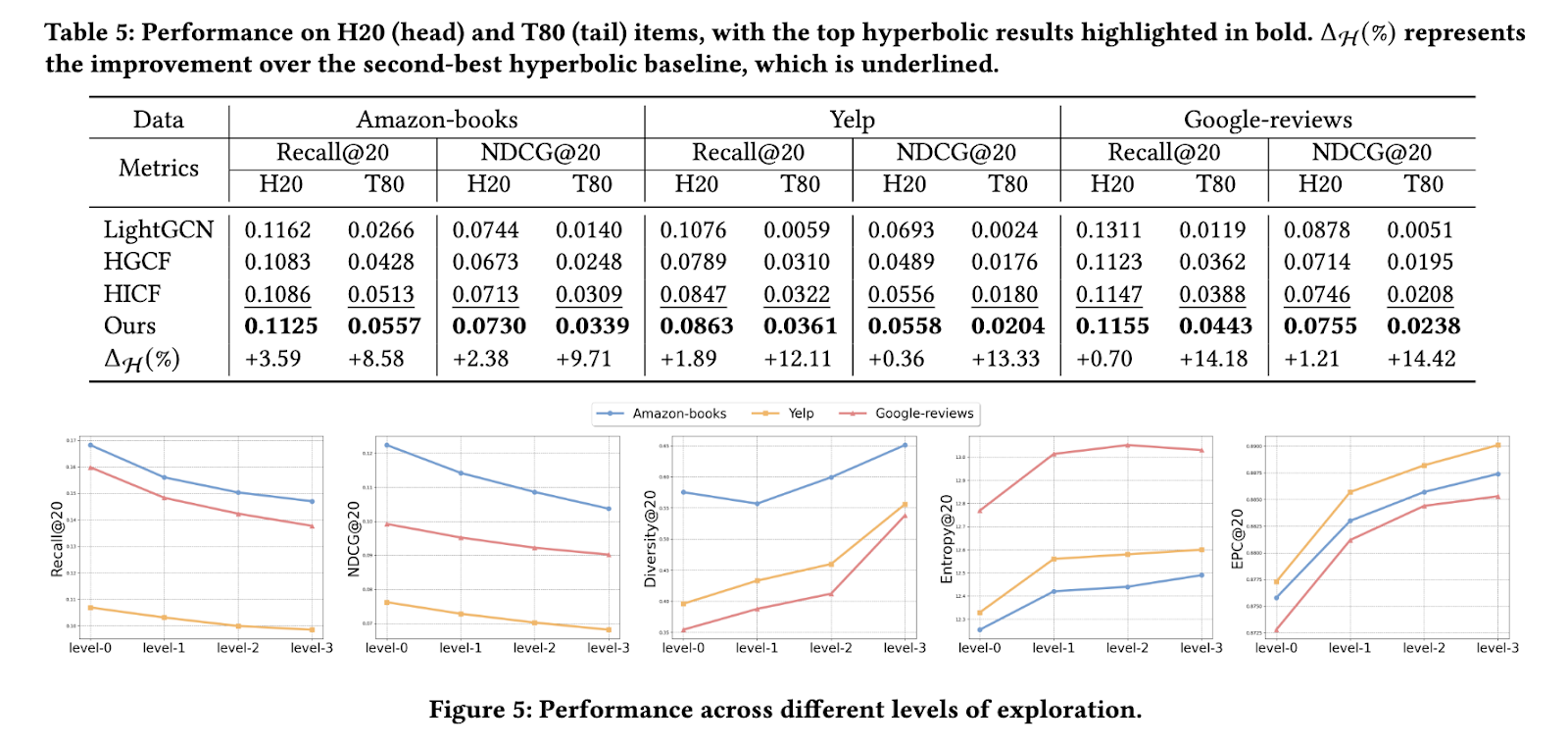
Further analysis showed HARec’s strength in addressing the cold-start problem, which affects items with limited interaction data. HARec demonstrated a performance boost of over 14% for tail items in Recall@20 compared to baseline hyperbolic models, underscoring its ability to incorporate semantic alignment effectively. The researchers also conducted ablation studies to evaluate individual components of the framework. Results indicated that removing either the hyperbolic margin ranking loss or the semantic alignment loss significantly reduced the model’s utility metrics, proving the necessity of these innovations.
HARec represents a substantial advancement in recommender systems by addressing the dual challenges of exploration and exploitation. Its integration of hyperbolic space and semantic alignment offers a novel solution to hierarchical modeling and semantic understanding. The user-adjustable framework ensures adaptability and relevance, making HARec a versatile tool in personalized recommendation systems. By achieving state-of-the-art results in both accuracy and diversity, HARec sets a new benchmark for balancing user preferences and exploration in digital content platforms.
Check out the Paper. All credit for this research goes to the researchers of this project. Also, don’t forget to follow us on Twitter and join our Telegram Channel and LinkedIn Group. If you like our work, you will love our newsletter.. Don’t Forget to join our 55k+ ML SubReddit.
🎙️ 🚨 ‘Evaluation of Large Language Model Vulnerabilities: A Comparative Analysis of Red Teaming Techniques’ Read the Full Report (Promoted)

Nikhil is an intern consultant at Marktechpost. He is pursuing an integrated dual degree in Materials at the Indian Institute of Technology, Kharagpur. Nikhil is an AI/ML enthusiast who is always researching applications in fields like biomaterials and biomedical science. With a strong background in Material Science, he is exploring new advancements and creating opportunities to contribute.
Credit: Source link