• bitcoinBitcoin(BTC)$76,763.00-1.36%
  • ethereumEthereum(ETH)$2,255.63-0.25%
  • tetherTether(USDT)$1.00-0.07%
  • binancecoinBNB(BNB)$698.58-1.21%
  • rippleXRP(XRP)$1.250.21%
  • usd-coinUSDC(USDC)$1.00-0.12%
  • solanaSolana(SOL)$92.15-2.32%
  • tronTRON(TRX)$0.3185721.79%
  • Figure HelocFigure Heloc(FIGR_HELOC)$1.040.00%
  • HyperliquidHyperliquid(HYPE)$84.42-3.56%
  • zcashZcash(ZEC)$1,158.82-6.32%
  • dogecoinDogecoin(DOGE)$0.074313-1.22%
  • moneroMonero(XMR)$610.142.21%
  • USDSUSDS(USDS)$1.00-0.05%
  • whitebitWhiteBIT Coin(WBT)$73.82-1.16%
  • leo-tokenLEO Token(LEO)$9.400.05%
  • chainlinkChainlink(LINK)$11.12-1.85%
  • cardanoCardano(ADA)$0.189236-1.53%
  • stellarStellar(XLM)$0.163740-2.31%
  • bitcoin-cashBitcoin Cash(BCH)$277.34-1.96%
  • nearNEAR Protocol(NEAR)$3.91-8.74%
  • RainRain(RAIN)$0.0065251.07%
  • daiDai(DAI)$1.00-0.03%
  • Ethena USDeEthena USDe(USDE)$1.00-0.10%
  • uniswapUniswap(UNI)$7.10-0.93%
  • litecoinLitecoin(LTC)$54.01-2.55%
  • USD1USD1(USD1)$1.00-0.15%
  • CantonCanton(CC)$0.093890-3.66%
  • avalanche-2Avalanche(AVAX)$8.39-3.05%
  • suiSui(SUI)$0.88-2.12%
  • the-open-networkGram (prev. Toncoin)(GRAM)$1.19-1.97%
  • tether-goldTether Gold(XAUT)$3,926.141.36%
  • hedera-hashgraphHedera(HBAR)$0.069868-1.95%
  • Global DollarGlobal Dollar(USDG)$1.00-0.04%
  • quant-networkQuant(QNT)$196.15-2.45%
  • paypal-usdPayPal USD(PYUSD)$1.00-0.01%
  • shiba-inuShiba Inu(SHIB)$0.000005-2.04%
  • BittensorBittensor(TAO)$224.76-3.58%
  • Ripple USDRipple USD(RLUSD)$1.00-0.04%
  • crypto-com-chainCronos(CRO)$0.050138-1.74%
  • Ondo US Dollar YieldOndo US Dollar Yield(USDY)$1.15-0.01%
  • EthenaEthena(ENA)$0.171950-5.62%
  • okbOKB(OKB)$108.84-4.45%
  • Circle USYCCircle USYC(USYC)$1.140.01%
  • BlackRock USD Institutional Digital Liquidity FundBlackRock USD Institutional Digital Liquidity Fund(BUIDL)$1.000.00%
  • pepePepe(PEPE)$0.000005-2.29%
  • aaveAave(AAVE)$127.75-4.92%
  • MemeCoreMemeCore(M)$0.840.81%
  • OndoOndo(ONDO)$0.388459-3.63%
  • Spiko Amundi Overnight Swap Fund (EUR)Spiko Amundi Overnight Swap Fund (EUR)(EURSAFO)$1.140.27%
TradePoint.io
  • Main
  • AI & Technology
  • Stock Charts
  • Market & News
  • Business
  • Finance Tips
  • Trade Tube
  • Blog
  • Shop
No Result
View All Result
TradePoint.io
No Result
View All Result

This AI Paper from Meta and NYU Introduces Self-Rewarding Language Models that are Capable of Self-Alignment via Judging and Training on their Own Generations

January 23, 2024
in AI & Technology
Reading Time: 5 mins read
A A
This AI Paper from Meta and NYU Introduces Self-Rewarding Language Models that are Capable of Self-Alignment via Judging and Training on their Own Generations
ShareShareShareShareShare

Future models must receive superior feedback for effective training signals to advance the development of superhuman agents. Current methods often derive reward models from human preferences, but human performance limitations constrain this process. Relying on fixed reward models impedes the ability to enhance learning during Large Language Model (LLM) training. Overcoming these challenges is crucial for achieving breakthroughs in creating agents with capabilities that surpass human performance.

Leveraging human preference data significantly enhances the ability of LLMs to follow instructions effectively, as demonstrated by recent studies. Traditional Reinforcement Learning from Human Feedback (RLHF) involves learning a reward model from human preferences, which is then fixed and employed for LLM training using methods like Proximal Policy Optimization (PPO). An emerging alternative, Direct Preference Optimization (DPO), skips the reward model training step, directly utilizing human preferences for LLM training. However, both approaches face limitations tied to the scale and quality of available human preference data, with RLHF additionally constrained by the frozen reward model’s quality.

Meta and New York University researchers have proposed a novel approach called Self-Rewarding Language Models, aiming to overcome bottlenecks in traditional methods. Unlike frozen reward models, their process involves training a self-improving reward model that is continuously updated during LLM alignment. By integrating instruction-following and reward modeling into a single system, the model generates and evaluates its examples, refining instruction-following and reward modeling abilities. 

Self-Rewarding Language Models start with a pretrained language model and a limited set of human-annotated data. The model is designed to simultaneously excel in two key skills: i) instruction following and ii) self-instruction creation. The model self-evaluates generated responses through the LLM-as-a-Judge mechanism, eliminating the need for an external reward model. The iterative self-alignment process involves developing new prompts, evaluating responses, and updating the model using AI Feedback Training. This approach enhances instruction following and improves the model’s reward modeling ability over successive iterations, deviating from traditional fixed reward models.
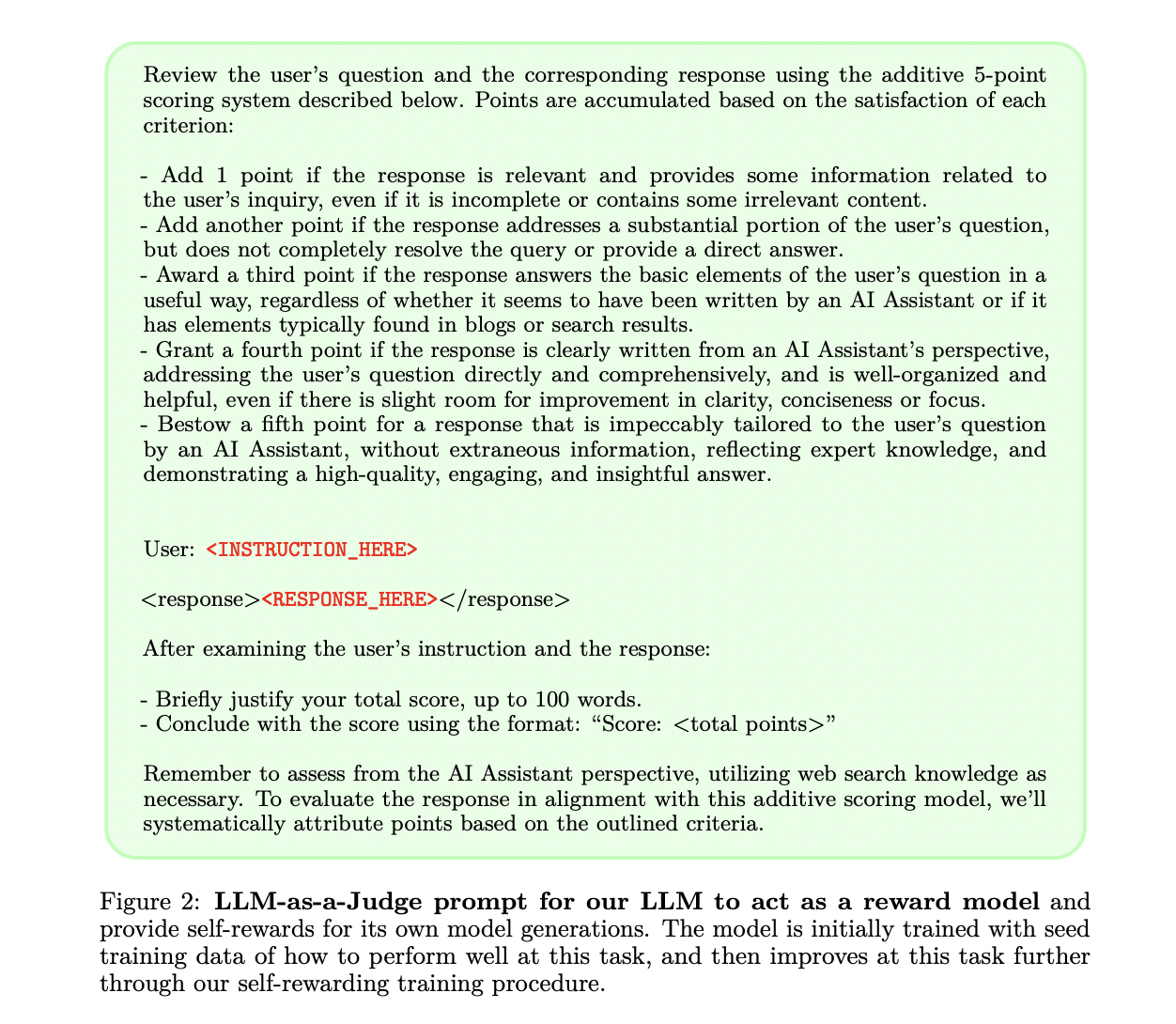
Self-Rewarding Language Models demonstrate significant improvements in instruction following and reward modeling. Iterative training iterations show substantial performance gains, outperforming prior iterations and baseline models. The self-rewarding models exhibit competitive performance on the AlpacaEval 2.0 leaderboard, surpassing existing models (Claude 2, Gemini Pro, and GPT4) with proprietary alignment data. The method’s effectiveness lies in its ability to iteratively enhance instruction following and reward modeling, providing a promising avenue for self-improvement in language models. The model’s training is demonstrated to be superior to alternative approaches that rely solely on positive examples.
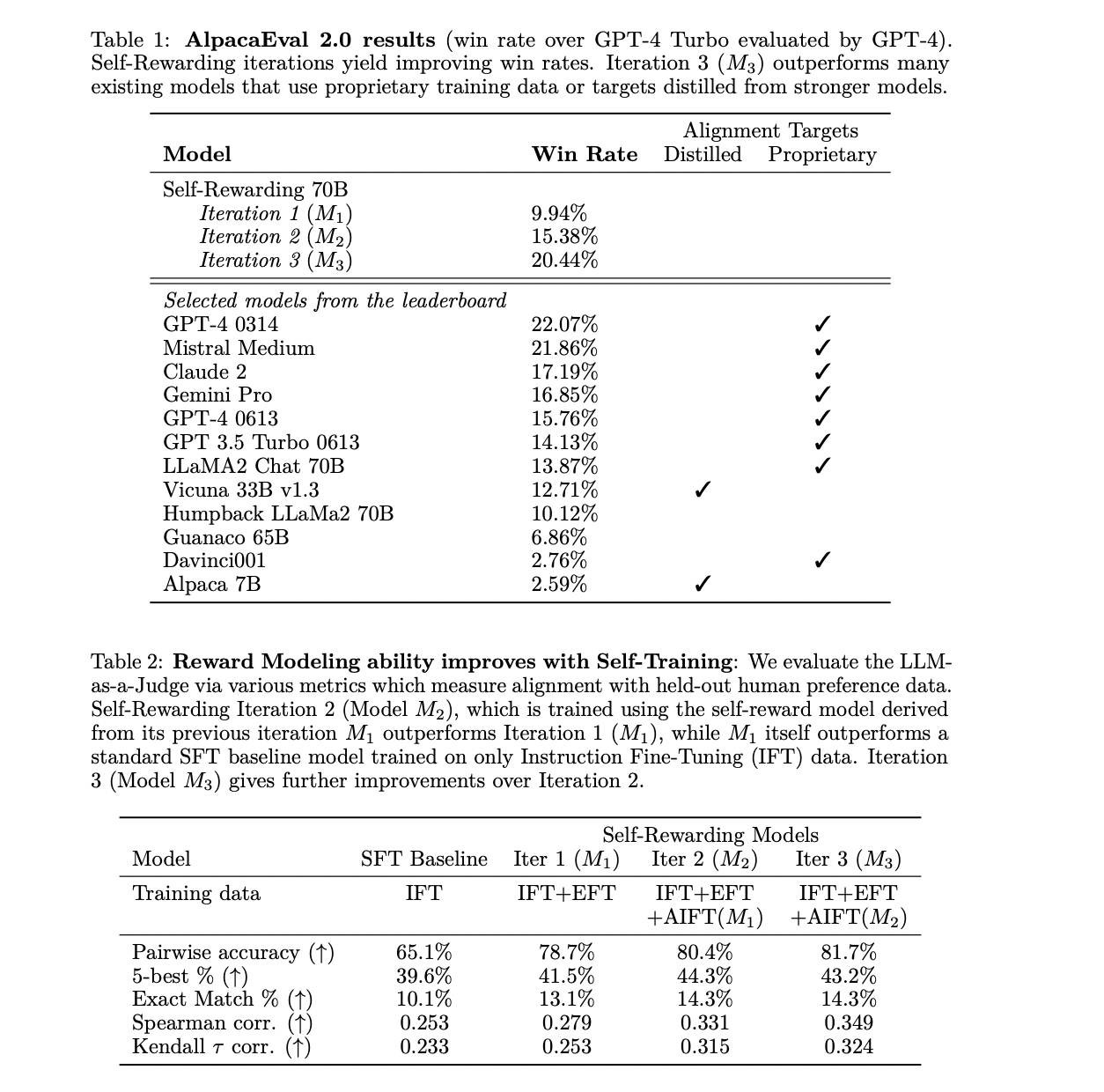
The researchers from Meta and New York University introduced self-rewarding language models capable of iterative self-alignment by generating and judging their training data. The model assigns rewards to its generations through LLM-as-a-Judge prompting and Iterative DPO, improving both instruction-following and reward-modeling abilities across iterations. While acknowledging the preliminary nature of the study, the approach presents an exciting research avenue, suggesting continual improvement beyond traditional human-preference-based reward models in language model training.


Check out the Paper. All credit for this research goes to the researchers of this project. Also, don’t forget to follow us on Twitter. Join our 36k+ ML SubReddit, 41k+ Facebook Community, Discord Channel, and LinkedIn Group.

If you like our work, you will love our newsletter..

Don’t Forget to join our Telegram Channel


YOU MAY ALSO LIKE

Oracle Files Concurrent Common Stock and Senior Notes Offerings – Unite.AI

Casio’s New Keyboard Lets Anyone Play Along To Songs Without Ever Hitting A Wrong Note

Asjad is an intern consultant at Marktechpost. He is persuing B.Tech in mechanical engineering at the Indian Institute of Technology, Kharagpur. Asjad is a Machine learning and deep learning enthusiast who is always researching the applications of machine learning in healthcare.


🐝 Join the Fastest Growing AI Research Newsletter Read by Researchers from Google + NVIDIA + Meta + Stanford + MIT + Microsoft and many others…


Credit: Source link

ShareTweetSendSharePin

Related Posts

Oracle Files Concurrent Common Stock and Senior Notes Offerings – Unite.AI
AI & Technology

Oracle Files Concurrent Common Stock and Senior Notes Offerings – Unite.AI

November 2, 2026
Casio’s New Keyboard Lets Anyone Play Along To Songs Without Ever Hitting A Wrong Note
AI & Technology

Casio’s New Keyboard Lets Anyone Play Along To Songs Without Ever Hitting A Wrong Note

November 2, 2026
Physicians Preferred AI Discharge Summaries in 95% of Cases in Stony Brook Study – Unite.AI
AI & Technology

Physicians Preferred AI Discharge Summaries in 95% of Cases in Stony Brook Study – Unite.AI

November 2, 2026
This Samsung Galaxy Problem Sadly Still Exists In 2026, But You Can Easily Fix It
AI & Technology

This Samsung Galaxy Problem Sadly Still Exists In 2026, But You Can Easily Fix It

November 2, 2026
Next Post
Watch: Trump pleads not guilty in 2020 election charges | NBC News

Watch: Trump pleads not guilty in 2020 election charges | NBC News

Leave a Reply Cancel reply

Your email address will not be published. Required fields are marked *

Search

No Result
View All Result
Meta’s Waddle World Is A Tamagotchi-Like AI Pet App

Meta’s Waddle World Is A Tamagotchi-Like AI Pet App

October 28, 2026
Former mayor says America is ready for a Jewish president

Former mayor says America is ready for a Jewish president

November 1, 2026
First Eagle Global Fund Q3 202 Portfolio Update

First Eagle Global Fund Q3 202 Portfolio Update

October 28, 2026

About

Learn more

Our Services

Legal

Privacy Policy

Terms of Use

Bloggers

Learn more

Article Links

Contact

Advertise

Ask us anything

©2020- TradePoint.io - All rights reserved!

Tradepoint.io, being just a publishing and technology platform, is not a registered broker-dealer or investment adviser. So we do not provide investment advice. Rather, brokerage services are provided to clients of Tradepoint.io by independent SEC-registered broker-dealers and members of FINRA/SIPC. Every form of investing carries some risk and past performance is not a guarantee of future results. “Tradepoint.io“, “Instant Investing” and “My Trading Tools” are registered trademarks of Apperbuild, LLC.

This website is operated by Apperbuild, LLC. We have no link to any brokerage firm and we do not provide investment advice. Every information and resource we provide is solely for the education of our readers. © 2020 Apperbuild, LLC. All rights reserved.

No Result
View All Result
  • Main
  • AI & Technology
  • Stock Charts
  • Market & News
  • Business
  • Finance Tips
  • Trade Tube
  • Blog
  • Shop

© 2023 - TradePoint.io - All Rights Reserved!