



• bitcoinBitcoin(BTC)$65,569.00-4.91%
  • ethereumEthereum(ETH)$1,831.06-5.97%
  • tetherTether(USDT)$1.000.00%
  • binancecoinBNB(BNB)$589.01-7.54%
  • usd-coinUSDC(USDC)$1.000.01%
  • rippleXRP(XRP)$0.95-6.76%
  • solanaSolana(SOL)$72.24-9.83%
  • tronTRON(TRX)$0.308077-1.68%
  • Figure HelocFigure Heloc(FIGR_HELOC)$1.054.33%
  • HyperliquidHyperliquid(HYPE)$65.46-10.23%
  • zcashZcash(ZEC)$854.72-10.20%
  • moneroMonero(XMR)$501.96-5.46%
  • dogecoinDogecoin(DOGE)$0.059917-8.62%
  • USDSUSDS(USDS)$1.00-0.03%
  • leo-tokenLEO Token(LEO)$9.24-0.48%
  • whitebitWhiteBIT Coin(WBT)$63.78-4.64%
  • chainlinkChainlink(LINK)$9.09-9.52%
  • cardanoCardano(ADA)$0.155101-9.72%
  • Ethena USDeEthena USDe(USDE)$1.000.01%
  • stellarStellar(XLM)$0.136601-8.71%
  • daiDai(DAI)$1.000.02%
  • bitcoin-cashBitcoin Cash(BCH)$207.89-8.18%
  • nearNEAR Protocol(NEAR)$3.09-12.24%
  • Quantix FinanceQuantix Finance(QFI)$999.150.00%
  • litecoinLitecoin(LTC)$45.42-8.92%
  • avalanche-2Avalanche(AVAX)$7.46-11.49%
  • CantonCanton(CC)$0.080333-8.61%
  • tether-goldTether Gold(XAUT)$3,826.97-1.11%
  • USD1USD1(USD1)$1.00-0.02%
  • the-open-networkGram (prev. Toncoin)(GRAM)$1.06-6.18%
  • suiSui(SUI)$0.73-10.16%
  • uniswapUniswap(UNI)$4.92-16.00%
  • Ripple USDRipple USD(RLUSD)$1.000.00%
  • Global DollarGlobal Dollar(USDG)$1.000.00%
  • paypal-usdPayPal USD(PYUSD)$1.00-0.03%
  • RainRain(RAIN)$0.003673-1.31%
  • hedera-hashgraphHedera(HBAR)$0.058034-8.33%
  • Ondo US Dollar YieldOndo US Dollar Yield(USDY)$1.15-0.02%
  • shiba-inuShiba Inu(SHIB)$0.000004-8.78%
  • BittensorBittensor(TAO)$193.44-11.10%
  • crypto-com-chainCronos(CRO)$0.043943-6.83%
  • quant-networkQuant(QNT)$150.56-7.80%
  • Circle USYCCircle USYC(USYC)$1.140.00%
  • Spiko Amundi Overnight Swap Fund (EUR)Spiko Amundi Overnight Swap Fund (EUR)(EURSAFO)$1.12-0.03%
  • MemeCoreMemeCore(M)$0.831.65%
  • okbOKB(OKB)$86.06-10.09%
  • Falcon USDFalcon USD(USDF)$0.99-0.11%
  • pax-goldPAX Gold(PAXG)$3,825.91-1.21%
  • pepePepe(PEPE)$0.000004-12.08%
  • BlackRock USD Institutional Digital Liquidity FundBlackRock USD Institutional Digital Liquidity Fund(BUIDL)$1.000.00%
TradePoint.io
  • Main
  • AI & Technology
  • Stock Charts
  • Market & News
  • Business
  • Finance Tips
  • Trade Tube
  • Blog
  • Shop
No Result
View All Result
TradePoint.io
No Result
View All Result

This AI Paper from Germany Proposes ValUES: An Artificial Intelligence Framework for Systematic Validation of Uncertainty Estimation in Semantic Segmentation

January 20, 2024
in AI & Technology
Reading Time: 4 mins read
A A
This AI Paper from Germany Proposes ValUES: An Artificial Intelligence Framework for Systematic Validation of Uncertainty Estimation in Semantic Segmentation
ShareShareShareShareShare

In the constantly evolving field of machine learning, particularly in semantic segmentation, the accurate estimation and validation of uncertainty have become increasingly vital. Despite numerous studies claiming advances in uncertainty methods, there remains a disconnection between theoretical development and practical application. Fundamental questions linger, such as whether it is feasible to separate data-related (aleatoric) and model-related (epistemic) uncertainty in real-world scenarios and identify the critical components of an uncertainty method for practical performance.

The study’s primary focus is on the challenge of effectively utilizing uncertainty methods in segmentation. This challenge arises from ambiguities around the separation of aleatoric and epistemic uncertainty. While theoretical studies often claim specific types of uncertainty captured by certain methods, these claims lack rigorous empirical validation. This gap between theory and practice often needs to be clarified and consistent in the field.

The German Cancer Research Center researchers have developed a comprehensive ValUES framework to address these gaps. ValUES aims to provide a controlled environment for studying data ambiguities and distribution shifts, facilitate systematic ablations of relevant method components, and create test beds for predominant uncertainty applications such as Out-of-Distribution (OoD) detection, active learning, failure detection, calibration, and ambiguity modeling. This framework is designed to overcome the pitfalls in current validation practices of uncertainty methods for semantic segmentation.

The empirical study using ValUES demonstrated several critical findings. It was observed that the separation of uncertainty types is possible in simulated environments but only sometimes translates seamlessly to real-world data. The study also revealed that the aggregation of scores is a crucial but often overlooked component of uncertainty methods. Ensembles were the most robust across various tasks and settings, while test-time augmentation emerged as a feasible lightweight alternative.

The approach systematically dissects the components of uncertainty methods, examining aspects such as the segmentation backbone, prediction models, uncertainty measures, and aggregation strategies. This detailed analysis allows for a deeper understanding of each component’s role and interdependencies, clarifying what drives uncertainty estimation improvements.

While aleatoric uncertainty measures captured ambiguity better than epistemic uncertainty measures in simulated data, this was not consistently the case in real-world datasets. The study also found that the effectiveness of separating epistemic from aleatoric uncertainty varied greatly depending on the inherent ambiguities in the training and test data. Evaluating downstream tasks, including OoD detection, active learning, and failure detection, provided practical insights for selecting the most suitable uncertainty method based on specific application needs.
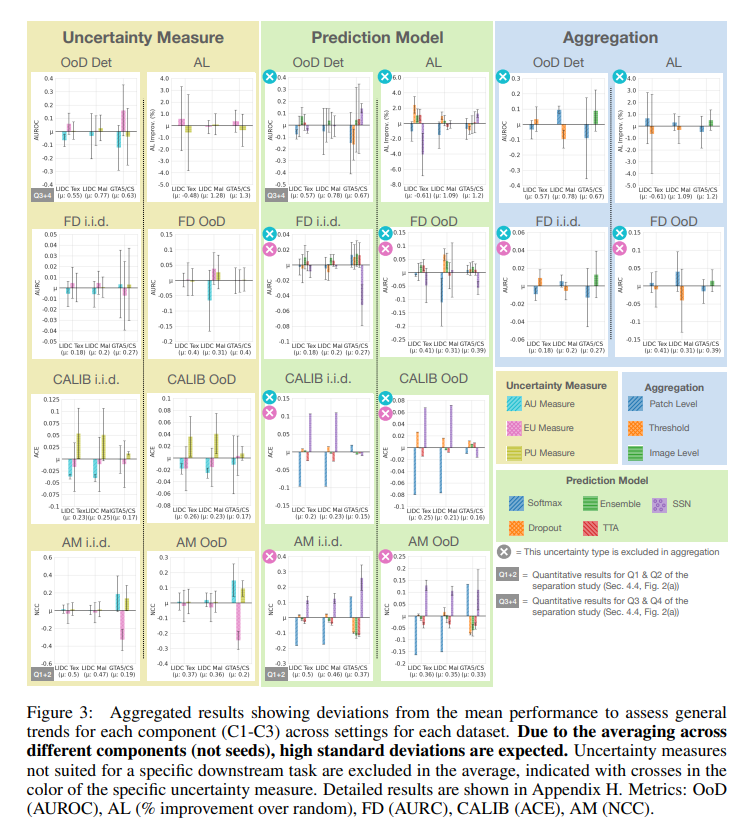
The research concludes by emphasizing that the feasibility and benefits of separating different types of uncertainty should not be assumed but rather require empirical evidence. The study also underscores the importance of selecting optimal components of uncertainty methods based on dataset properties and the interplay between these components.

In conclusion, this study bridges the gap between theoretical and practical aspects of uncertainty estimation in semantic segmentation and offers a robust foundation for future research. By systematically dissecting and validating uncertainty methods, the researchers have provided a comprehensive guide for practitioners and academics, facilitating the development of more reliable and efficient segmentation systems.


Check out the Paper and Github. All credit for this research goes to the researchers of this project. Also, don’t forget to follow us on Twitter. Join our 36k+ ML SubReddit, 41k+ Facebook Community, Discord Channel, and LinkedIn Group.

If you like our work, you will love our newsletter..

Don’t Forget to join our Telegram Channel


YOU MAY ALSO LIKE

Samsung May Be Getting Rid Of Another One UI Feature

Cmpnd Releases dspy-wsp: Weight-Space Programming Comes to DSPy

Sana Hassan, a consulting intern at Marktechpost and dual-degree student at IIT Madras, is passionate about applying technology and AI to address real-world challenges. With a keen interest in solving practical problems, he brings a fresh perspective to the intersection of AI and real-life solutions.


🐝 Join the Fastest Growing AI Research Newsletter Read by Researchers from Google + NVIDIA + Meta + Stanford + MIT + Microsoft and many others…


Credit: Source link

ShareTweetSendSharePin

Related Posts

Samsung May Be Getting Rid Of Another One UI Feature
AI & Technology

Samsung May Be Getting Rid Of Another One UI Feature

November 14, 2026
Cmpnd Releases dspy-wsp: Weight-Space Programming Comes to DSPy
AI & Technology

Cmpnd Releases dspy-wsp: Weight-Space Programming Comes to DSPy

November 14, 2026
Smart Glasses Could Replace Your Monitor But They Shouldn’t — Here’s Why
AI & Technology

Smart Glasses Could Replace Your Monitor But They Shouldn’t — Here’s Why

November 14, 2026
What Is the NIST AI Risk Management Framework? A Guide for AI Teams – Unite.AI
AI & Technology

What Is the NIST AI Risk Management Framework? A Guide for AI Teams – Unite.AI

November 14, 2026
Next Post
Cognizant: 2024 Is Unlikely To Be A Repeat Of 2023 (NASDAQ:CTSH)

Cognizant: 2024 Is Unlikely To Be A Repeat Of 2023 (NASDAQ:CTSH)

Leave a Reply Cancel reply

Your email address will not be published. Required fields are marked *

Search

No Result
View All Result
Democrat Keisha Lance Bottoms projected to win Georgia governor’s race

Democrat Keisha Lance Bottoms projected to win Georgia governor’s race

November 11, 2026
CopilotKit Releases OpenBot 1.0: An MIT-Licensed, Self-Hostable AI Coworker With Built-In Governance

CopilotKit Releases OpenBot 1.0: An MIT-Licensed, Self-Hostable AI Coworker With Built-In Governance

November 12, 2026
Ohio State and Microsoft Form Five-Year Clinical AI Partnership – Unite.AI

Ohio State and Microsoft Form Five-Year Clinical AI Partnership – Unite.AI

November 10, 2026

About

Learn more

Our Services

Legal

Privacy Policy

Terms of Use

Bloggers

Learn more

Article Links

Contact

Advertise

Ask us anything

©2020- TradePoint.io - All rights reserved!

Tradepoint.io, being just a publishing and technology platform, is not a registered broker-dealer or investment adviser. So we do not provide investment advice. Rather, brokerage services are provided to clients of Tradepoint.io by independent SEC-registered broker-dealers and members of FINRA/SIPC. Every form of investing carries some risk and past performance is not a guarantee of future results. “Tradepoint.io“, “Instant Investing” and “My Trading Tools” are registered trademarks of Apperbuild, LLC.

This website is operated by Apperbuild, LLC. We have no link to any brokerage firm and we do not provide investment advice. Every information and resource we provide is solely for the education of our readers. © 2020 Apperbuild, LLC. All rights reserved.

No Result
View All Result
  • Main
  • AI & Technology
  • Stock Charts
  • Market & News
  • Business
  • Finance Tips
  • Trade Tube
  • Blog
  • Shop

© 2023 - TradePoint.io - All Rights Reserved!