
BreakingTheWalls
Introduction
The steel industry is not in a great place right now.
Here are some of the latest headlines from Bloomberg, which show a wide range of issues, including problems in China, warnings of a “severe industry crisis,” and plummeting iron ore sales:
Bloomberg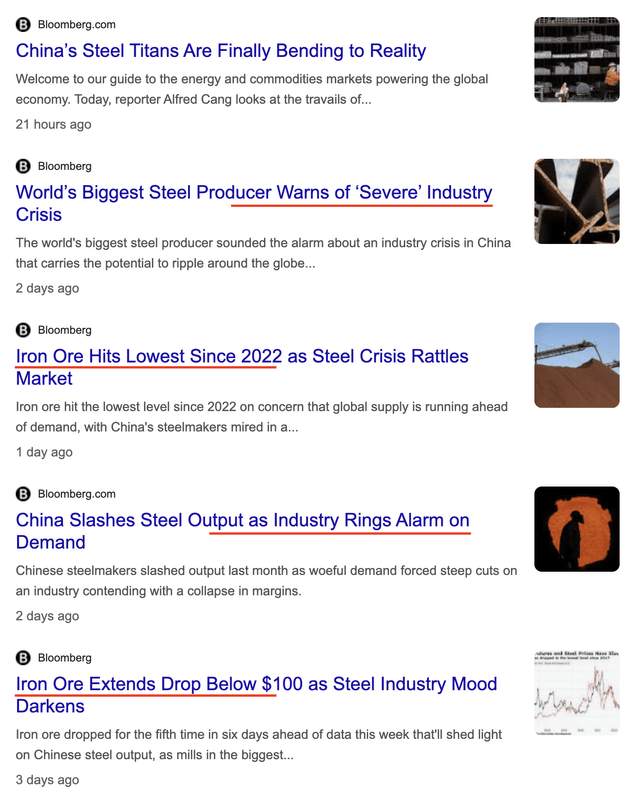
Using China, the world’s biggest steel producer, as an example, margins haven’t been this bad since the global manufacturing/commodity recession in 2015!
Bloomberg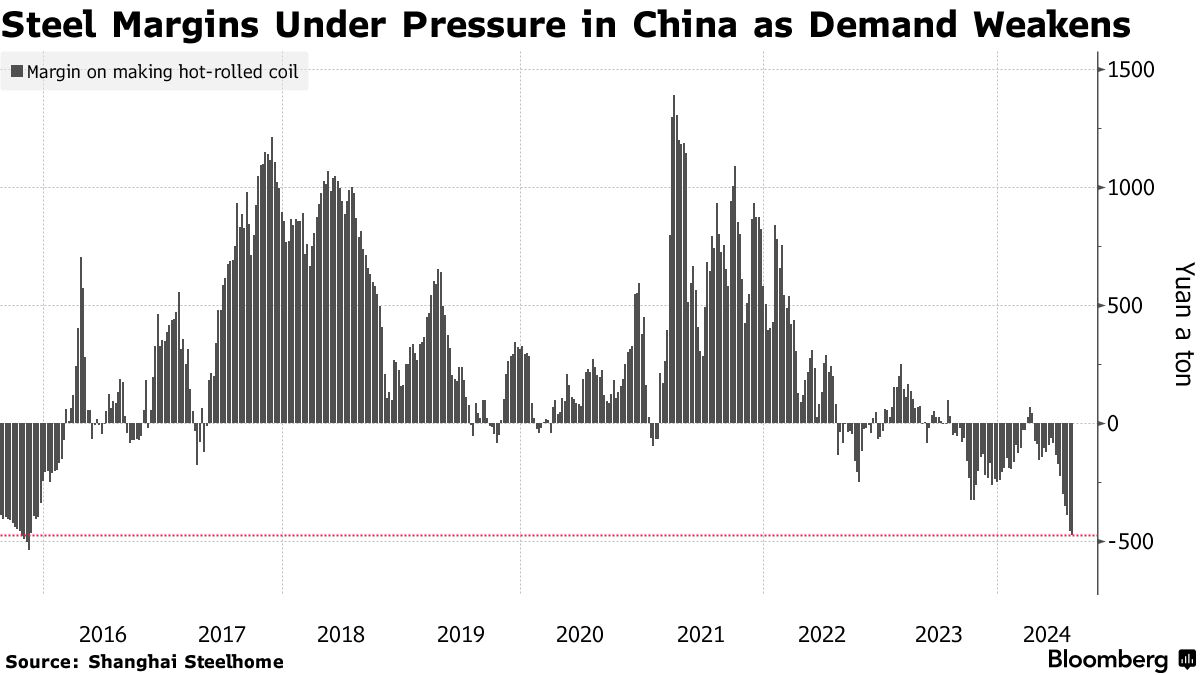
Back then, China rescued its steel industry through massive stimulus. Now, it’s uncertain what will happen as China’s economy is transitioning. The nation knows it cannot be the world’s producer of “cheap” goods much longer, which is why it is now turning to value-adding products – the kind of products it usually imports from Europe and the United States.
When adding cyclical headwinds, it explains why both iron ore and steel prices are trading as if we’re in a global manufacturing recession again.
Bloomberg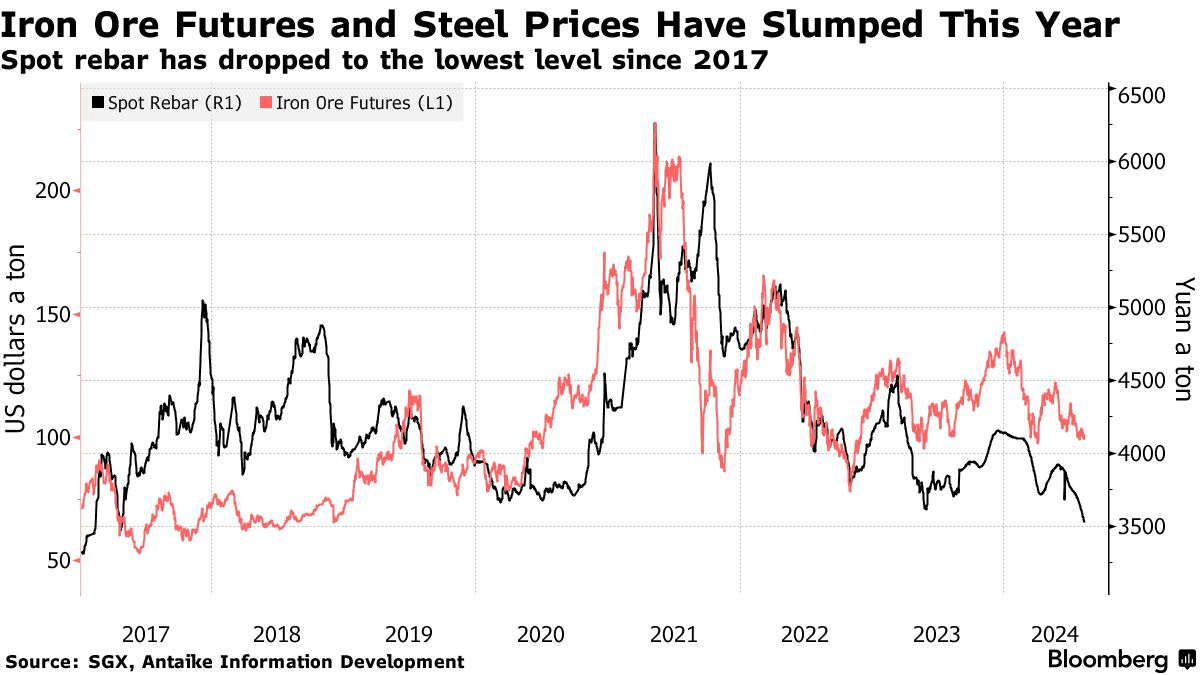
This impacts steel producers all over the world, including Cleveland-Cliffs (NYSE:CLF), a steel producer I have covered for almost a decade. I initially started covering the company when it still had energy exposure and was called Cliffs Natural Resources.
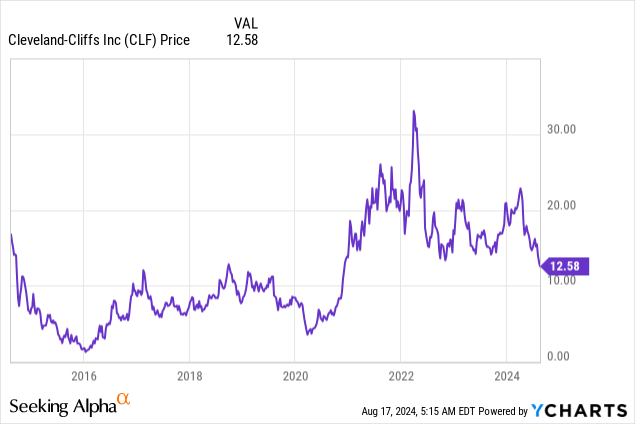
Since my June 3 article that included “Why Cleveland-Cliffs Is A Steal” in the title, the stock has lost another 27%, pressured by the negative headlines above, increasing odds of a Trump loss in November (based on current betting odds), and a renewed manufacturing slump in the United States.
The good news is that the company continues to engage in strategic M&A, building one of the most impressive steel companies in the world.
Using its recently released earnings, the takeover of Stelco, and other major developments, I’ll update my thesis in this article and explain why I remain bullish on CLF.
So, let’s buckle up and get to it!
Taking Things To The Next Level
In general, I would make the case that conservative investors should stay very far away from the steel industry. It’s a cyclical industry that has the potential to both generate and destroy a lot of shareholder wealth in a short amount of time.
In 2022, Cleveland-Cliffs was trading north of $30. Now, it trades below $13.
With that said, I don’t mind the volatility. Although one can make the case that my bullish call a few months ago had poor timing, I care about the big picture, as my thesis was never a short or medium-term thesis.
After all, Cleveland-Cliffs isn’t a “normal” steel stock. This Ohio-based corporation is one of the world’s fastest-growing steel companies.
Before the pandemic, the company and I had one thing in common. Neither one of us produced steel. Now, it’s the second-largest steel producer in the United States. This includes the acquisition of AK Steel, a company that used to trade under the “AKS” ticker, and the United States assets of ArcelorMittal (MT).
After failing to buy United States Steel (X), Cleveland-Cliffs has made its next move. Last month, the company announced a $2.5 billion deal to buy Stelco, a Canadian steel producer. Interestingly enough, Stelco used to be owned by United States Steel, which struggled with the integration.
The Wall Street Journal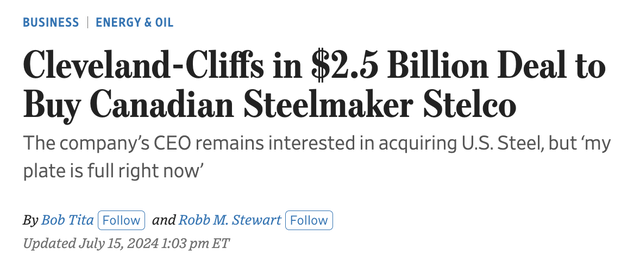
This is another deal made by CEO Lourenco Goncalves, who has been the key driver behind CLF’s impressive transformation in recent years.
In fact, I think he made a brilliant move by buying a fantastic steel asset at a discount price.
This is what The Wall Street Journal wrote (I added emphasis):
Steel prices in the U.S. have been falling lately as manufacturers hold off on large purchases in response to weakening business activity. The U.S. spot-market price for flat-rolled steel is about $650 a ton, down more than 40% from the beginning of the year, according to S&P Global Commodity Insights. Goncalves said he is confident that prices will rebound by the time the deal is expected to close in the fourth quarter.
“Prices will not stay low forever,” he said. “Cleveland-Cliffs is buying a fantastic company at the bottom of the market.”
I have to agree with Mr. Goncalves. I believe steel prices are bottoming, and the addition of Stelco is a genius move.
Why?
Cleveland-Cliffs is acquiring the Canadian company at a price of C$70 per share. This represents a deal valuation of only 4.8x EBITDA, including synergies.
It’s a very cost-effective deal and will add two operating sites to the CLF portfolio: Lake Erie Works, where it manufactures steel, and Hamilton Works, which covers finishing and coke-making operations.
Cleveland-Cliffs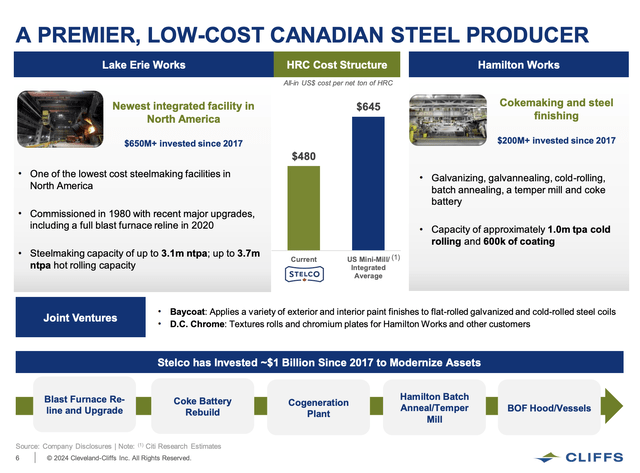
Cleveland-Cliffs aims to generate roughly $120 million in annual cost savings. These are not expected to impact union jobs but come from improved operations and better integration of the CLF supply chain, including raw material supply.
This makes sense, as CLF has built one of the most impressive steel supply chains in North America, including iron ore mines, coke production facilities, and steel production. This reduces supply chain risks and creates an even more resilient player. I would even make the case that having a steel producer like CLF is a huge benefit for national security.
Cleveland-Cliffs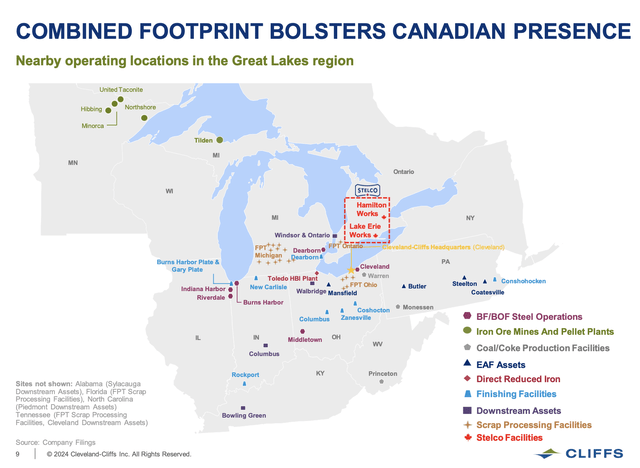
It also adds 2.6 million tons of annual steel production capacity to CLF’s portfolio, tightening the gap to its peer Nucor (NUE).
Cleveland-Cliffs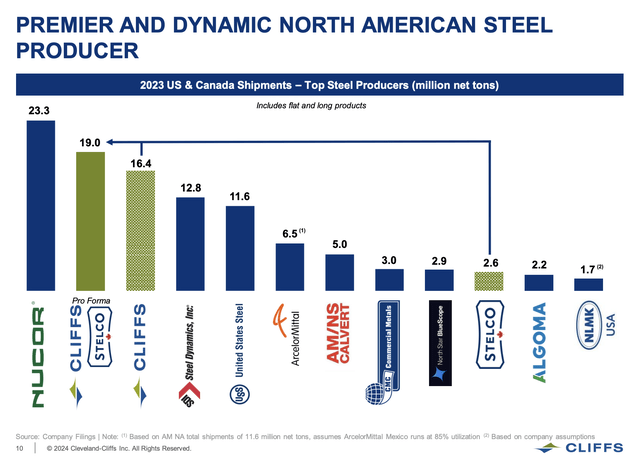
On top of that, the deal has other benefits, including:
- Favorable power costs in Ontario.
- Internal power generation.
- The Lake Erie Works is the newest integrated facility in North America.
- The company benefits from Canada’s publicly funded healthcare system.
Moreover, Cleveland-Cliffs, which has a big focus on high-margin steel in the automotive area, is further diversifying its product portfolio by going into the production of electrical transformers, a market that currently benefits from significant supply shortages.
Cleveland-Cliffs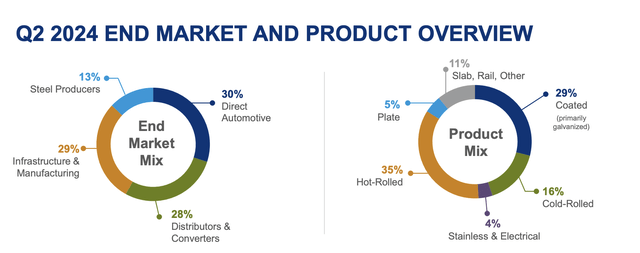
According to the company, the new transformer plant in West Virginia, which is supported by a $50 million grant from the state, is a strategic move to capture a high-margin market.
The plant is expected to come online by the first half of 2026 and is expected to leverage Cleveland-Cliffs’ expertise in electrical steels and the availability of skilled labor from its shuttered tin mill in Weirton, West Virginia.
Cleveland-Cliffs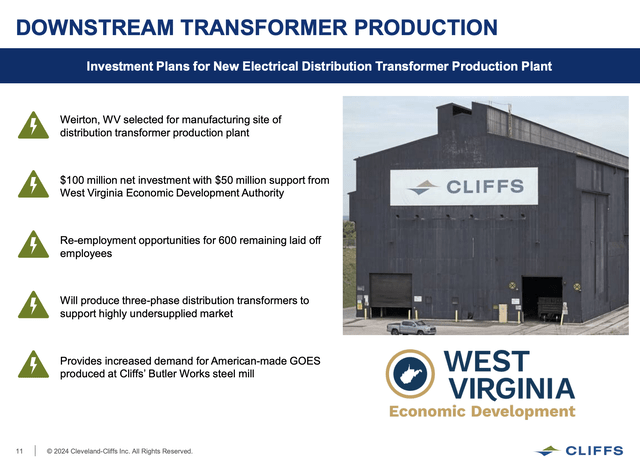
Although the company will remain a cyclical steel giant, these moves make it a bigger beneficiary from the ongoing secular growth trend in electrification fueled by artificial intelligence (data centers).
Cyclical Headwinds & Shareholder Value
Current times are tough – not just in China.
As we can see below, U.S. Midwest Hot-Rolled Coil Steel prices have fallen to the lowest level since the pandemic. This move lower is caused by a further deterioration in manufacturing business expectations, as displayed by the ISM Manufacturing Index (the purple line).
TradingView (HRC Steel, ISM Index)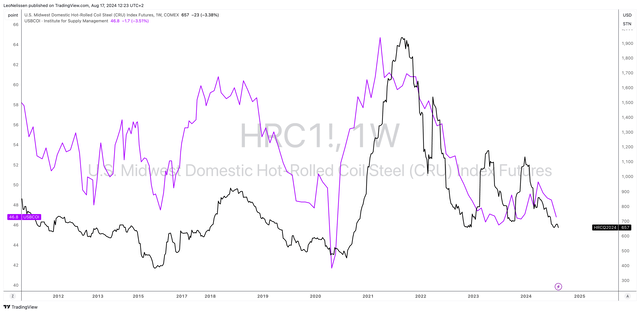
This has reduced 2Q24 adjusted EBITDA to $323 million, down from $775 million in 2Q23. External steel sales remained steady, which shows how big the impact of pricing is.
Cleveland-Cliffs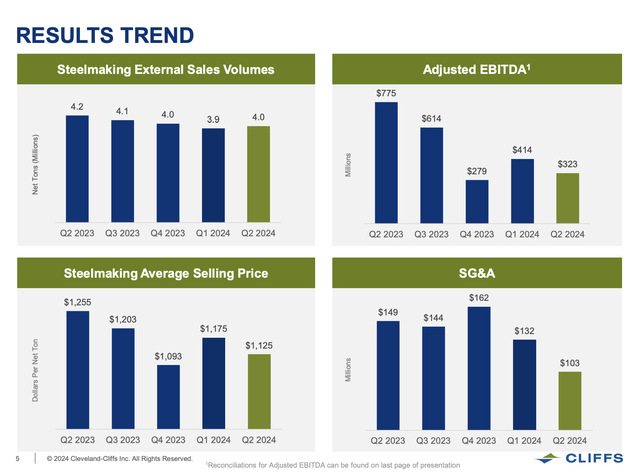
As a result, CLF focuses on factors it can influence. This includes its business transformation and cost reduction.
In 2Q24, the company has already achieved a $30 per ton year-over-year cost reduction, with another $30 per ton reduction expected from 2Q24 to 3Q24.
These reductions are largely driven by lower coal and iron ore costs, which improve the company’s overall profitability.
Moreover, it is reducing debt and buying back stock.
In the second quarter of this year, the company generated $362 million in free cash flow. Roughly 65% of this free cash flow went towards reducing net debt by $237 million, bringing the net debt balance down to $3.4 billion.
The remaining 35%, or $125 million, was used to buy back stock, reducing the share count to 474 million shares. Over the past three years, CLF has bought back a fifth of its shares.
Cleveland-Cliffs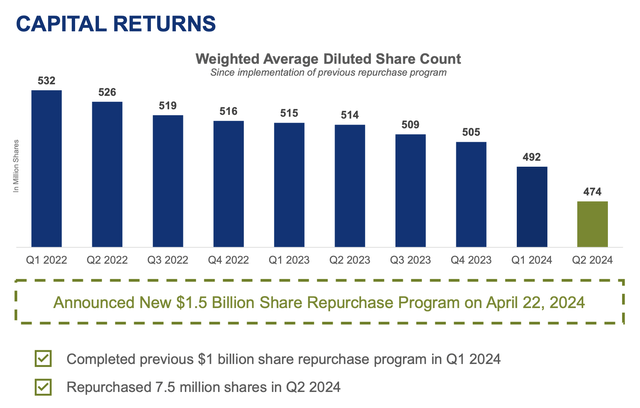
On August 13, the company issued $500 million in senior debt to fund the cash payments related to the Stelco takeover and pay off the entire outstanding balance under its asset-based lending facility.
Valuation-wise, we are dealing with a significant decline in expectations.
Using the FactSet data in the chart below, CLF is expected to generate $3.22 in per-share OCF (operating cash flow) in 2026. That is down from $4.30 on May 31, 2024.
FAST Graphs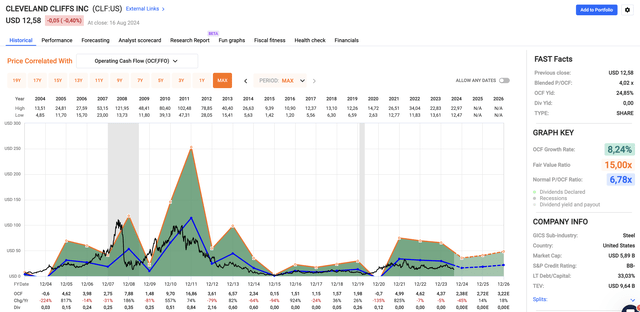
Applying its normalized P/OCF ratio of 6.8x to current expectations, we get a price target of $21.90, 74% above the current price.
If Mr. Goncalves is right and demand is bottoming in the second half of this year, CLF is likely much more than 74% undervalued, as it will benefit from higher volumes, better pricing, M&A synergies, and structural cost-cutting.
As such, I apply a Strong Buy rating. However, it comes with an asterisk, as this is an investment very different from the usual dividend (growth) investments we discuss. So, please be aware of that. Despite my bullish view, CLF may not be right for you.
Takeaway
The steel industry is in a tough spot, as it faces cyclical headwinds and significant pricing pressures, especially in China.
However, Cleveland-Cliffs stands out due to its strategic acquisitions, cost-cutting initiatives, and focus on value-adding products like those in the high-margin automotive and electrical transformer markets.
Despite the volatility and the stock’s recent decline, I remain bullish on CLF, especially given its aggressive expansion and transformation under CEO Lourenco Goncalves.
As such, I believe CLF presents a compelling opportunity with substantial upside potential.
Pros & Cons
Pros:
- Strategic M&A: Cleveland-Cliffs is building an impressive steel empire, with the recent acquisition of Stelco adding significant value at a great valuation.
- Cost Reduction: The company is aggressively cutting costs, improving profitability, and reducing debt.
- Unique Positioning: CLF is not your typical steel stock. It’s a fast-growing player in a critical industry, with a focus on high-margin markets like automotive and electrification.
- Potential Upside: If steel prices rebound as expected, CLF could be massively undervalued, offering substantial upside.
Cons:
- Cyclical Risks: The steel industry is very volatile, with prices and demand heavily tied to global economic conditions.
- Short-Term Pain: The recent downturn in steel prices and manufacturing could lead to continued pressure on the stock.
- High-Risk Investment: This isn’t your usual safe, dividend-growth play. Investors need tolerance for elevated cyclical risks and volatility.
Credit: Source link