
imagedepotpro/iStock via Getty Images
“The more I learn about confirmation bias, the more I see it everywhere.“
Craig Good
The important questions
In July, we opened this mini-series on climate change with a letter called Challenging Common ‘Wisdom’. That was followed up in September with How to Invest when El Nino Tempers. Then, in October, The Key Driver of Climate Change … other than Human Behaviour was published – you can find them all here. We have now reached the finale.
Before going any further, allow me to quickly explain why I have chosen to structure this letter differently from its usual format. I started writing the December letter, using the standard format, but quickly realised it wasn’t going to work.
I then asked myself: what are the most important questions to do with climate change? Questions, and associated answers, which not only dictate the political response but also drive investor behaviour? After thinking long and hard about it, I came up with the following four questions (in no particular order):
- How much of the changing climate is associated with human behaviour, and how much is beyond human control?
- What is the level of economic damage at different warming levels?
- Assuming the political establishment (ex. the Trump administration) is committed to it, what is the most cost-effective path to Net Zero?
- Is CO2 actually the liability (nearly) everybody claims it is, or could it possibly be (turned into) an asset?
There are obviously plenty of other important questions, for example this one: “Is there (as many claim) in fact a tipping point and, if so, where is it?” Once you pass such a tipping point, the changing climate will cause irreversible damages, even if CO2 and other GHG emissions are later reduced.
Question #1: How much of the changing climate is associated with human behaviour, and how much is beyond human control?
This is an almost impossible question to answer. We do know a few things, though. We know that, prior to the Industrial Revolution, the human impact was negligible, and we know that, since around 1750, the human impact has been going up, but by how much?
The answer you get depends on who you ask, and most people you ask are biased. I have therefore taken a somewhat unusual approach when looking for the answer. I asked a retired climatologist. It was important that he/she is retired, as political correctness/pressure could otherwise skew the answer.
I entered the discussion with an expectation that the correct answer is not 0%, as climate deniers claim, but nor is it 100%, as claimed by many climate activists. The conversation progressed roughly as expected, with him providing many reasons why nobody knows the answer. I then put him on the spot and asked him “what is the best answer you can provide?” “About 65/35”, he said (65% due to human behaviour).
Now, in a perverse sort of way, and if it is possible to turn CO2 into an asset (see later), 100% would actually have been a more promising answer, as that would mean we could relatively ‘easily’ get the CO2 concentration in the atmosphere down to pre-industrial levels again (about 280 parts per million (ppm), but it will be more complex, if the correct answer is 65/35.
Question #2: What is the level of economic damage at different warming levels?
This is another difficult question, and there are two key reasons for that. Firstly, the fact that we haven’t been here before means that the answers I have obtained are all built on simulations. Secondly, the regional differences are enormous. Certain parts of the world will actually benefit, whereas higher temperatures will be catastrophic for other regions. With those caveats in mind, here is my best answer:
If +1.5°C: Global GDP is expected to be 1-2% lower than it would otherwise have been. Coastal regions and small islands in tropical areas (like the Maldives) can really feel the impact, but most of us can’t. This is essentially where we are now.
If +2.0°C: The negative impact on GDP is now meaningful – possibly as much as 4%. Water stress becomes a serious problem, and extreme weather events are now much more frequent. The agricultural industry will begin to relocate – painful for some but beneficial for others.
If +3.0°C: This is when the impact on society is no longer only measured in GDP numbers. Water stress levels are now so high that armed conflict(s) could quite possibly be the outcome in the worst affected areas. Migration becomes a serious problem (as if it isn’t already), important parts of the infrastructure no longer works, and labour productivity collapses because of rising health problems. GDP? Somewhere between -5% and -10%.
I could go on, but you probably get the gist by now. Before moving on, I need to make an important point, though. The GDP estimates above are all global averages; however, as mentioned earlier, regional differences will be massive. Therefore, you’ll need to do more work to estimate the impact on your region.
Question #3: Assuming the political establishment (ex. the Trump administration) is committed to it, what is the most cost-effective path to Net Zero?
Commitment is one thing. To actually make it happen is a different kettle of fish. I am prepared to bet ten panfried plaices (an old Danish saying – couldn’t resist that one) that to reach Net Zero by 2050 will prove impossible. Having said that, this doesn’t mean we shouldn’t try, and it certainly doesn’t mean that there isn’t a significant amount of money to be saved, if the most cost-effective route is chosen, so let me have a go.
Experience so far suggests that consumers react to price more than anything. Therefore (outside the US), we should expect energy prices, particularly fossil fuel prices, to go up, potentially quite a lot. Norway (#1) and Denmark (#2) benefit from the highest sales of EVs in Europe, and the reason is simple. Consumer taxes on EVs in those two countries are much lower than they are on ICEs. In fact, in Norway, the tax on EVs (ex. VAT) has been completely abolished.
One of two things may happen; either the Scandinavian model spreads to other parts of the world, or the sale of ICEs continues for much longer than anticipated. In many countries, EVs are still far too expensive for consumers to embrace them.
In the public sector, the most cost-effective approach is quite clearly to reduce leaks in the archaic pipeline system. In western Europe, the UK suffers the worst leaks, probably because not enough has been spent to modernise it since it was first established under Queen Victoria, who was in power from 1837 to 1901. From an investment point-of-view, this is interesting because it means plenty of opportunities.
Question #4: Is CO2 actually the liability (nearly) everybody claims it is, or could it possibly be (turned into) an asset?
This question, I believe, is the most important of them all. The bad news first: I believe enormous amounts of capital are wasted every year by an ill-informed political leadership trying to deal with the problem the wrong way.
When I was born in 1959, only 16 months after scientists at the Mauna Loa Observatory in Hawaii began to formally measure CO2 levels in the atmosphere, it was about 315 ppm (Exhibit 1). Before 1750, i.e. before the Industrial Revolution, it was pretty constant around 280 ppm, as calculated by analysing air bubbles trapped in ancient ice cores in Antarctica and Greenland.
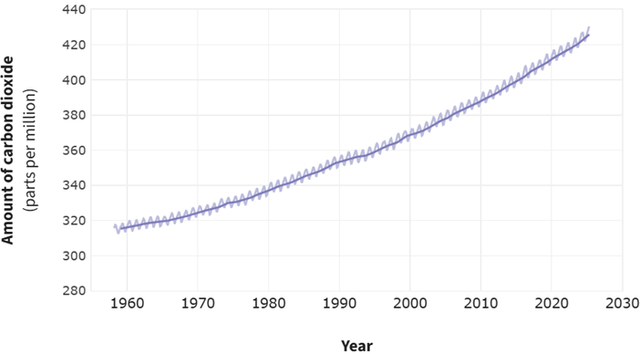
Exhibit 1: Atmospheric concentration of CO2
Source: Climate change: atmospheric carbon dioxide
Today, the concentration of CO2 in the atmosphere is about 425 ppm. The overwhelming majority of climate experts believe that explains the higher temperature. Only a small minority disagree with that. In the following, I will argue that, if an emerging, new technology can be commercialised, it won’t matter who is right and who is wrong.
The technology is called DAC (Direct Air Capture), and it works by removing CO2 from atmospheric air and then, through a chemical process, turning it into syngas, which can replace the fuel that goes into diesel engines. Syngas is a mix of:
- hydrogen (H2) – 30-40%;
- carbon monoxide (CO) – 40-50%;
- carbon dioxide (CO2) – up to 15%;
- methane (CH4) – 0-5%; and
- nitrogen (N2) – up to 10%.
Unlike conventionally captured CO2, it is not stored underground but almost immediately converted to syngas. A Canadian company called Carbon Engineering Ltd. came first with the new technology. In 2023, it was acquired by Occidental Petroleum. My first reaction, when I heard about the acquisition, was that OXY probably acquired Carbon Engineering to kill the technology, thereby protecting its core business, but it looks like OXY has great plans with the company. It is certainly investing a lot in it.
Elsewhere, a team at Cambridge University is working on a similar technology, and they are also quite advanced in their work, so my guess is that we will get this technology one way or the other. Therefore, the answer to Q4 is definitely a yes – if handled correctly, assuming the technology can be commercialised, CO2 may in fact turn into an asset.
Final comments
Before wrapping this mini-series on climate change up, I need to point out why GHGs affect the temperature (although this is also disputed by some). The sun emits energy in the form of visible light and radiation. Most of this energy passes through the Earth’s atmosphere and warms the surface. The warmed Earth then releases energy (HEAT) back into the atmosphere.
GHGs absorb some of this outgoing infrared radiation and re-emit it in all directions, including back toward the Earth’s surface. This process traps heat in the lower atmosphere (the troposphere), warming Earth more than if this radiation simply reached the higher atmosphere (the stratosphere and the mesosphere).
In other words, it is a fine balance. Too many GHGs will cause problems, but so will not enough GHGs. GHGs help plants to grow, and they make a valuable contribution when humans attempt to turn deserts into arable land. It is very much a story of two sides, and that explains why opinions are so divided.
Having said that, I hope that I, with this letter, have pointed out that there is a way forward; that you shouldn’t despair, just because your local Member of Parliament (or whoever) likes to create a bit of drama. The problem in a nutshell is that climate change is no longer a science – it has become a religion. And, when that happens, simple logic no longer applies.
By Niels Clemen Jensen
Original Post
Editor’s Note: The summary bullets for this article were chosen by Seeking Alpha editors.
Credit: Source link