
temizyurek
Teck Resources (NYSE:TECK) is a Vancouver, Canada-based diversified natural resources company with engagements across mining and mineral development, including metallurgical, steelmaking coal, copper, zinc, and other energy and metal and mineral products.
Teck Q2’23 Presentation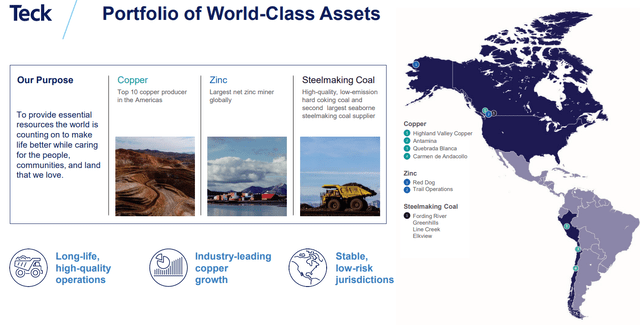
Through these activities, Teck has successfully generated a Q2 revenue of $2.65bn- a 40.92% YoY decline-alongside a net income of $384.74mn- a 70.42% decline- and a free cash flow of -464.71mn- a 140.88% decline.
Introduction
Central to both Teck’s growth capabilities and general operations remains its multi-sided positioning across its traditional met coal presence in addition to commodities such as copper and zinc, which benefit from electrification and renewable energy megatrends. Moreover, with a better-than-average steelmaking coal profitability model, investors can expect significant windfall for reinvestment in higher growth platforms.
Teck Q2’23 Presentation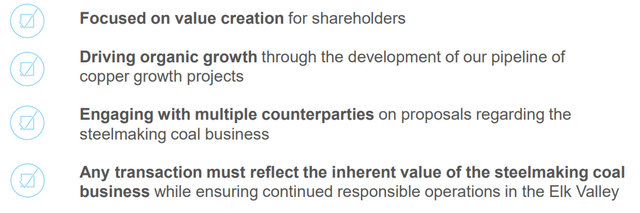
The combined accretive growth of Teck’s organic growth, potential met coal sale, and effective capital deployment strategy, alongside a general undervaluation, lead me to rate the company a ‘buy’.
Valuation & Financials
General Overview
In the TTM period, Teck’s stock-up 20.54%- has experienced middling growth between TradingView’s Mining Index-up 22.78%- and the broader market, as represented by the S&P 500 (SPY)- up 8.52%.
Teck (Blue) vs Industry and Market (TradingView)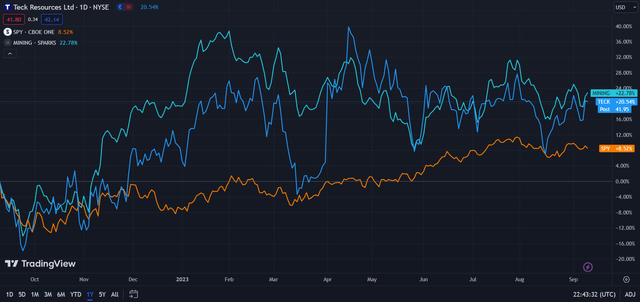
I believe the relative outperformance of the mining industry to the market attests to wider public investment in the sector, alongside a significant purchase backlog in the coal subsector and favourable commodity price fluctuations across the board.
That said, both macro tailwinds and the potential of a Teck coal sale propel Teck’s future potential above market peers.
Comparable Companies
The mining industry remains highly fragmented between regional miners, junior miners, precious metals miners, rare earth metal miners, and so on and so forth. With Teck’s diverse capabilities across energy and metals, the firm is better compared to similarly sized miners rather than direct competitors. This group includes one of the largest uranium producers in the world, the Saskatoon-based Cameco (CCJ), the Toronto-based gold miner, Agnico Eagle (AEM), the world’s largest gold producer, the Denver-based Newmont (NGT), and copper-major, First Quantum Minerals (FM.TO).
barchart.com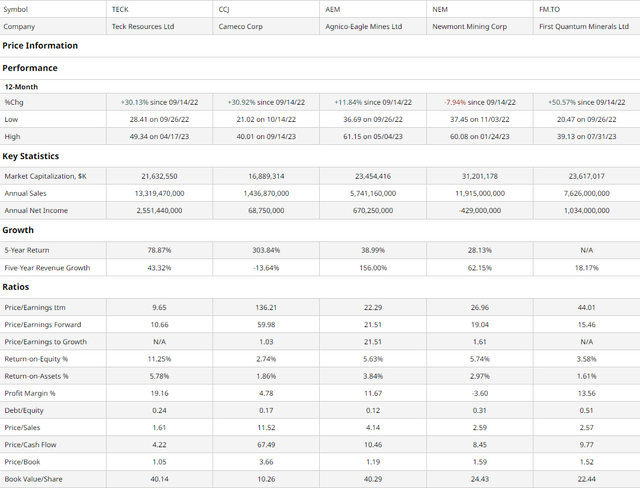
Over the previous year, Teck has seen the joint second-best price action among peers, largely driven by a combination of commodity prices and the potential for a buyout of the firm’s coal unit. Despite this 1Y run-up, I believe, when assessing the company’s propensity for growth, multiples-based value, and asset quality, Teck maintains more baked-in growth than peers.
For instance, Teck retains the second-highest 5Y return, driven by the third-highest revenue growth and reinforced by best-in-class ROE and ROA. Moreover, the miner has the lowest trailing and forward P/E ratios, which, in conjunction with the lowest P/S, P/CF, and P/B ratios, demonstrates strength across all financial statements for the firm.
Supplemented with the highest profitability among peers, a reasonable debt/equity, and the joint-highest book value/share, investors can ensure risk aversion alongside growth.
Valuation
According to my discounted cash flow model, at its base case, the net present value for Teck is $49.85, meaning, at its current price of $43.79, the stock is undervalued by 12%.
My analysis, calculated over 5 years without perpetual growth built-in, assumes a discount rate of 9%, balancing the firm’s debt-light capital structure with greater implied volatility owing to commodity price fluctuation. Additionally, to remain conservative, I projected an average forward revenue growth rate of 6%, lower than the trailing average of 8.68%.
Alpha Spread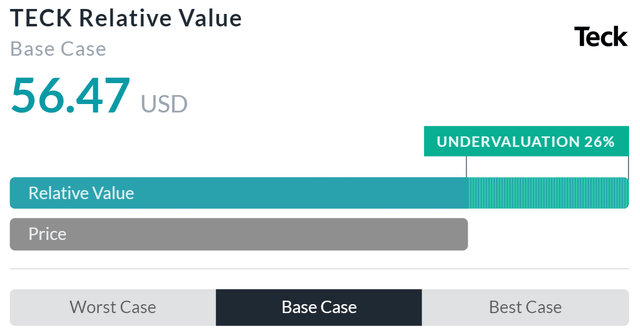
Alpha Spread’s multiples-based relative valuation supports my thesis on undervaluation, estimating a base case undervaluation of 26%, with a relative value of $56.47.
Taking an average of my NPV and Alpha Spread’s relative valuation, the fair value of Teck is thus $53.16, a 19% undervaluation.
Teck Demands a Premium for Positioning Across Traditional & Growth Commodities
Teck’s intrinsic value remains tied to its presence across copper, zinc, and seaborne steelmaking coal segments. While each is driven by secular demand tailwinds-with copper driven by green technology megatrends and zinc privy to the same shifts and general infrastructure investment and coal demand remaining resilient- Teck has effectively positioned itself to maximize profitability given these circumstances.
Teck Q2’23 Presentation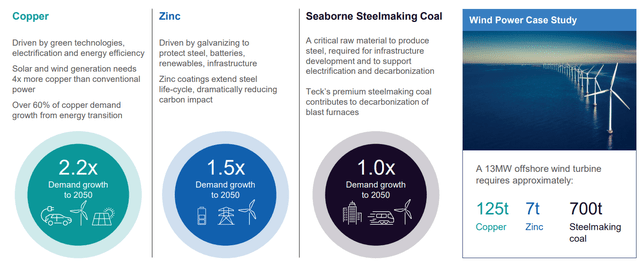
To execute the latter, Teck has constructed a geographically diverse capex pipeline. Below, Teck outlines its copper capex bridge, aiming to boost copper production from ~0.6Mt today to ~1.1Mt by 2029 and ~1.9Mt in the years beyond. The company aims to do so by developing its assets in Mexico, Chile, Peru, the US, and Canada with gradual investments and controlled scale growth.
Teck Q2’23 Presentation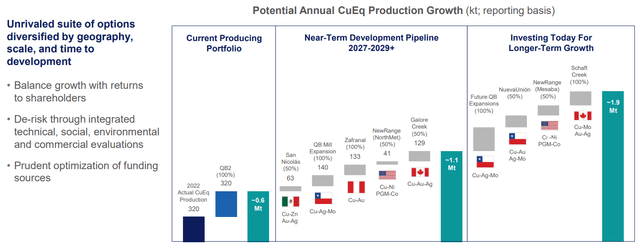
This feeds into Teck’s larger capital allocation strategy of balancing reinvestment with shareholder returns. The firm prioritizes sustaining its capital position and ensuring a base level of reinvestment, with subsequent cash flow going towards Teck’s 0.88% dividend and deleveraging/reducing the cost of capital. After that, the firm engages in opportunistic share buybacks and other shareholder distributions.
Teck Q2’23 Presentation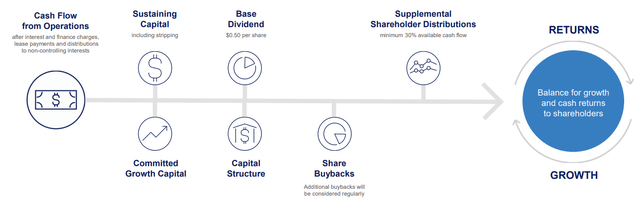
Wall Street Consensus
Analysts generally echo my positive view on the company, projecting an average 1Y price growth of 19.41% to a price of $50.10.
TradingView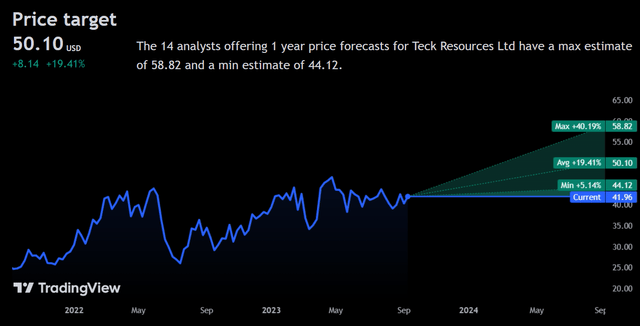
Even at the minimum predicted price estimate of $44.12, analysts expect the stock to grow 5.14%, signalling the company’s overall strength and analyst belief that Teck’s positioning and potential coal asset sale deserve a price premium.
Risks & Challenges
Uncertainty Around Coal Asset Sale May Induce Volatility
Since the potential multi-billion dollar sale of Teck’s coal division to a number of buyers supports the firm’s higher price point when considering EV/EBITDA, the company’s price is dependent on a sale of its assets, and any news for or against the asset sale may give rise to price volatility. This would subsequently reduce Teck’s risk-adjusted attractiveness and potentially raise the cost of equity.
Rising Interest Rates May Reduce Demand for Metals and Coal
Although Teck and all its major segments benefit from rising private and public investment in infrastructure, electrification, and green technology, rising or sticky interest rates may curb potential upside. The stalled construction and infrastructure development following rising interest rates and inflationary pressures reduce the downstream demand for steelmaking coal, copper, and zinc.
Conclusion
Looking forward, with or without a coal asset sale, Teck is well-positioned to leverage secular tailwinds for years to come, reinvesting and judiciously returning capital to shareholders.
Credit: Source link