
• bitcoinBitcoin(BTC)$81,024.004.26%
  • ethereumEthereum(ETH)$2,624.485.40%
  • tetherTether(USDT)$1.000.05%
  • binancecoinBNB(BNB)$760.280.71%
  • rippleXRP(XRP)$1.416.41%
  • usd-coinUSDC(USDC)$1.000.02%
  • solanaSolana(SOL)$111.665.46%
  • tronTRON(TRX)$0.3376300.44%
  • zcashZcash(ZEC)$1,565.375.17%
  • Figure HelocFigure Heloc(FIGR_HELOC)$1.030.23%
  • HyperliquidHyperliquid(HYPE)$92.885.60%
  • dogecoinDogecoin(DOGE)$0.0868532.99%
  • moneroMonero(XMR)$568.016.05%
  • whitebitWhiteBIT Coin(WBT)$83.153.83%
  • RainRain(RAIN)$0.0139036.51%
  • USDSUSDS(USDS)$1.000.02%
  • chainlinkChainlink(LINK)$12.293.99%
  • cardanoCardano(ADA)$0.2221253.79%
  • leo-tokenLEO Token(LEO)$8.89-0.15%
  • stellarStellar(XLM)$0.1914601.90%
  • uniswapUniswap(UNI)$9.154.84%
  • bitcoin-cashBitcoin Cash(BCH)$245.86-0.65%
  • Ethena USDeEthena USDe(USDE)$1.000.05%
  • nearNEAR Protocol(NEAR)$3.674.99%
  • daiDai(DAI)$1.00-0.01%
  • litecoinLitecoin(LTC)$56.923.30%
  • CantonCanton(CC)$0.109763-0.69%
  • USD1USD1(USD1)$1.000.06%
  • the-open-networkGram (prev. Toncoin)(GRAM)$1.35-0.11%
  • avalanche-2Avalanche(AVAX)$8.558.29%
  • hedera-hashgraphHedera(HBAR)$0.0784572.76%
  • suiSui(SUI)$0.813.77%
  • Global DollarGlobal Dollar(USDG)$1.000.01%
  • shiba-inuShiba Inu(SHIB)$0.0000051.01%
  • crypto-com-chainCronos(CRO)$0.0591330.61%
  • MemeCoreMemeCore(M)$1.281.12%
  • BittensorBittensor(TAO)$252.382.85%
  • paypal-usdPayPal USD(PYUSD)$1.000.02%
  • tether-goldTether Gold(XAUT)$4,371.65-0.36%
  • Circle USYCCircle USYC(USYC)$1.140.03%
  • okbOKB(OKB)$116.321.96%
  • Ripple USDRipple USD(RLUSD)$1.000.01%
  • BlackRock USD Institutional Digital Liquidity FundBlackRock USD Institutional Digital Liquidity Fund(BUIDL)$1.000.00%
  • Ondo US Dollar YieldOndo US Dollar Yield(USDY)$1.14-0.16%
  • aaveAave(AAVE)$142.295.98%
  • AsterAster(ASTER)$0.761.09%
  • mantleMantle(MNT)$0.602.79%
  • OndoOndo(ONDO)$0.3963952.71%
  • Pump.funPump.fun(PUMP)$0.004095-4.98%
  • pax-goldPAX Gold(PAXG)$4,363.25-0.56%
TradePoint.io
  • Main
  • AI & Technology
  • Stock Charts
  • Market & News
  • Business
  • Finance Tips
  • Trade Tube
  • Blog
  • Shop
No Result
View All Result
TradePoint.io
No Result
View All Result

Tavus Launches Phoenix-4: A Gaussian-Diffusion Model Bringing Real-Time Emotional Intelligence And Sub-600ms Latency To Generative Video AI

February 18, 2026
in AI & Technology
Reading Time: 7 mins read
A A
Tavus Launches Phoenix-4: A Gaussian-Diffusion Model Bringing Real-Time Emotional Intelligence And Sub-600ms Latency To Generative Video AI
ShareShareShareShareShare

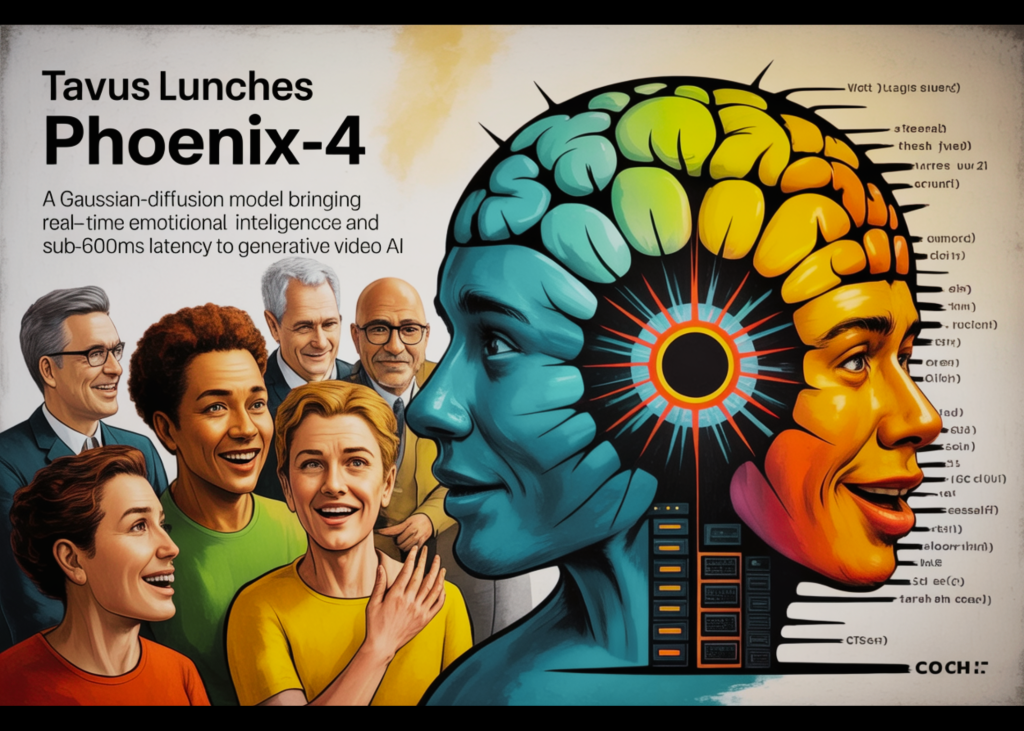
The ‘uncanny valley’ is the final frontier for generative video. We have seen AI avatars that can talk, but they often lack the soul of human interaction. They suffer from stiff movements and a lack of emotional context. Tavus aims to fix this with the launch of Phoenix-4, a new generative AI model designed for the Conversational Video Interface (CVI).

Phoenix-4 represents a shift from static video generation to dynamic, real-time human rendering. It is not just about moving lips; it is about creating a digital human that perceives, times, and reacts with emotional intelligence.

YOU MAY ALSO LIKE

GGUF vs GPTQ vs AWQ vs EXL2: LLM Model Formats Explained (2026)

Consumers Sue Anthropic, OpenAI, SpaceXAI and Google Over Alleged AI Pact – Unite.AI

The Power of Three: Raven, Sparrow, and Phoenix

To achieve true realism, Tavus utilizes a 3-part model architecture. Understanding how these models interact is key for developers looking to build interactive agents.

  1. Raven-1 (Perception): This model acts as the ‘eyes and ears.’ It analyzes the user’s facial expressions and tone of voice to understand the emotional context of the conversation.
  2. Sparrow-1 (Timing): This model manages the flow of conversation. It determines when the AI should interrupt, pause, or wait for the user to finish, ensuring the interaction feels natural.
  3. Phoenix-4 (Rendering): The core rendering engine. It uses Gaussian-diffusion to synthesize photorealistic video in real-time.
https://www.tavus.io/post/phoenix-4-real-time-human-rendering-with-emotional-intelligence

Technical Breakthrough: Gaussian-Diffusion Rendering

Phoenix-4 moves away from traditional GAN-based approaches. Instead, it uses a proprietary Gaussian-diffusion rendering model. This allows the AI to calculate complex facial movements, such as the way skin stretching affects light or how micro-expressions appear around the eyes.

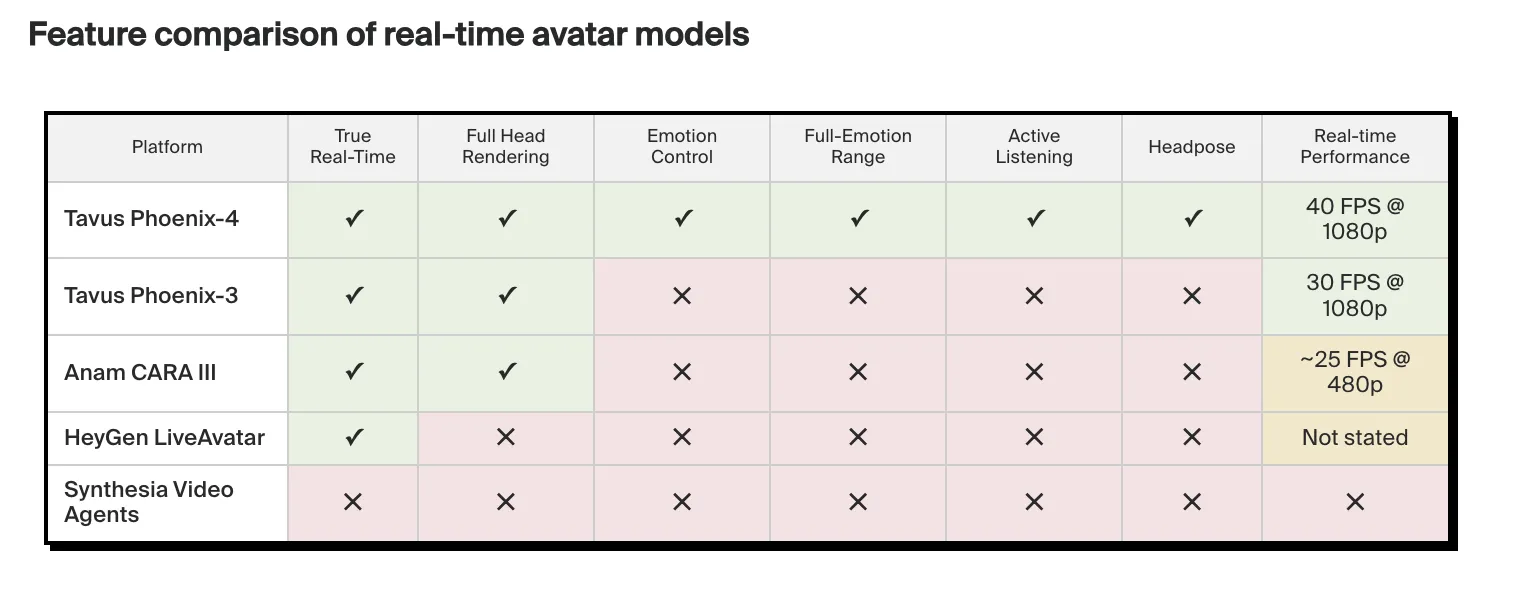
This means the model handles spatial consistency better than previous versions. If a digital human turns their head, the textures and lighting remain stable. The model generates these high-fidelity frames at a rate that supports 30 frames per second (fps) streaming, which is essential for maintaining the illusion of life.

Breaking the Latency Barrier: Sub-600ms

In a CVI, speed is everything. If the delay between a user speaking and the AI responding is too long, the ‘human’ feel is lost. Tavus has developed the Phoenix 4 pipeline to achieve an end-to-end conversational latency of sub-600ms.

This is achieved through a ‘stream-first’ architecture. The model uses WebRTC (Web Real-Time Communication) to stream video data directly to the client’s browser. Rather than generating a full video file and then playing it, Phoenix-4 renders and sends video packets incrementally. This ensures that the time to first frame is kept at an absolute minimum.

Programmatic Emotion Control

One of the most powerful features is the Emotion Control API. Developers can now explicitly define the emotional state of a Persona during a conversation.

By passing an emotion parameter in the API request, you can trigger specific behavioral outputs. The model currently supports primary emotional states including:

  • Joy
  • Sadness
  • Anger
  • Surprise

When the emotion is set to joy, the Phoenix-4 engine adjusts the facial geometry to create a genuine smile, affecting the cheeks and eyes, not just the mouth. This is a form of conditional video generation where the output is influenced by both the text-to-speech phonemes and an emotional vector.

Building with Replicas

Creating a custom ‘Replica’ (a digital twin) requires only 2 minutes of video footage for training. Once the training is complete, the Replica can be deployed via the Tavus CVI SDK.

The workflow is straightforward:

  1. Train: Upload 2 minutes of a person speaking to create a unique replica_id.
  2. Deploy: Use the POST /conversations endpoint to start a session.
  3. Configure: Set the persona_id and the conversation_name.
  4. Connect: Link the provided WebRTC URL to your front-end video component.
https://www.tavus.io/post/phoenix-4-real-time-human-rendering-with-emotional-intelligence

Key Takeaways

  • Gaussian-Diffusion Rendering: Phoenix-4 moves beyond traditional GANs to use Gaussian-diffusion, enabling high-fidelity, photorealistic facial movements and micro-expressions that solve the ‘uncanny valley’ problem.
  • The AI Trinity (Raven, Sparrow, Phoenix): The architecture relies on three distinct models: Raven-1 for emotional perception, Sparrow-1 for conversational timing/turn-taking, and Phoenix-4 for the final video synthesis.
  • Ultra-Low Latency: Optimized for the Conversational Video Interface (CVI), the model achieves sub-600ms end-to-end latency, utilizing WebRTC to stream video packets in real-time.
  • Programmatic Emotion Control: You can use an Emotion Control API to specify states like joy, sadness, anger, or surprise, which dynamically adjusts the character’s facial geometry and expressions.
  • Rapid Replica Training: Creating a custom digital twin (‘Replica’) is highly efficient, requiring only 2 minutes of video footage to train a unique identity for deployment via the Tavus SDK.

Check out the Technical details, Docs and Try it here. Also, feel free to follow us on Twitter and don’t forget to join our 100k+ ML SubReddit and Subscribe to our Newsletter. Wait! are you on telegram? now you can join us on telegram as well.

Credit: Source link

ShareTweetSendSharePin

Related Posts

GGUF vs GPTQ vs AWQ vs EXL2: LLM Model Formats Explained (2026)
AI & Technology

GGUF vs GPTQ vs AWQ vs EXL2: LLM Model Formats Explained (2026)

September 19, 2026
Consumers Sue Anthropic, OpenAI, SpaceXAI and Google Over Alleged AI Pact – Unite.AI
AI & Technology

Consumers Sue Anthropic, OpenAI, SpaceXAI and Google Over Alleged AI Pact – Unite.AI

September 19, 2026
How Focus Mode Has Changed In iOS 27
AI & Technology

How Focus Mode Has Changed In iOS 27

September 18, 2026
AI Almost Led The US Military To Start A War With China, Report Says
AI & Technology

AI Almost Led The US Military To Start A War With China, Report Says

September 18, 2026
Next Post
Brooklyn Beckham co-hosts Miami’s wine-and-food festival in wake of family drama

Brooklyn Beckham co-hosts Miami's wine-and-food festival in wake of family drama

Leave a Reply Cancel reply

Your email address will not be published. Required fields are marked *

Search

No Result
View All Result
Sheeran’s tour chaos: What to know as Macklemore pledges M in Palestinian aid – The Washington Post

Sheeran’s tour chaos: What to know as Macklemore pledges $1M in Palestinian aid – The Washington Post

September 17, 2026
New details reveal Leon Black’s friendship with Jeffrey Epstein

New details reveal Leon Black’s friendship with Jeffrey Epstein

September 13, 2026
‘We must slow the pace’: CEO of Anthropic calls for an AI slowdown – The Guardian

‘We must slow the pace’: CEO of Anthropic calls for an AI slowdown – The Guardian

September 12, 2026

About

Learn more

Our Services

Legal

Privacy Policy

Terms of Use

Bloggers

Learn more

Article Links

Contact

Advertise

Ask us anything

©2020- TradePoint.io - All rights reserved!

Tradepoint.io, being just a publishing and technology platform, is not a registered broker-dealer or investment adviser. So we do not provide investment advice. Rather, brokerage services are provided to clients of Tradepoint.io by independent SEC-registered broker-dealers and members of FINRA/SIPC. Every form of investing carries some risk and past performance is not a guarantee of future results. “Tradepoint.io“, “Instant Investing” and “My Trading Tools” are registered trademarks of Apperbuild, LLC.

This website is operated by Apperbuild, LLC. We have no link to any brokerage firm and we do not provide investment advice. Every information and resource we provide is solely for the education of our readers. © 2020 Apperbuild, LLC. All rights reserved.

No Result
View All Result
  • Main
  • AI & Technology
  • Stock Charts
  • Market & News
  • Business
  • Finance Tips
  • Trade Tube
  • Blog
  • Shop

© 2023 - TradePoint.io - All Rights Reserved!