




stockcam
As Spotify (NYSE:SPOT) prepares to release its Q2 2024 results on July 23rd before the market opens, several indicators point to a strong performance that should exceed analyst consensus expectations on both topline and operating income. Spotify’s strategic initiatives are a crucial factor in its positive outlook for Q2. As another positive catalyst, I highlight that in the 1H of 2024, Spotify has been proactive in enhancing monetization and expanding its service offerings.
This includes the introduction of new pricing tiers and the scaling of audiobook services, which provide additional revenue streams and help maintain user engagement. While most of the benefits of the monetization push will likely materialize only in the 2H of 2024, Q2 reporting may surprise investors on a stronger-than-expected guidance looking for the remainder of the year. On valuation, I increase my 2030 ARPU estimate for Spotify by 10%, to $44, while I lower my cost of equity assumption by 50 basis points, to 8.5%. This brings my target price for Spotify stock to approximately $453.
For context: Spotify stock has significantly out-performed the broader equities market this year. Since the beginning of the year, SPOT shares have appreciated by approximately 61%, compared to a gain of about 18% for the S&P 500 (SP500).
Seeking Alpha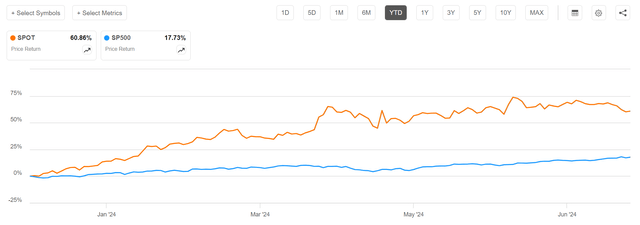
Price Hikes Are Bullish …
In a previous article on Spotify stock I highlighted that I am very bullish on Spotify’s ability to increase prices. However, I must admit that I didn’t expect the music streaming leader to push for higher prices so soon. But this is a pleasant surprise. On June 3rd, Spotify announced that the company is planning for price adjustments in the U.S., following successful price increases in the U.K. and Australia. Overall, price increases range from $1 to $3 per subscriber per month, which should have significant implications for the company’s financial performance.
In fact, Deutsche Bank analysts estimate that the US price increase alone could contribute approximately €70 million to Q3 2024 revenue, assuming the changes take effect mid-July. On an annualized basis, the revenue impact should push north of €300 million by 2025 (Source: Deutsche Bank research note on Spotify, dated June 4th: Price is Looking Right).
While it is unclear when pricing updates should materialize, I expect adjustments to take effect as early as July this year. Interestingly, this marks the second time within a year that Spotify has raised prices, indicating the company’s strong confidence in its strategic position and ability to capitalize on the strong demand and perceived value of its services. The previous round of price hikes, implemented in May in countries like the UK and Australia, appears to have been well-received, setting a positive precedent for the upcoming adjustments in the US.
… While Bundling Strategy Adds To Margin Upside
In addition to the higher prices, Spotify has also made notable adjustments to its bundling strategy. Specifically, I highlight that Spotify has recently introduced a higher-priced audio bundle, which includes music, podcasts, and audiobooks. This bundling strategy, now available in markets representing approximately 50% of Spotify’s user base, is designed to capitalize on the increasing consumption of diverse audio content and maximize user engagement.
In my opinion, the bundling strategy is not merely a short-term revenue booster but a long-term growth enabler. By offering a comprehensive audio experience, Spotify makes an important step towards the company’s broader goal of becoming the world’s leading audio platform. At the same time, the strategic introduction of new pricing tiers, such as a music-only option, provides flexibility for users who might be price-sensitive, thereby mitigating potential churn and maintaining subscriber base stability.
On a profitability level, the new bundled pricing structure is expected to drive gross margin expansion. Analysts suggest that the majority of the incremental revenue from these price hikes will flow through to the profit and loss statement with minimal participation from music labels. This is particularly relevant for the audiobook service, which is believed to be a key driver behind the price adjustments. The introduction of a new basic tier, excluding audiobooks, allows Spotify to segment its offerings and justify the price increases as an added value for enhanced services.
For instance, Morgan Stanley’s analysis suggests that the gross margin for bundled users in the US could increase to 35.7%, up from 27.8% under the previous pricing model (Source: Morgan Stanley research note on Spotify, dated July7th: The Bundler). To give further context, I highlight that the incremental Q3 revenue of €70 million could generate €50-55 million in incremental gross profit, according to estimates projected by Deutsche Bank (Source: Deutsche Bank research note on Spotify, dated June 4th: Price is Looking Right).
Q2 Reporting & Q3 Guidance Preview
Spotify’s is set to report Q2 results on July 23rd before the market opens. As of July 14th, analysts project €3.79 billion in revenue, which I think is very conservative. In fact, I highlight that Spotify’s own guidance stands at €3.8 billion, and the company has a strong track-record in beating its own guidance. Similarly, Spotify’s guidance calls for 250 million in operating income, vs. analyst consensus at 220 million, according to data collected by Refinitiv. Shifting to user growth, I expect MAU and premium subscriber in line with guidance and TTM growth trends, projecting 15-17 million net-adds in MAU and 5-6 million net-adds in premium subscriber, reflecting YoY growth of around 15% and 11%, respectively.
Also relating to the Q2 reporting, I am very bullish on the company’s guidance for Q3. Pointing to the price hikes and bundling efforts discussed earlier, I believe that a significant step-up QoQ in gross profit, operating income and free cash flow could be expected. Moreover, I am optimistic on a likely announcement for a share buyback program, after the company has achieved sustainable, strong free cash flow inflection, paired with a $4.7 billion cash position as of Q1 2024.
Valuation: Raise TP To $453
Shifting focus to valuation, I update my ARPU assumption for 2030 to $44, up 10% from my $40 estimate from 3 months ago. The increased ARPU expectation should reflect Spotify’s more aggressive than expected monetization push and bundling efforts. In addition, I lower my cost of equity assumption by 50 basis points, to 8.5%, mostly as a reflection of lower risk premia across the equity asset class. Based on these adjustments, my base case target price for Spotify jumps to approximately $453, which suggests close to 50% upside compared to the company’s trading price as of early July 2024.
Company Financials; Author’s EPS Estimates; Author’s Calculation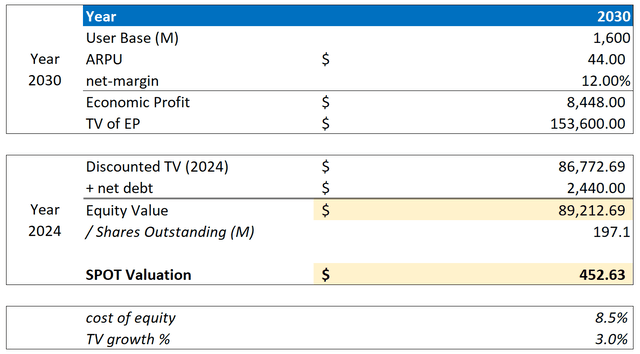
Below I also share the updated sensitivity table. For context, rows project ARPU, while columns project user count (all data for 2030)
Company Financials; Author’s EPS Estimates; Author’s Calculation
Investor Takeaway
Spotify’s price increases and bundling strategy represent a well-calculated move to enhance revenue and improve gross margins: In fact, the company’s ability to raise prices twice within a year in major markets like the US and UK without significant churn demonstrates strong consumer trust and the perceived value of Spotify’s offerings. In my view, investors should take Spotify’s pricing power is a testament to the company’s market leadership and its ability to leverage its vast user base for incremental revenue gains.
Looking to Q2, I expect the upcoming earnings report to broader validate Spotify’s strategic direction and its capability to generate long-term shareholder value, with the announcement of a share buyback program also in the cards. On valuation, I increased my 2030 ARPU estimate for Spotify by 10% to $44. Additionally, I have lowered my cost of equity assumption by 50 basis points to 8.5%. As a result, my target price for Spotify stock now stands at approximately $453. Spotify remains my top investment pick.
Credit: Source link