



DNY59
Dear readers,
I have been fairly bullish on the broader stock market over the first half of the year and have periodically updated you on my positioning, as well as outlook, for the S&P 500 ETF (NYSEARCA:SPY) which constitutes a major part of my portfolio.
Most recently, when the index stood at 5,430 points, I published an article titled Stay Invested, But Pay Attention To These Risks. In particular, I shared my positive outlook for the second half of the year, driven by expectations of declining inflation and a likely Fed pivot, but I also warned against non-negligible long-term concentration and valuation risks.
SA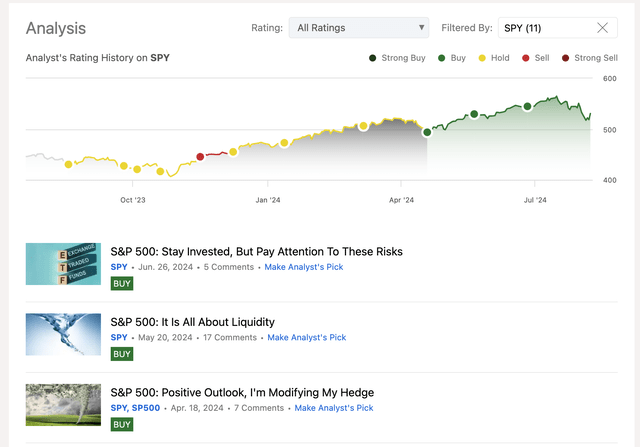
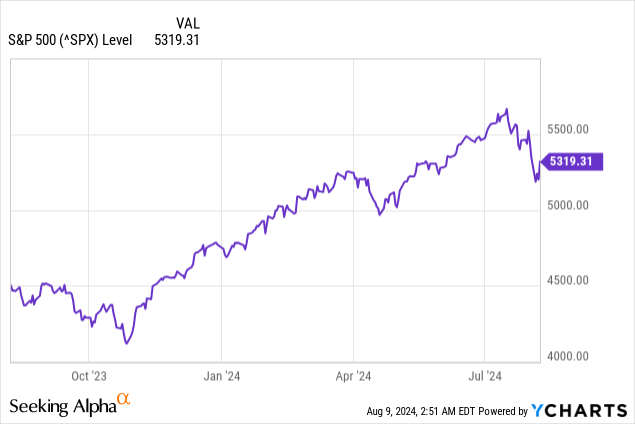
Frankly, investing in the first half of the year has been great (and quite easy). The macro backdrop gradually continued to improve as inflation came down to 3% and the economy remained resilient with solid GDP growth and reasonable unemployment. These macro improvements largely contributed to an impressive 20% increase in the S&P 500, as the index reached a high of nearly 5,700 points.
Last week, however, everything changed, as a number of bearish news send the market into free fall with the largest stock index declining by nearly 10% to 5,150 points. Today, I want to take the opportunity to unpack these new developments and share my strategy for these volatile times.
What happened?
On Monday, August 5th, the volatility index – S&P VIX Index (VIX) – reached a high of 64, a level seen only a few times since the turn of the decade, as investors went into full on panic mode.
Tradingview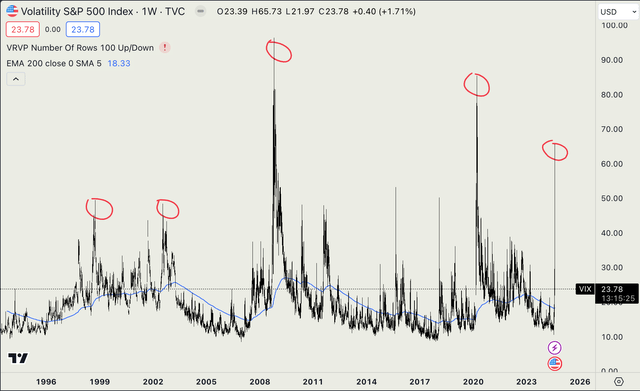
The panic, which manifested into a stock market sell-off, was primarily driven by two events:
- The release of a relatively poor job openings report and a corresponding uptick in the unemployment rate adding to recession fears,
- and a surprise rate hike by the Bank of Japan which resulted in a massive unwind of the USD-JPY carry trade.
The job openings report released last week disappointed big time with only 114,000 added in July, well below the expectation of 175,000. As a result, the unemployment rate increased to 4.3%, up 20bps from just one month ago, marking a fifth consecutive month of MoM unemployment rise with a total cumulative increase of 0.5%.
U.S. Bureau of Labor Statistics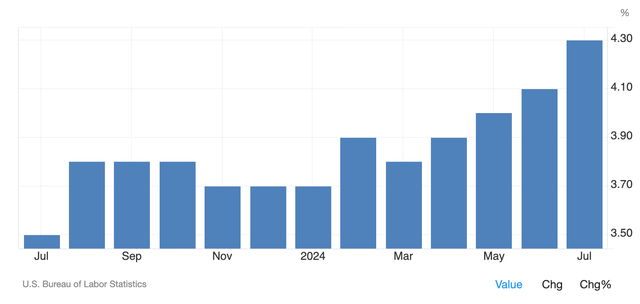
A 0.5% increase may not seem like much, but historically speaking, it is right around the average increase in unemployment rate that we tend to see before a recession. The real run up only happens once the economy officially slips.
Richmond Fed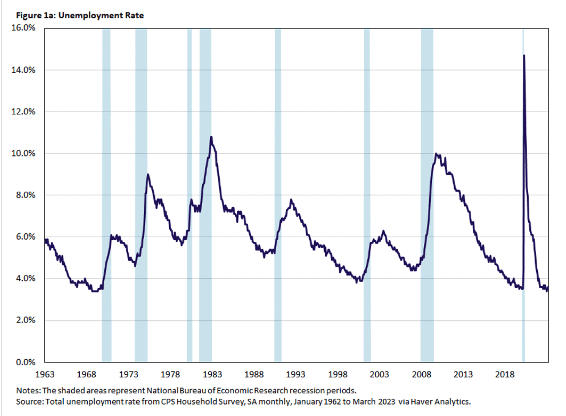
As a result of the weakening labor market, Goldman Sachs (GS) increased the probability of a recession by the end of the year to 35%. A number that is way too high to ignore in my opinion. And while we have since got some slightly comforting news regarding weekly job claims which fell more than expected, there is still a real possibility that we will eventually get the recession which we have been talking about for the past year and a half.
Beyond recession fears, the final blow to the market came from the Bank of Japan which unexpectedly increased their interest rate by 0.25% causing a massive unwind in the USD-JPY carry trade.
In short, investors had been borrowing in Japanese Yen at zero interest rates, exchanging the money for U.S. Dollars, and investing at higher rates to earn the spread. This put a lot of downward pressure on the Yen over the years. But when the central bank raised rates last week, many investors were caught off guard and chose to (or were forced to) unwind their trades.
Unwinding the trade essentially involves selling USD to buy JPY to repay the loans. As a result of the unwind, Yen has appreciated significantly relative to the dollar. More importantly, due to uncertainty (and panic), the Japanese market plummeted by double-digits intraday sending a huge panic wave across the global markets. This is what caused the final capitulation and spike in the VIX.
Since then, the Bank of Japan has essentially capitulated, walking back their expectations of further rate cuts and calming the markets. But while they have essentially declared that they will bail out Japanese markets if need be, that does not mean that U.S. stocks will get bailed out as well.
What’s next?
In fact, I believe that the Fed will drive the economy into a recession.
The Fed has a dual mandate – low inflation and maximum employment. Currently, I’d argue that inflation is a far bigger threat to the Fed (the economy, and the stock market) than a recession. The last thing the Fed wants is to decrease interest rates too fast, allowing inflation to re-ignite, as this could have devastating consequences similar to the 1970s. While certainly nobody wants a recession, from an inflation standpoint it’s actually healthy. Therefore, I expect the Fed to (once again) cut rates too late and by too little, choosing the lesser of two evils (i.e. a recession). Especially knowing that they have a lot of ammunition in a form of 5%+ of potential rate cuts to stimulate.
Historically, a (forced) rate cutting cycle has been bearish for stocks and the market has only bottom once interest rates have bottom. Since it now seems quite possible that we will enter a recession and not a soft landing, it’s only fair to be more bearish on the S&P 500, especially when factoring in the upcoming election which comes with high uncertainty and volatility.
Tradingview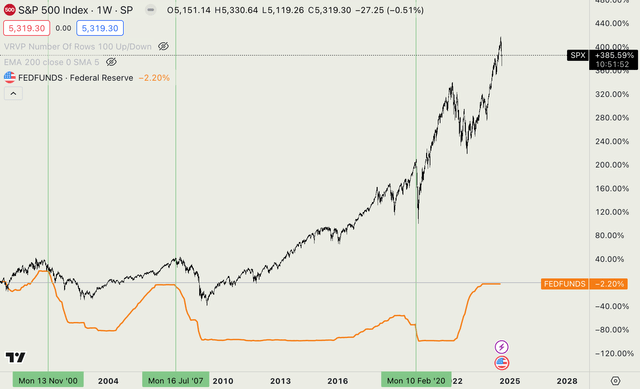
Bottom Line
Therefore, I’m cautious to add to my position at this time. Rather, I have been selling out-of-the-money puts on some of my favorite names, including the S&P 500, to take advantage on excessively high volatility.
All things considered, I downgrade the S&P 500 to a HOLD, until the election or until we get more clarity regarding the weakening jobs market.
Editor’s Note: This article covers one or more microcap stocks. Please be aware of the risks associated with these stocks.
Credit: Source link