

Kameleon007
First, let’s get a few things straight. I just passed the 20-month mark since I started writing on Seeking Alpha. More than 300 articles and 2,100 comments and responses later, I’ve developed some strong opinions about what I think matters in modern investment markets. I’m not talking so much about what to buy and sell at any point in time, but what behaviors and elements of an investment process provide me with the best trade-off between making consistent positive returns, and not losing “big.” Everyone defines big loss differently. Frankly, for me, losing more than a few percent on my entire portfolio is unacceptable to me. Because after 30 years of investing “other people’s money” and now 4 years into my family being “the client,” I am convinced that competitive, lifestyle-maintaining returns can be had year in, year out, without having to deal with what many investors willingly accept. I think they do that in some cases under the guise of “I’m a long-term investor. Someone told me an expression a while back: the definition of an investor is a disappointed speculator! We all want to make money over the long run. But at what cost to our portfolio and our psyche over the interim period?
My key takeaways for modern investors
After all of that research, writing about it, and exchanging opinions with so many enthusiastic and well-intentioned investors over the past 20 months.
1. Past performance in investing is focused on misleading aspect of that performance
Market prices are a behavioral science of their own, and I think more investors should study it. Instead, many simply say “the market has always gone up, and it will go up in the future.” That’s too vague for a analytical type by me. And very naive. Things like “the stock market always goes up” ignore what has occurred throughout market history, and is more likely to occur going forward. It is as much an element of human behavior as anything else.
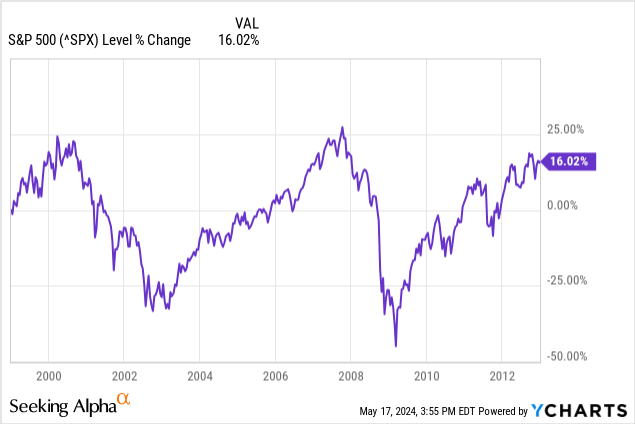
Above, that’s a picture of a period (1999-2013) in which the S&P 500 went everywhere. But after all that time, it averaged about 1% per year. And depending on where you started your “past performance’ tracking you had a big green number, a big red figure or somewhere in between. Yes, I excluded dividends, but those are not a big part of the S&P 500 going forward, since companies tend to buy back stock a lot more, and the biggest index components pay no or low dividends.
Below, here’s a chart of 10-year annualized returns of the S&P 500 over a period that covers a good chunk of the present century. What’s my point? Don’t fall for the “recency effect.” The stock market is not what many think, and while history is not to be taken literally, neither should we assume that the only range of possible outcomes is the ones we’ve seen.
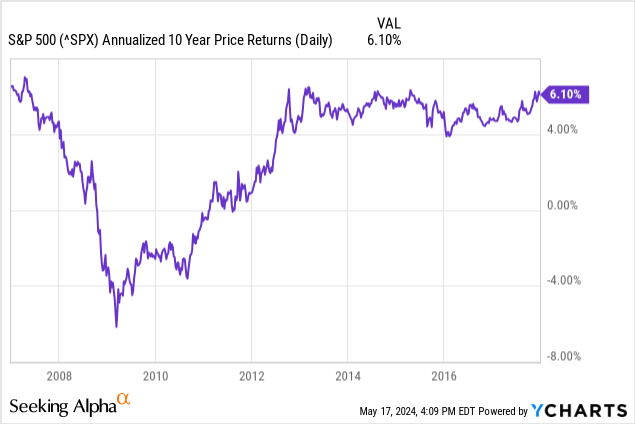
That’s a long time to go without many S&P 500 buy points producing more than a 6% annualized return. And today, we have inflation impacts and as mentioned above dividends can help, but we have to be crafty in that area too. I’ll have a lot more on that in an article next week, where I present my about to be completed 40-stock portfolio.
2. Too much focus on “picks” over process
I laugh every time someone comments on one of my articles from a few days ago, a few months ago, or in some cases things I wrote well over a year ago. The most important part of any investor’s genetic makeup should be the constant willingness and ability to adapt. Conditions don’t stand still in the markets. As such, forecasting the future is fine, but investing rigidly based on that forecast is just plain dumb.
I think of every investment decision as being a trade-off between reward potential and potential for major loss. And, each security I own is part of a bigger puzzle. I’m not picking stocks or ETFs, I’m constructing a living, breathing portfolio of securities, that work together like a rowing team. Not like a tennis player. Different aspects and skills of each team member (portfolio holding), rather than it all relying on one. I try to educate in this regard, but I’ve done about all I can do in that area. And I am truly grateful to the many, many investors who not only follow me on Seeking Alpha and elsewhere, but who do so recognizing what the best alignment should be between those like me who have been around, and those who seek to learn from my mistakes and successes. But most of all, from how I organize a portfolio to drive toward an outcome with much lower potential for drastic outcomes than many “experts.” This is what comes from having been a fiduciary for 27 years, until I sold my advisory practice.
That background was the prologue for this article. Now, to the specifics of what the S&P 500 looks like to me now, and how I am looking forward. Because when I do, I see a bull case for the market…not a “prediction” about what the market will do, but an analysis of what I think could be a higher-percentage shot for me than a lot of the “stay the course, own the market, corrections are healthy types of BS that surrounds us.”
Here’s VOO’s current allocation to the 11 S&P 500 sectors.
Seeking Alpha 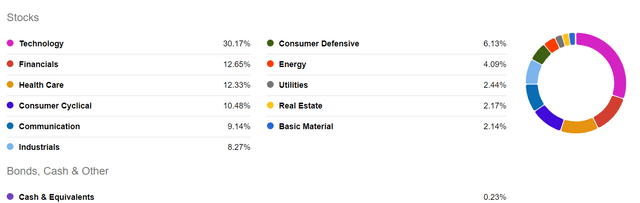
I see 4 sectors that really don’t matter in the broad index. Energy, Utilities, REITs and Basic Materials. Yet those 4 are a big part of my portfolio now. Because my stock selection and ETF allocation process has led to a lot of T-bills, and an above-average exposure to sectors and stocks that don’t make the headlines the way the Magnificent 7 do. And THAT is the key point. I think there’s a big risk in being heavily invested in what HAS worked.
There are 2 other sectors that have only modest impact on what we hear when the S&P 500’s performance is reported. Consumer Defensive or “Staples” is 6% of VOO and Industrials, the most diverse sector of the 11 in that it doesn’t tilt heavily toward a few giant stocks, is around 8%.
So, that’s 6 sectors totaling only 25% of VOO. That leaves 5 others that account for 75% of it. That has worked for a while, but I think the risk many investors are taking is in following the index too closely. Because we’ve seen this movie before, where a shift in leadership occurs, but many investors don’t realize until too late. They think the “market” is fine but don’t realize they are focused only on what the top-heavy math of VOO makes them think is going on.
A top-heavy index that blinds investors to the forward-looking opportunity
Here are the top 10 holdings as of the end of last month. My guess is that many investors could name most of these blindfolded. Because the overwhelming amount of coverage devoted to them is akin to what we see on sports talk shows, where perhaps 10 players in an entire league hog 90% of the media time. That’s not because the players seek it, but because the media tends to keep plugging the same “in vogue” names over and over again. The whole “search engine optimization” aspect of modern media feeds right into this.
Seeking Alpha 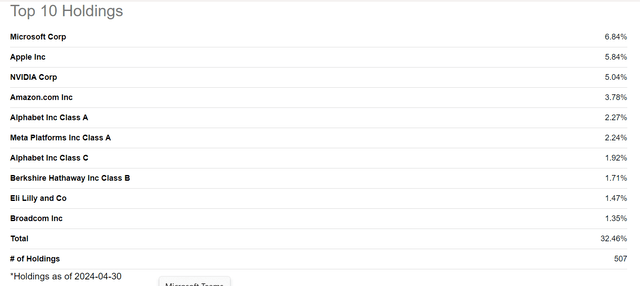
And THAT is where I think a big opportunity sits for investors, going forward. The index is capitalization-weighted, and when markets go up over time, VOO increasingly favors yesterday’s winners. That feeds on itself for a while, but at some point it implodes. And that is when investors who blind themselves to the inner workings of that “headline” S&P 500 Index.
So many investors I encounter don’t know nearly enough about what they own. They simply know it did well in the past, and they know what others have said about it. Sometimes, those “others” are the people whose lifestyle and financial well-being is heavily reliant on the continued rise of the stock market. So really, can their opinions matter? For decades, I’ve seen investors get taken advantage of this ever-present factor in investing, the desire to be part of the “herd.”
Where’s the bull case now?
I think it boils down to this:
1. The smaller S&P 500 sectors are where the higher reward/risk trade-off is
2. A proverbial “stock pickers market” is gradually replacing the dominance of a small number of stocks
3. In every sector, the strongest risk-adjusted performers will likely be companies that are not among the top few in their sector by market cap, but also not among the smallest. That is, the S&P 500 top 50 or top 100 is less prone to continue to carry the rest of the market. If there were an ETF that, say, filtered the S&P 500 down by cutting out the top 50 and choosing, say 100 stocks to focus on from there, that would be where I think a lot of the 3-5 year opportunities lie. In fact, I think I’ll conduct that filter and compare it to the 40-stock portfolio I’m finishing building (I have 34 as of this writing, and I am adding the last ones this week). I’ll report the “finished” set here soon.
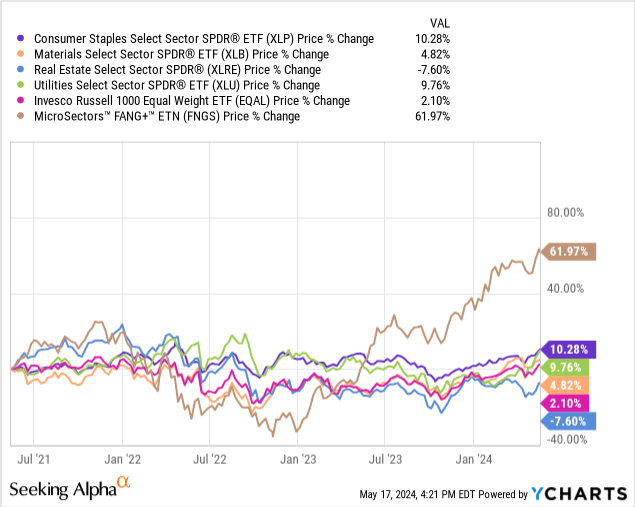
What’s driving all of this?
Valuation is part of it, technicals are another big part of it, and the nature of market cycles is another key contributor to my view. Here’s an example of the last time this type of shift occurred, and again why past performance is a muse, not an investment factor to take as literally as many do.
Past performance: don’t get fooled again
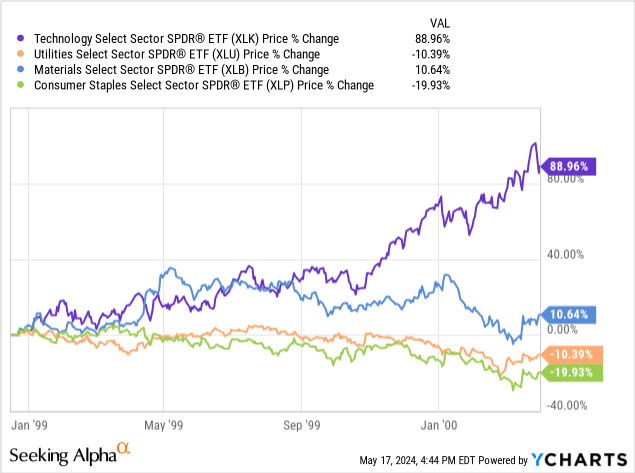
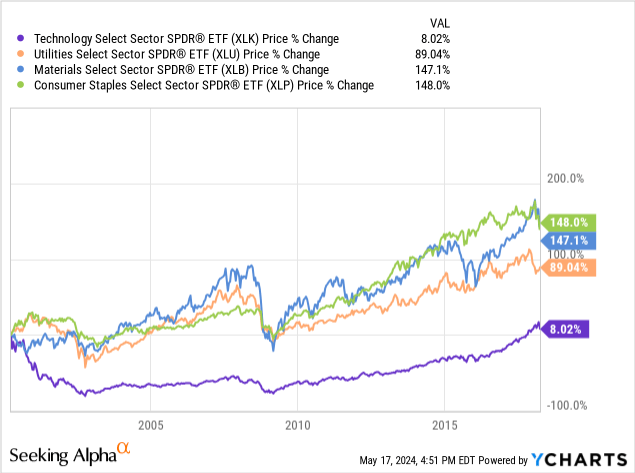
The SPDR Sector ETF series didn’t start until late last century, but here’s how they started, from 1998 through early 2020. Which would you buy? Many would simply say “tech did well, it is the future, it will continue to do well.” That’s essentially what I hear from some commenters. Is it that simple? No. Performance leadership can persist for longer than we think, but that “market of stocks” still has a say over time.
Because the second chart below is what happened during 18 years following that tech surge. Remember, the construction of VOO currently means that the “little sectors” can lead for years before the broad index will reflect it. This is so important to keep in mind.
Summing up…for now
My thesis here is simple:
1. The market is not what many think it is, following such a top-heavy, late last century-type period, the long-term value and even a lot of near-term upsides is likely to come from places investors are not accustomed to. That requires them to conduct a more thoughtful type of research than needed to get strong results in the recent past.
2. Past performance is valuable, but not simply applying it in one fell swoop. Markets are cyclical, long-term and shorter-term. That’s going to matter more than ever now, given the newer market forces at work.
3. Many parts of the market took a breather the past few years, and that could end up being a “pause that refreshes” as opposed to needing a full flushing of the whole stock market, all sectors. The leading sectors that now dominate VOO are more vulnerable, and the smaller ones are more intriguing based on my stock-specific, bottom-up research I conducted to construct my 40-stock portfolio.
4. Stocks from every sector have potential. But the era of 5–10 stocks driving all performance for years at a time is, in my view, gradually ending.
Credit: Source link