
jetcityimage/iStock Editorial via Getty Images
I gave Sherwin-Williams (NYSE:SHW) a ‘Hold’ rating in my previous coverage published in December 2023, expressing concerns about the residential housing market. Since the publication, the stock price has underperformed the S&P 500 index by more than 12%. The company is scheduled to release its Q2 result on July 23rd prior to the market opening. I anticipate the weakness in its paint stores will continue in the coming quarters. Since the stock price is still overvalued, I downgrade the stock to a ‘Sell’ rating with a fair value of $270 per share.
Weak Paint Store Growth Might Continue
In Q1 FY24, Sherwin-Williams experienced a 0.1% decline in its Paint Store same store-sales growth (SSS), as illustrated in the chart below. The weakness was caused by the sluggish new residential housing market. Its revenue growth in the new residential market declined by MSD during the quarter.
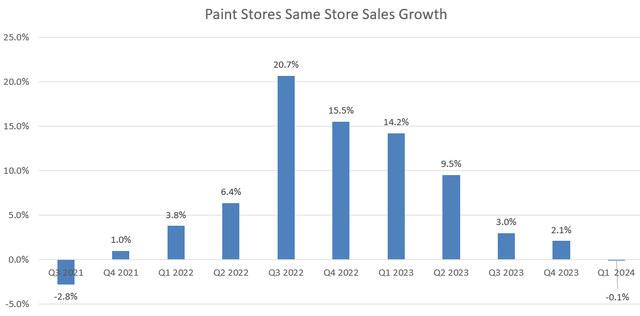
Sherwin-Williams Quarterly Earnings
The Paint Group business is quite important for Sherwin-Williams’s overall growth, as the segment accounts for more than half of total sales. For the coming quarters, I anticipate the weakness in the Paint Group will persist for the following reasons:
- Amid the current high mortgage rate, the housing starts have shown continued weakness in the U.S. market. As depicted in the chart below, the housing starts haven’t shown any recovery in recent months. The weakness in the residential housing market could potentially put growth pressure on Sherwin-Williams’s Paint Group.
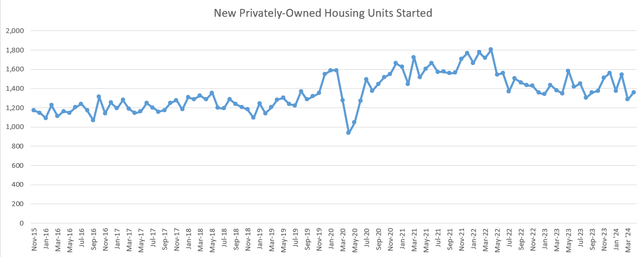
U.S. Department of Commerce
- Sherwin-Williams raised its product price by 5% on February 1st, 2024, and anticipates continuing to raise price in the coming quarters. The price increase could potentially offset the weakness of volume growth. However, I doubt the company has enough pricing power to raise its price several times in 2024. The US consumer confidence index has been declining in recent months due to the affordability issue and tightening of cash flows for individual/families.
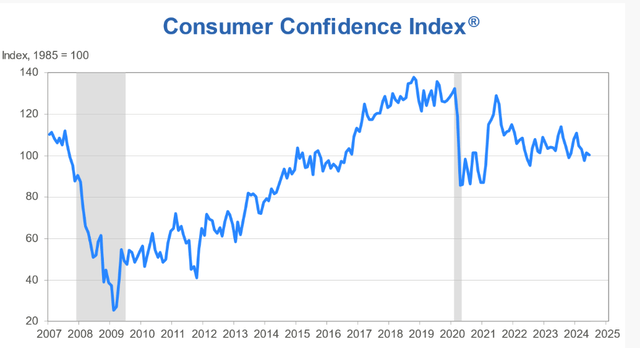
The Conference Board
Q2 and FY24 Outlook
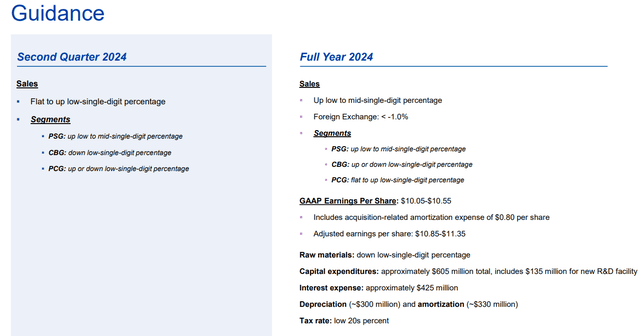
The company guided flat to LSD growth in revenue for Q2 FY24, and low-to-MSD growth for the full year, as detailed in the slide below.
Sherwin-Williams Investor Presentation
I think the current guidance is a bit optimistic, and I am considering the following factors:
- The current guidance implies several price hikes during FY24. As discussed earlier, I doubt Sherwin-Williams has the capacity to raise its price several times without meaningfully impacting its volumes. The current consumption of goods is quite weak in the U.S. market, as individuals/families have to pay more for their mortgages, rents and transportation costs.
- According to the latest report from U.S. Department of Commerce, the permits for future construction of single-family houses dropped to a one-year low in June. Unless the Fed starts to cut the interest rate soon, it would be hard to expect the housing market to recover in the near future.
I forecast Sherwin-Williams will deliver flat organic revenue growth in FY24, assuming a 3% price increase and 3% volume decline.
Valuation Revision
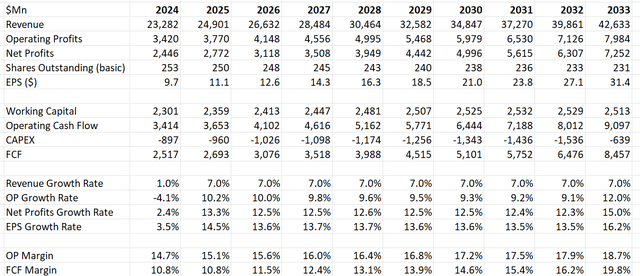
As acquisitions are part of Sherwin-Williams’s growth strategy, I assume the company will spend 2% of revenues on acquisitions, contributing 1% to the topline growth.
For the revenue growth from FY25 onwards, I anticipate the company will recover its 6% organic revenue growth rate, assuming:
- I anticipate the Fed will cut interest rates later this year, followed by several cuts in 2025. The mortgage rate will decline over time, resulting in a recovery of U.S. residential housing market.
- Sherwin-Williams can continue its annual price increase to offset inflation and operation costs. I assume the company will deliver 2% pricing growth.
- The volume growth is forecasted to be 4%, aligning with the historical average.
I assume 40-50bps of annual margin expansion, assuming 20bps from gross profit leverage, and 20-30bps from SG&A driven by the company’s cost cutting efforts.
Sherwin-Williams DCF – Author’s Calculations
The WACC is calculated to be 7.4% assuming:
- Risk free rate: 4.2% (US 10Y Treasury Yield)
- Beta 1.18 (Seeking Alpha)
- Equity risk premium 7%; cost of debt 7%
- Debt balance $10.5 billion; equity $3.7 billion
- Tax rate: 20%
Discounting all the free cash flow, the fair value of the stock price is calculated to be $270 per share.
Upside Risks
As I gave a ‘Sell’ rating to Sherwin-Williams, I am considering the following upside risks:
- Sherwin-Williams increased its cash dividends and share buyback in Q1 FY24, maintaining a 2-2.5x net debt to EBITDA target. The company could potentially accelerate its stock repurchase in the second half of FY24. In that case, the stock price might get some technical support from the buyback.
- The Fed might cut interest rates earlier and more frequently than the market expected, which could boost sentiment in the U.S. housing market. In this scenario, Sherwin-Williams’s growth could recover much earlier than I anticipate.
Takeaway
While I agree that Sherwin-Williams is a high-quality and well-managed coating company, the weakness in the new residential market and poor consumer sentiment could put tremendous growth pressure on the company’s business. The stock price is overvalued; therefore, I downgrade the stock to a ‘Sell’ rating with a fair value of $270 per share.
Credit: Source link