

piola666
Shell plc (NYSE:SHEL) is currently backpedaling their decarbonization initiatives as seen throughout the last half-a-decade as management refocuses the firm’s resources towards maximizing shareholder value. This transition emphasizes liquids and gas production as well as a strong focus on their integrated gas business by expanding their LNG trading footprint. Despite this turn, I believe management will remain prudent in tooling the company’s operations to meet the demand if the energy transition takes a stronger foothold later in the decade as it pertains to renewable fuels and biofuels. Given Shell’s enhanced focus on maximizing and optimizing operations, I recommend SHEL shares with a BUY rating with a price target of $78.56/share at 4.06x eFY25 EV/aEBITDA.
Shell Operations
FinChat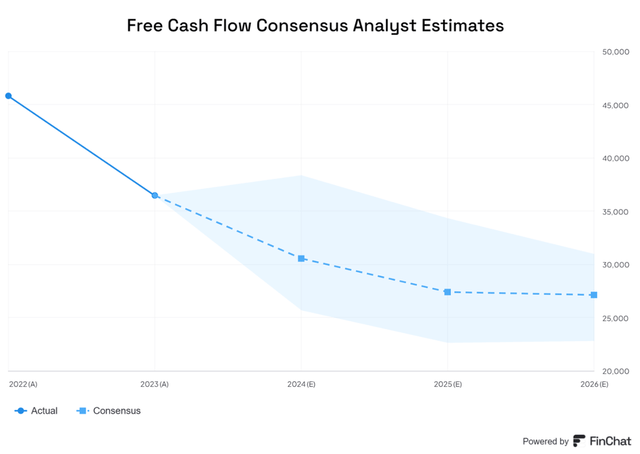
Shell is currently undergoing major changes to how the firm thinks about energy and decarbonization. It hasn’t even been 3 years since Shell completed its sale of its Permian Basin assets to ConocoPhillips (COP) in December 2021 at a time when the Dutch oil company was steering the ship towards a more renewable playbook. Fast forward to their latest capital markets day, the firm is projecting a 500Mboe/d increase in production by 2025. Whether all of this was a part of the plan is questionable, but one thing is for certain, management is sidelining less profitable biofuel projects in favor of hydrocarbons.
That’s not to say that the firm has completely turned a blind eye to biofuels; projects will likely be postponed to the end of the decade, when demand is expected to pick up. Despite there being a lot of interest in biofuels, adoption of these sustainable fuels isn’t moving forward as fast as one may have presumed, resulting in the misalignment of investment outlays and demand. Today’s economics just do not align with Shell’s business, given the higher feedstock costs paired with moderating product prices. As a result, management made the decision to pause the facility in Rotterdam, intended to be one of the largest production facilities of sustainable aviation fuel and renewable diesel.
Regional governments aren’t helping with the matter, either. According to an article published by Reuters, Sweden cut their biofuel mandate. Finland and Germany have also made reductions to their biofuel mandates, making the practice of fuel blending less appealing from an economic standpoint. For the most part, management hasn’t yet abandoned their long-term strategy of producing biofuels; however, management suggested in the q2’24 earnings call that government mandates will likely be required in order to bring more demand into this market.
Ironically, just as Shell is favoring hydrocarbons more heavily, the British government brought forth a multibillion-dollar initiative to further entrench the country into renewable resources. According to the Wall Street Journal, Great British Energy, a state-funded investment initiative that is funded by taxes on O&G production, has roughly $11b to invest in renewable projects in the region, bolstering the country’s capacity of onshore wind and solar over the course of the next 5-6 years. This initiative doesn’t appear to be well received by the oil giant, as it may undermine energy stability.
However this is played, the stability is key. More changes at the goal posts just undermines the element of stability that we would advocate for.
Wael Sawan, CEO, Shell
Looking to oil and gas production, management’s focus on maximizing shareholder value has become more apparent in recent quarters as the firm transitions its focus back to hydrocarbons. This includes investing oil & gas developments and LNG terminals. On the integrated gas side of the business, Shell is actively increasing their presence in the LNG trade as the firm builds out or acquires liquefaction facilities. This includes Shell’s recent acquisition of Pavilion Energy, which will bring in 6.5MTPA of contracted supply volumes. In addition to this, Shell is partnering with ADNOC Ruwais LNG on a project in Abu Dhabi and has taken FID on the Manatee Backfill project in Trinidad and Tobago.
Shell Financials
Corporate Reports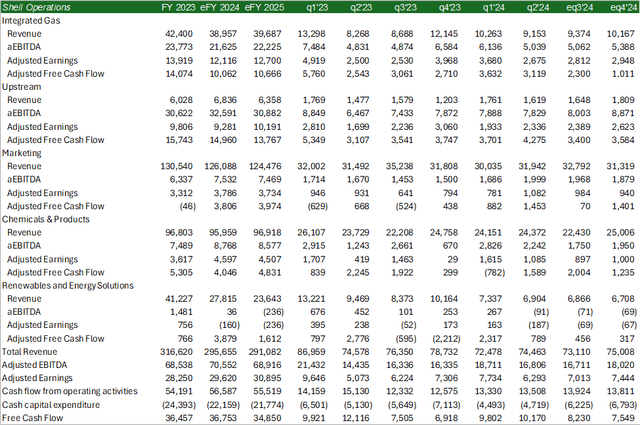
Mapping out financials for Shell, management laid out a relatively flat production rate going forward as the firm manages their cash position. Total production across segments is expected to grow by an additional 250Mboe/d through 2025 as the firm brings online additional gas fields and offshore rigs in the GoM and Brazil. This includes Vito and Rydberg in the GoM, Mero-2 in Brazil, Block 10 in Oman, and Timi and Jerun in Malaysia. Shell has additional projects expected to start, such as Mero-3 in Brazil and Penguins in the North Sea. The firm took FID on Atapu-2 in Brazil and Sparta in the GoM. Management anticipates these investments to maintain liquids production in the range of 1.4MMbbl/d through the end of the decade.
In renewable and energy solutions, management is focused on high grading their portfolio in order to support future energy transition. This includes the exit of their Home Energy business in Europe in 2023 and will likely continue shrinking this segment through the end of the decade. Despite the slowdown in renewables, Shell announced FID for Polaris in Canada, their carbon capture sequestering project that is expected to capture 650,000 tonnes of CO2 annually. Shell also announced FID with the Atlas Carbon Storage Hub in partnership with ATCO EnPower as part of the Polaris project. These projects are expected to commence operations towards the end of 2028. In chemicals, Shell exited the Energy and Chemicals Park in Singapore and their ownership rights in the PCK Refinery in Germany.
Translating this to cash flow, I forecast Shell to generate $36.75b in free cash flow in eFY24 and $35.37b in eFY25. The decline in eFY25 is the result of the decline curve pricing Brent futures in the mid-to-low-$70s/bbl in 2025 paired with stronger natural gas futures pricing.
Valuation & Shareholder Value
Corporate Reports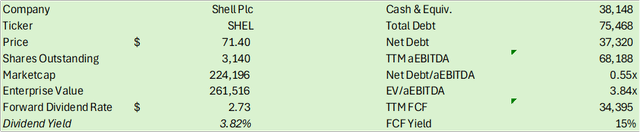
SHEL shares trade at a premium over its European peers and remain at a significant discount to the domestic IOCs. I believe that the company is making the right moves to create additional shareholder value to migrate closer to its domestic peers. For example, management announced a $3.5b share repurchase program for eq3’24, which should conclude at the end of the quarter. Shell also poses a strong forward dividend yield relative to Exxon Mobil (XOM) and Chevron (CVX) at 3.82%; however, this falls below the total average of the cohort at 4.4%.
Seeking Alpha
Based on my forecast for cash flow generation, I believe SHEL shares are slightly undervalued at their current premium of 3.84x trailing EV/aEBITDA. I believe that the firm has some room to expand their trading multiple if management continues their robust share repurchase program. I rate SHEL shares with a BUY recommendation with a price target of $78.56/share at 4.06x eFY25 EV/aEBITDA.
Corporate Reports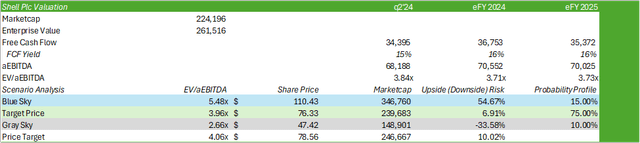
Credit: Source link