Automated code generation is a rapidly evolving field that utilizes large language models (LLMs) to produce executable and logically correct programming solutions. These models, pre-trained on vast datasets of code and text, aim to simplify coding tasks for developers. Despite their progress, the field remains focused on addressing the complexity of generating reliable and efficient code, especially in the face of intricate problems that require precision and creativity.
A significant challenge in code generation lies in navigating the vast search space to produce correct and optimized solutions. Existing methods often fail to effectively address multi-stage planning and debugging, leading to limitations when handling more complex tasks. Moreover, using brute-force methods to generate large code samples has proven inefficient. At the same time, refinement-based approaches frequently encounter the problem of getting stuck in suboptimal solutions.
Current methodologies in the field include strategies such as brute-force generation, iterative refinement, and the application of feedback mechanisms. Brute-force methods attempt to improve the likelihood of generating a correct solution by sampling many outputs. Iterative approaches refine a smaller set of solutions based on feedback from execution outcomes. Despite their utility, these methods need more scalability and often need to leverage the full capabilities of LLMs in generating diverse and innovative solutions.
Researchers from the University of Texas and Salesforce Research introduced a groundbreaking framework called CodeTree to overcome these limitations. CodeTree employs a tree-based structure for the code generation process, enabling systematic exploration and refinement of solutions. At its core, CodeTree leverages multiple collaborative agents, including a Thinker agent for strategic planning, a Solver agent for generating initial code, and a Debugger agent for refining solutions. These agents are guided by a Critic agent, which evaluates and scores each solution dynamically based on execution feedback and AI-generated insights.
The CodeTree framework constructs a heterogeneous tree, with each node representing a potential solution. The Thinker agent generates multiple strategies, each serving as a tree branch. The Solver agent then produces initial implementations, which are tested and critiqued by the Critic agent. Based on this feedback, the Debugger agent refines or rejects solutions, ensuring the search space is efficiently traversed. This method allows for flexible decision-making, with the Critic agent determining whether to expand, abort, or finalize a given path in the tree. The collaboration among these agents enables CodeTree to identify optimal solutions while avoiding redundancy and inefficiency.
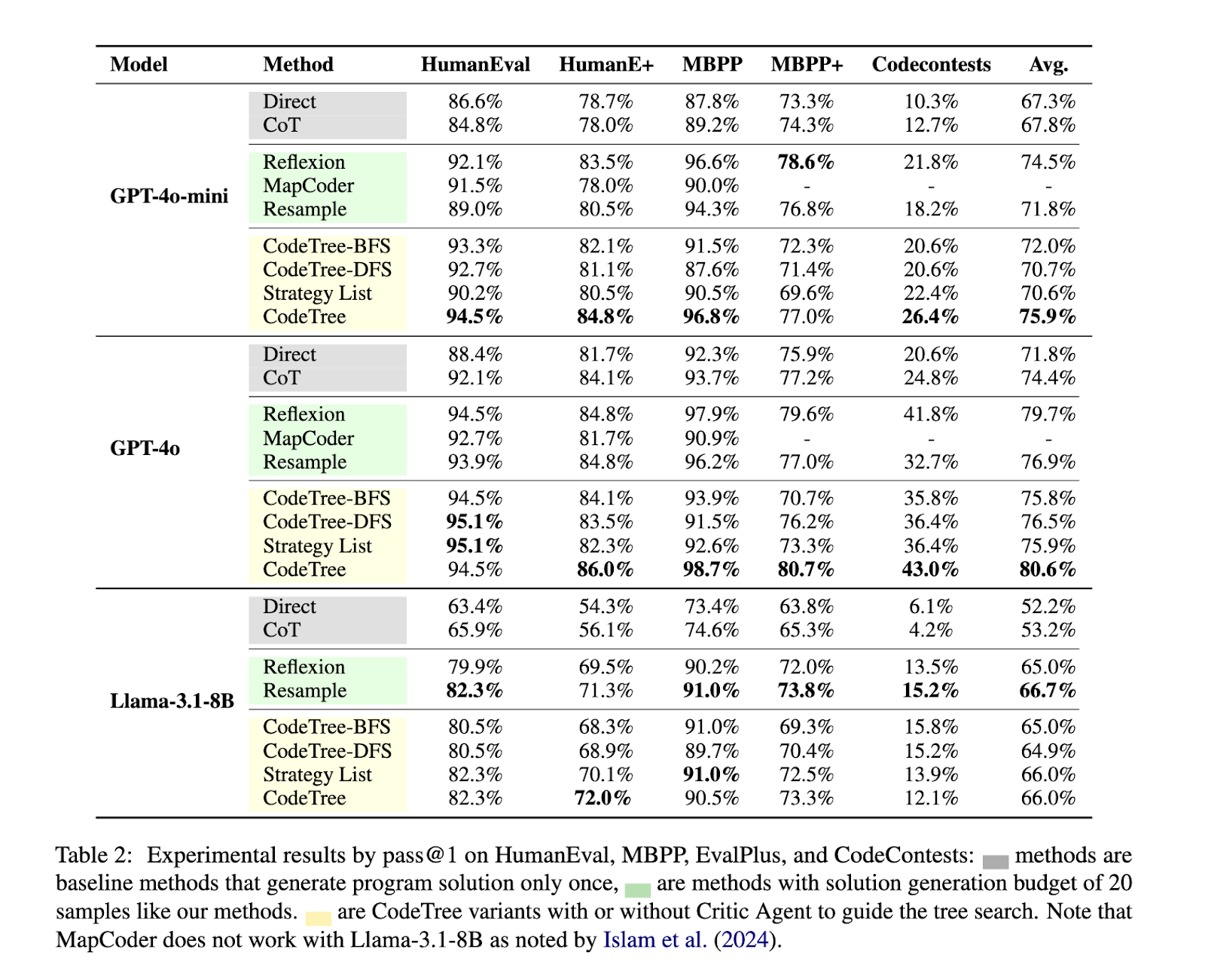
The researchers comprehensively evaluated CodeTree across several challenging benchmarks. Using GPT-4o as the base model, the framework achieved remarkable results. It scored 95.1% on HumanEval, 98.7% on MBPP, and 43.0% on CodeContests, outperforming traditional approaches. Notably, the system excelled on the SWEBench benchmark, which generates code patches for real-world Github repositories. By adapting its strategy to this complex task, CodeTree effectively handled large search spaces. The experiments highlighted that CodeTree outperforms strong baselines like Reflexion and MapCoder by significant margins, particularly in challenging competition-level tasks.
Further analysis revealed the advantages of CodeTree’s search strategies. Breadth-first search (BFS) proved more effective than depth-first search (DFS) for exploring diverse strategies. The Critic agent played a crucial role, with tasks like solution verification and node scoring significantly improving performance. For example, excluding these tasks resulted in a noticeable drop in accuracy. The ability of CodeTree to dynamically adjust its exploration depth and breadth ensured that the system could adapt to problems of varying complexity, making it a versatile tool for automated code generation.
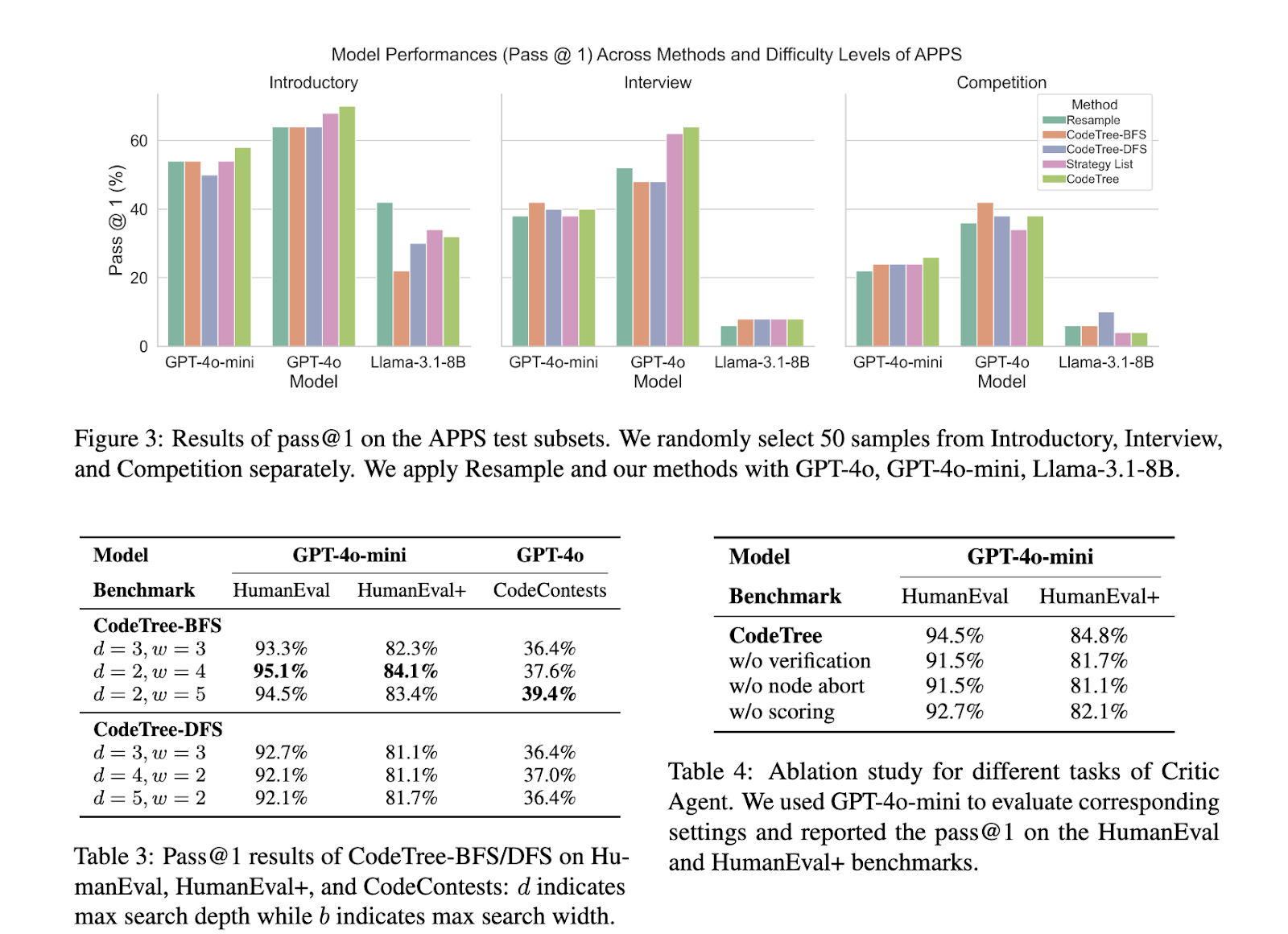
The results demonstrate that CodeTree is not only efficient but also scalable. Even with a limited generation budget of 20 samples per problem, the framework achieved high accuracy across benchmarks. This efficiency suggests that the system could perform even better with an increased budget, highlighting its potential for practical applications in software development and competitive programming environments.
In conclusion, CodeTree offers a transformative approach to automated code generation by combining structured exploration with multi-agent collaboration. The framework Developed by Salesforce Research effectively addresses existing methods’ limitations, providing a robust solution for tackling complex coding challenges. With its ability to navigate vast search spaces and achieve high accuracy, CodeTree sets a new standard for future advancements in the field.
Check out the Paper. All credit for this research goes to the researchers of this project. Also, don’t forget to follow us on Twitter and join our Telegram Channel and LinkedIn Group. If you like our work, you will love our newsletter.. Don’t Forget to join our 60k+ ML SubReddit.
🚨 [Must Attend Webinar]: ‘Transform proofs-of-concept into production-ready AI applications and agents’ (Promoted)

Nikhil is an intern consultant at Marktechpost. He is pursuing an integrated dual degree in Materials at the Indian Institute of Technology, Kharagpur. Nikhil is an AI/ML enthusiast who is always researching applications in fields like biomaterials and biomedical science. With a strong background in Material Science, he is exploring new advancements and creating opportunities to contribute.
Credit: Source link