
VioletaStoimenova
H2 2023 Results
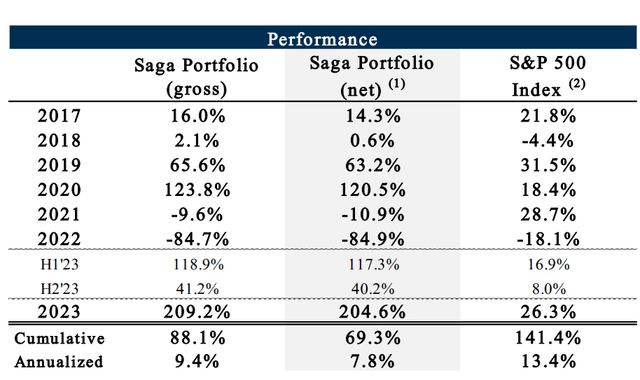
During the second half of 2023, the Saga Portfolio (“the Portfolio”) increased 40.2% net of fees. This compares to the overall increase for the S&P 500 Index, including dividends, of 8.0%. For the full year 2023, the Portfolio increased 204.6% net of fees compared to the S&P 500’s 26.3%.
The cumulative return since inception on January 1, 2017, for the Saga Portfolio is 69.3% net of fees compared to the S&P 500 Index of 141.4%. The annualized return since inception for the Saga Portfolio is 7.8% net of fees compared to the S&P 500’s 13.4%. Please check your individual statement as specific account returns may vary depending on the timing of any contributions throughout the period.
Interpretation of Results
Despite the share prices of our companies increasing from their 2022 year-end lows, returns since inception remain below the S&P 500 Index. That is disappointing since the goal is to outperform over the long term. What else is the point of actively picking stocks if it is not to beat a passive index?
As I reflect on the last seven years since the Saga Portfolio’s inception, obviously mistakes have been made. Under Armour (UA) and GoodRx (GDRX) are bigger ones that come to mind. Mistakes are bound to happen since we are working with a foggy future. The goal is for the more successful investments to outweigh the disappointments in order to provide an overall attractive result.
The irony is that the mistakes were not what led to the majority of the Portfolio’s decline in 2022. They only made a modest dent to results. It was the share prices of Carvana (CVNA), Roku (ROKU), Redfin (RDFN), and Meta Platforms (META) that made up the majority of the 2022 drawdown and relative underperformance. It was those companies that I considered, and still consider to varying degrees, some of the most promising long-term opportunities. Where their share prices are today is what makes me excited for the future results of the Portfolio.
Identifying investing mistakes is not always obvious. It is not perfectly clear if prior decisions were good or bad just because a certain outcome has occurred thus far. Owning a stock with a declining share price is not a mistake in and of itself. If one decides to actively seek out misunderstood stocks that the market undervalues, it does not mean that those stocks will become better understood by the market immediately after purchase or within the timeframe they desire. Even the very best businesses endure challenging periods or perhaps miss short-term expectations that result in significant share price declines. It can be difficult to decipher whether deteriorating fundamentals and a falling share price are a near-term setback that will be overcome in time or are more permanent in nature and appropriately reflect a less promising future. During such times, the only person one can look to for answers is oneself, because the market, headlines, and majority of other people will be yelling “SELL!” regardless of whether the company has a bright future.
Perhaps the most widely followed example of a company in the Saga Portfolio that faced extreme share price volatility and fundamental challenges, while the investment thesis remained intact was Meta Platforms. During 2022, Meta experienced multiple competitive threats surrounding Apple’s iOS App Tracking Transparency (ATT) (AAPL) changes that limited sharing user data across apps, the rise of TikTok, and increased scrutiny surrounding spending on its Reality Labs segment. Headlines framed Meta as a company that could easily be disrupted by the next social media trend, dependent on the whims of Apple, and a reckless CEO who was hellbent on his wasteful pet project, the Metaverse.
One could point to stagnating advertising revenues, rising expenses, and increased capital expenditures that resulted in declining free cash flow as signs of a business in trouble. Anecdotally, there were unhappy employees and numerous articles and surveys of teenagers viewing Facebook and Instagram as “uncool.” Wall Street analysts explained the low valuation multiple on terminal value risk and critics claimed long-term investors in the stock suffered from thesis drift, unwilling to admit they were wrong.
This fed into a falling stock price that led to further price declines. The first 50% price drop to $190 may have been a buying opportunity, but was the second 50%+ decline to $90 a signal of a company in terminal decline? Emotions run high as investors see their paper wealth disappear. Investors think, “it’s been over seven years with zero return. I should have just bought the S&P 500 Index! How could management have been so careless with investors’ capital?” I summarized my views surrounding Meta at the time in the Appendix of the Q2’22 Saga Investor Letter.
Mark Zuckerberg was put through the wringer by the media. If one was able to look past the headlines and dig a little deeper, Zuckerberg had historically been very transparent in explaining his vision and goals for the company and successful in executing on that vision. During 2022, Meta faced very real challenges and Zuckerberg was clear about the company’s strategy in addressing those challenges going forward. Despite the negative sentiment surrounding Meta, active user and engagement trends remained strong through the end of 2022. Reels, Meta’s shortform video product in response to TikTok, was growing rapidly but was not yet being fully monetized. If the company continued to execute well, then the fundamentals would eventually recover, and the market would revalue the company higher.
Regardless of what happens to a company’s share price in the short-term, it must eventually track the long-term earning power of the company. If Meta consistently earned $50 billion in free cash flow and was valued at a $200 billion market cap, it would not take long for the company to repurchase all outstanding shares. As fewer shares become available to purchase, the remaining shareholders would require a higher price to sell. Of course, determining Meta’s earning power far into the future is the determining factor.
Even if a company currently generates no free cash flow because they are reinvesting in growing earning power and therefore not able to repurchase shares, eventually the company’s reinvestment opportunities will become saturated. Growth will slow and the true earning power of the company will shine through, which can then be allocated to dividends or share repurchases if shares appear undervalued at that time. For companies with significant attractive reinvestment opportunities, they may have a long runway and many years of little to no free cash flow as earning power continues to compound. Amazon has been a prime example of this over the last 30 years.
Fast forward one year and the results and narrative surrounding Meta (and Mark Zuckerberg) shifted rapidly and share prices rebounded faster than headlines could have anticipated. While most would celebrate a rising share price, for long-term owners of Meta it was in their best interest for the share price to remain at $90, or to have fallen even further. It may not feel that way during the drawdown, but Meta owners want the company to be executing exceedingly well, providing attractive fundamental results, and celebrate when shares go down, not up. The cheaper the shares, the more Meta can repurchase at attractive prices or if one was a net saver, they could buy more Meta shares at lower prices.
This is not how most public stock market participants think. Most are interested in selling their shares to others at a higher price than they recently bought them. They follow a strategy more common in private equity of trying to buy and then flip companies at modest gains, as fast as possible. When share prices fall, they can no longer sell for a gain and become worried if they will ever be able to sell them at their previous highs or that it will take so long to make up their recent “losses.” They are not interested in the long-term intrinsic value of the company but in management doing everything possible to boost the share price as much and as fast as possible even if it’s not in the best long-term interests of the company. It is a seller’s philosophy, not an owner’s.
Many consider it a mistake to hold shares that crash from past highs. In fact, conventional portfolio theory equates a stock’s volatility with its risk. Avoiding drawdowns, regardless of how temporary, is believed to be good portfolio management. However, any stock over a long enough period will experience significant drawdowns. Therefore, if planning to own shares over the long term, one should expect drawdowns to happen at some point. Assuming one has discovered a highly attractive long-term investment, attempting to sell at interim peaks and buy back at troughs is more likely to limit the gains as opposed to the losses. That is more a game of mass psychology in trying to guess what others are going to guess the share price will do in the near term as opposed to forming expectations about what returns shares will provide if they were held for the company’s remaining life.
One could even make the argument that a highly volatile stock is a sign that the market has difficulty valuing the company. If one can truly understand a company’s intrinsic value while the market appears to have little idea, then volatility represents opportunity, not risk. Risk is overpaying for the eventual cash returned to owners. If one can form a good explanation for why the market is underappreciating a company’s long-term future, which is the essence of investing, then share price volatility just provides more opportunity along the way.
Portfolio Review
Even though I continue to stress the philosophy of approaching the stock market with an owner’s mentality, that does not mean it is a “never sell” philosophy. For example, the Saga Portfolio sold the last of our Meta shares during the first quarter of 2024. Thinking like an owner means expecting the return to shareholders to come from the cash that is distributed to you over the life of the company as opposed to trying to sell your shares to someone else at a higher price. My approach to investing is: 1) identify companies whose long-term earning potential I think I can determine within a certain range, and then 2) allocate among the most attractive opportunities. Even though Meta’s shares still look attractive at current prices in my opinion, they do not look nearly as attractive when compared to other current opportunities.
I do not consider exchanging ownership from one company into another lightly. It is extremely rare to find a company that I have a solid understanding of its future and the market is underappreciating that expected future by a wide margin. There are numerous businesses that future earning power seems pretty clear, but the market appears to either fairly value or even overvalue those futures. History suggests that the majority of stocks underperform the market over the long term, meaning most stocks are overvalued at any point in time. Coca-Cola (KO) or Costco (COST) may be great businesses with bright futures, but that does not necessarily mean their stocks will provide outsized returns from current prices.
Some of the best opportunities are in companies that I expect the future to look different than the recent past, not because their core services change but because they will be providing them on a much larger scale. If you look back five or ten years at what the companies we own were doing, the core value proposition and competitive advantages were much the same as they are today. I have referred to this as surfing big waves. This is a good hunting ground for mispriced opportunities because the market tends to anchor on recent results and then extrapolate them far into the future. That is reasonable because companies that are able to grow by reinvesting capital at high returns for long periods of time are extremely rare. Expecting a company to have average future results as opposed to exceptional ones is typically a prudent bet to make. It can feel uncomfortable to pick Trade Desk over Google, Carvana over CarMax (KMX), Roku over Netflix (NFLX), or Redfin over Zillow (Z). However, if there is a good explanation for why a company will continue to win far into the future and the price of shares relative to that outlook appears very attractive, then it stacks the odds of a good outcome in one’s favor.
For this portfolio review, I want to provide an update on the progress of some of the largest holdings; Carvana, Redfin, and Roku. Given the length of the write-ups, I put them in the Appendix below for those interested in reading them. The general message is that after adjusting to 2022’s operating environment, strong progress was made during 2023, and despite these developments, shares continue to sell at depressed levels, in my opinion.
Conclusion
As I reflect on the past few years and the Saga Portfolio’s prospects, it is even more clear to me that from an investor’s standpoint 2022 was truly the best of times. But from a portfolio manager’s perspective, it was the worst of times. As an investor I love when the share prices of our companies go down. I want share prices to be highly volatile, assuming the business continues to widen its moat and grow intrinsic value per share over the long term. Paradoxically, that is the opposite of what I want as a portfolio manager. As a portfolio manager, I want nothing more than to provide consistent market-beating returns for the Saga Portfolio investors, i.e. I want our stocks to go up. It feels good to report big consistent returns and it does not feel good to report steep drawdowns. That is the inherent conflict of interest that portfolio managers face even if they are trying to think and act like long-term owners of businesses. The long-term interests of investors and portfolio managers are aligned (market outperformance), but the short-term emotions and incentives are what cause the conflict (consistent results with no drawdowns).
The last few years have been a stress test for whether the Saga Portfolio could endure such volatility. I expect that when we look back many years from now, 2022 will prove to have been a benefit to ultimate returns. Just as a forest fire clears away debris for the surviving trees to flourish, the last few years have put our companies and their competitors to the test. The very same companies we owned during 2022 became leaner and stronger in 2023 and are in even stronger positions as they navigate 2024 and beyond. Their competitors, on the other hand, are generally either in relatively worse positions, acquired, or no longer exist. In aggregate, I believe our companies’ intrinsic values are higher today than two years ago, but the market is far from fully appreciating their improved prospects. That is exactly the situation I love as a long-term investor.
It truly is a privilege to manage your hard-earned capital. The Saga Portfolio’s success will always be directly correlated to an investor base that is aligned, stable, and thinks long-term. That is what makes it possible to navigate the inevitable ups and downs of the market. As always, please reach out if you have any questions or comments!
Sincerely,
Joe Frankenfield
Disclosures & Disclaimers
This document should not be the basis of an investment decision. An Investment decision should be based on your customary and thorough due diligence procedures, which should include, but not be limited to, a thorough review of all relevant offering documents as well as consolation with legal, tax and regulatory experts. Any person subscribing for an investment must be able to bear the risks involved and must meet the particular fund’s or account’s (each a “Fund” and, collectively, “Funds”) suitability requirements. Some or all alternative investment programs may not be suitable for certain investors. No assurance can be given that any Fund will meet its investment objectives or avoid losses. A discussion of some, but not all, of the risks associated with investing in the Funds can be found in the Funds’ private placement memoranda, subscription agreement, limited partnership agreement, articles of association, investment management agreement or other offering documents as applicable (collectively the “Offering Documents”), among those risks, which we wish to call to your attention, are the following:
Future looking statements, Performance Date: The information in this report is NOT intended to contain or express exposure or concentration recommendations, guidelines or limits applicable to any Fund. The information in this report does not disclose or contemplate the hedging or exit strategies of the Funds. All information presented herein is subject to change without notice. While investors should understand and consider risks associated with position concentrations when making an investment decision, this report is not intended to aid an investor in evaluating such risk. The terms set forth in the Offering Documents are controlling in all respects should they conflict with any other term set forth in other marketing materials, and therefore, the Offering Documents must be reviewed carefully before making an investment and periodically while an investment is maintained. Statements made in this release include forward-looking statements. These statements, including those relating to future financial expectations, involve certain risks and uncertainties that could cause actual results to differ materially from those in the forward-looking statements. Unless otherwise indicated, Performance Data is presented unaudited, net of actual fees and other fund expenses (i.e. legal and accounting and other expenses as disclosed in the relevant Fund’s Offering Documents”), and with dividends re invested. Since actual fees and expenses have been deducted, specific performance of any particular capital account may be different than as reported herein. Due to the format of data available for the time periods indicated, both gross and net returns are difficult to calculate precisely and the actual performance of any particular investor in a Fund may be different than as reported herein. Accordingly, the calculations have been made based on a number of assumptions. Because of these limitations, the performance information should not be relied upon as a precise reporting of gross or net performance, but rather merely a general indication of past performance. The performance information presented herein may have been generated during a period of extraordinary market volatility or relative stability in the particular sector. Accordingly, the performance is not necessarily indicative of results that the Funds may achieve in the future. In addition, the foregoing results may be based or shown on an annual basis, but results for individual months or quarters within each year may have been more favorable or less favorable than the results for the entire period, as the case may be. Index information is merely to show the general trend in the markets in the periods indicated and is not intended to imply that the portfolio of any Fund was similar to the indices in either composition or element of risk. This report may indicate that it contains hypothetical or actual performance of specific strategies employed by The Adviser, such strategies may comprise only a portion of any specific Fund’s portfolio, and, therefore, the reported strategy level performance may not correspond to the performance of any Fund for the reported time period.
Investment Risks: The Funds are speculative and involve varying degrees of risk, including substantial degrees of risk in some cases, which may result in investment losses. The Funds’ performance may be volatile. The use of a single advisor could mean lack of diversification and, consequently, higher risk. The Funds may have varying liquidity provisions and limitations. There is no secondary market for investors’ interests in any of the Funds and none is expected to develop.
Not Legal, Accounting or Regulatory Advice: This material is not intended to represent the rendering of accounting, tax, legal or regulatory advice. A change in the facts or circumstances of any transaction could materially affect the accounting, tax, legal or regulatory treatment for that transaction. The ultimate responsibility for the decision on the appropriate application of accounting, tax, legal and regulatory treatment rests with the investor and his or her accountants, tax and regulatory counsel. Potential investors should consult, and must rely on their own professional tax, legal and investment advisors as to matters concerning the Fund and their investments in the Fund. Prospective investors should inform themselves as to: (1) the legal requirements within their own jurisdictions for the purchase, holding or disposal of investments; (2) applicable foreign exchange restrictions; and (3) any income and other taxes which may apply to their purchase, holding and disposal of investments or payments in respect of the investments of a Fund.
The S&P 500 Index is an unmanaged index of 500 widely held common stocks. The S&P Index is not available for investment, and the returns do not reflect deductions for management fees or other expenses.
Original Post
Editor’s Note: The summary bullets for this article were chosen by Seeking Alpha editors.
Credit: Source link