

Catherine Delahaye
I believe the next cycle will be one where market-cap weighted averages are the only place to be. I believe the next cycle will have relative broadening of performance and include more mid-caps and small-caps as leaders. I believe the next cycle favors equal weight over cap weight. These are all the same beliefs. Equal weighting by its nature means more stocks which occupy the mid and small-cap space receive more relative attention than the largest of the large. Cycles have not gone away, and at some point, the cycle will favor the smaller market-cap companies that have lagged their counterparts over the past several years. And if you believe the same, and are bullish on industrials, then the Invesco S&P 500 Equal Weight Industrials ETF (NYSEARCA:RSPN) is worth a close look. The momentum is there, and it’s in my view a lot less risky than many other larger funds it competes again.
Launched on November 1, 2006, by Invesco, RSPN aims to provide investment results that correspond generally to the total return performance of the S&P 500 Equal Weight Industrials Index. This index includes companies from the industrials sector of the S&P 500 but assigns each an equal weight at each quarterly rebalance, unlike the traditional cap-weighted indices. This approach means the fund’s performance is not overly reliant on the success or failure of the largest stocks, but rather reflects a more balanced view of the industrials sector.
A Look Under The Hood
The ETF’s holdings are well spread out, covering a wide range of industries within the sector. The top positions include companies from aerospace and defense, machinery, air freight and logistics, construction and engineering, and diversified industrials. These companies are bedrocks to what defines the sector overall.
invesco.com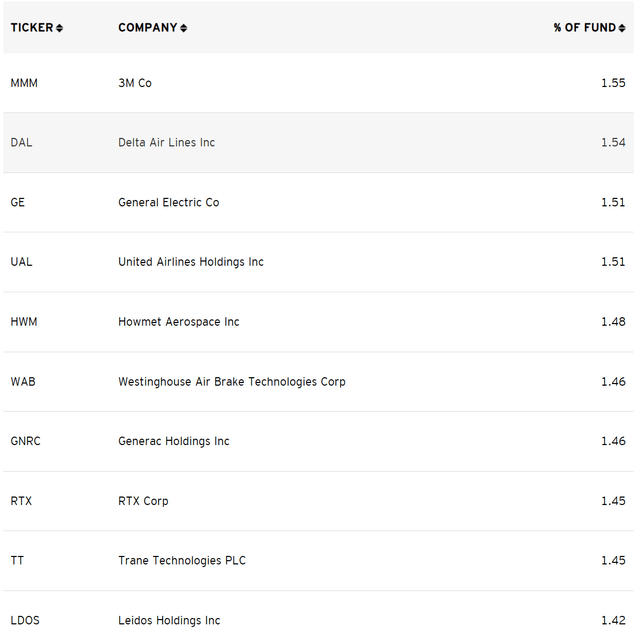
Notice that no position makes up more than 1.55% of the fund, and that the portfolio is very nicely spread out overall, not just by position size but types of companies. For instance, a leading aerospace and defense manufacturer in the fund’s portfolio highlights the importance of national defense and space exploration. Similarly, including major machinery companies highlights the role of construction and agricultural equipment in global development.
Sector Composition
Keep in mind that equal weighting of stocks is not the same as equal weighting subgroups within the sector. Machinery makes up 21.65% of the fund as the largest allocation, followed by Aerospace & Defense. I mention this because the tilts in the fund that happen naturally from the equal weighting positioning will still result in some degree of concentration risk if, for example, the Aerospace & Defense sub-industry suffers a broader setback/less funding from the government (unlikely but still possible).
invesco.com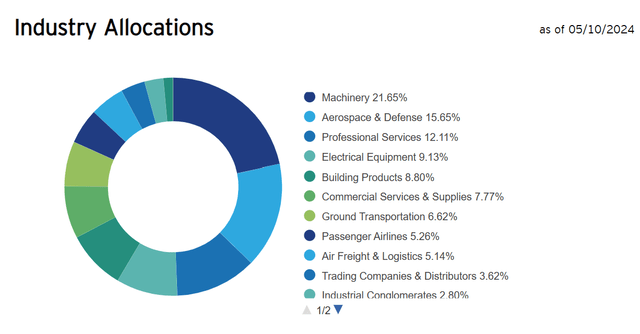
Competitors
When compared to other ETFs focusing on the industrials sector, RSPN’s equal weight strategy is clearly the biggest differentiator. Other ETFs, such as the Vanguard Industrials ETF (VIS) and the Industrial Select Sector SPDR ETF (XLI), follow a market cap-weighted index approach, which can lead to a concentration of risk in the largest companies. In contrast, RSPN’s equal weight approach offers a more even representation of the industrials sector, potentially leading to less volatility and a more stable performance over time. The interesting thing here is equal weighting industrials has actually already outperformed market-cap, and I expect this to continue as breadth widens.
StockCharts.com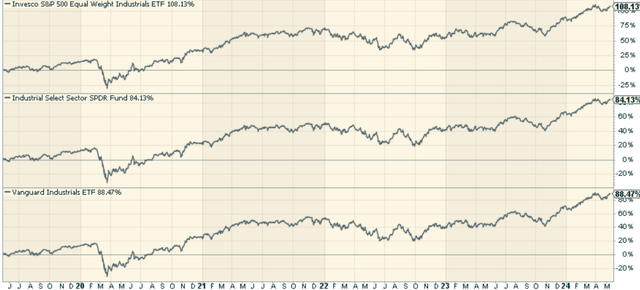
Pros and Cons
On the plus side? The equal weight strategy provides really nice diversification to the sector, reducing the impact of any single company’s performance on the overall fund. This can lead to more stable returns and lower volatility. Additionally, the industrials sector is poised for growth, driven by infrastructure development, defense spending, and technological advancements. There is downside, though, which is more cyclical by nature. The sector is susceptible to economic cycles, with demand for industrial products and services often linked to the broader economic health. This can introduce volatility and risk, particularly in times of economic downturn. It’s been a while since we’ve seen that, but it is a noteworthy risk.
The industrials sector broadly has big catalysts in its favor. These include increased infrastructure spending by governments worldwide, which directly benefits companies involved in construction, engineering, and machinery. Additionally, the global push towards sustainability and renewable energy sources is driving demand for innovative solutions in energy efficiency and green technologies, areas where many industrial companies are key players. None of this is going away, and those trends remain very early from a big picture perspective.
Bottom Line? A Great Fund
RSPN makes a ton of sense. The performance has been hot, it’s in the right sector for longer-term growth, and its equal weight strategy mitigates the risks associated with market cap-weighted indices, providing a more balanced and stable investment option. While the sector’s cyclical nature introduces some level of risk, the potential for growth and the diversified exposure offered by RSPN make it an attractive option. Worth considering an allocation here. With investors in love with Tech, industrials deserve far more attention for their performance in the last several years.
 Anticipate Crashes, Corrections, and Bear Markets
Are you tired of being a passive investor and ready to take control of your financial future? Introducing The Lead-Lag Report, an award-winning research tool designed to give you a competitive edge.
The Lead-Lag Report is your daily source for identifying risk triggers, uncovering high yield ideas, and gaining valuable macro observations. Stay ahead of the game with crucial insights into leaders, laggards, and everything in between.
Go from risk-on to risk-off with ease and confidence. Subscribe to The Lead-Lag Report today.
Click here to gain access and try the Lead-Lag Report FREE for 14 days.
Credit: Source link