

gorodenkoff
Investment Action
I recommended a hold rating for Rockwell Automation, Inc. (NYSE:ROK) when I wrote about it the last time, as I thought the valuation had already priced in any upside for the stock. Following the fiscal Q1 results, and based on my current outlook and analysis of ROK, I again recommend a hold rating. I believe there is a high chance for ROK to miss its FY24 guidance or potential downgrade it given the implied acceleration in order growth seems to be too much, especially when compared to the organic growth outlook. Also, the return profile is not attractive at all, in my opinion.
Review
Rockwell Automation, Inc. fiscal Q1 2024 sales came in at $2.05 billion, driven by stronger sales in software and control and lifecycle services, offset by weaker intelligent devices. Segment operating margins contracted 292 bps, as a sharp decline in margins in Intelligent Devices and Software & Control outweighed margin expansion in Lifecycle Services. On a consolidated basis, ROK saw blended segment margins of 17.3%, or $356 million, 11% lower than in fiscal Q1 2023. As a result, adj EPS came in lower at $2.04 vs. $2.56 in Q1 2023. Management maintained 2024 EPS guidance at $12 to $13.50 and the organic growth range to remain unchanged at -2% to 4%. Total orders are still expected to increase by low single-digits for FY24, with segment margins remaining at ~21.5%. End-market expectations are also all unchanged.
I am leaning towards a sell rating for ROK in the near term because the risk of meeting management FY24 guidance is too high based on the information we have today. Because of this uncertainty, I expect the market to take a risk-off approach and stay on the sidelines for this (as can be seen from the immediate share price reaction after the earnings). The biggest uncertainty here is the implied order growth for 2H24 that management has hinted they have no visibility for.
Sure. Let me just clarify that the shift that’s going on that we saw challenges in the first quarter was the move from servicing backlog of products to shipping out book-and-bill of products, where the orders come in, in the quarter. We continue to have a certain amount of configure-to-order business, our motor control centers, our big drives, our independent cart technology and so on. That isn’t representing the biggest challenge to us. Those are very different processes. Those configure-to-order businesses come in with varying degrees of customization specific to a customer. But the big dynamic that we’ve been talking about in Q1 is the move from a somewhat concentrated list of SKUs that we had backlog building — that backlog build-up because we couldn’t get the chips, moving to book-and-bill of a more diverse set of SKUs, as we see the largest portion of our shipments coming from orders received in that quarter, not one or two or three quarters prior. So that’s the main dynamic that we’re working through. You have much less visibility to what’s coming in from that book-and-bill profile. Q1 2024 earnings call.
Author’s work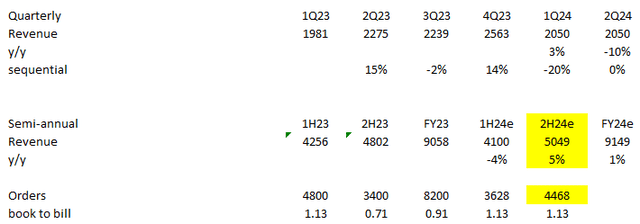
Starting from the revenue line, management mentioned that 2Q24 will see similar sales as 1Q24, which means 1H24e should see around $4.1 billion in sales. Using the midpoint of the FY24 sales guide (1% growth), we can back into 2H24 implied growth of around $5.05 billion in sales. ROK had a book-to-bill ratio of 1.13x in 1Q24, which is roughly the same as the historical average of around 1.14x. Assuming the same book-to-bill ratio for 2H24, this implies $4.47 billion in the order figure.
Author’s work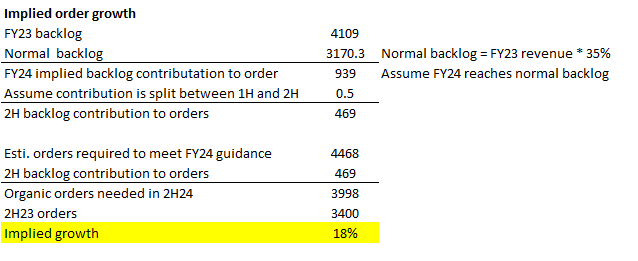
Author’s work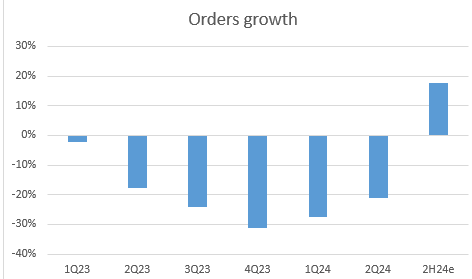
Of the $4.47 billion implied order figure, we have to adjust for the contribution from ROK’s backlog to derive the implied underlying organic order growth for 2H24. As of FY23, ROK has a backlog of $4.1 billion, and assuming that FY24 will see the backlog go back to a normalized level of ~$3.2 billion (the normalized backlog is 30 to 35% of revenue; I assumed 35%), this implies a backlog contribution of around $940 million in FY24. Splitting that evenly across the two halves implies a backlog contribution of ~$470 million. Deducting this $470 million from the estimated orders needed for 2H24 to meet the FY24 guide, my analysis suggests that ROK will need ~$4 billion of organic orders in 2H24, which is an 18% growth vs. 2H23. The implied 18% (or high-teens) growth required is a big hurdle for me to be convinced that FY24 is achievable at this point, given the low visibility. This also implies significant sequential improvement from 1H24 and the entirety of FY23.
Yeah, what I said on the last call was that we expect the backlog in a more normal range of 30% to 35% of our revenue. I think that we still see that as a good point. Q3 2023 call.
As such, I think there is a high chance for management to miss their guidance or be forced to downgrade guidance in the near term. Based on the current demand trends (order), it is just hard to believe ROK is going to see a huge ramp. I mean, management did not give a lot of color regarding the backlog as well. I am giving the benefit of doubt that the backlog will normalize in FY24. If it doesn’t, the implied organic order growth required is even larger, which makes believing it is achievable even harder.
Valuation
Author’s work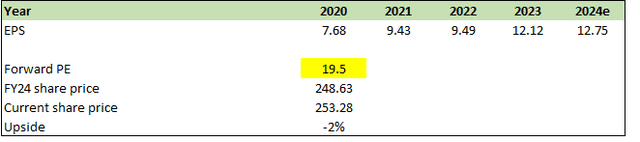
Even if I were to think that the guidance is achievable and ROK actually achieved it, the upside is not attractive at all. Management is guiding for ~$12.75 (midpoint) in adj EPS for FY24, and if we attach the current multiple that ROK is trading at (19.5x forward P/E) to $12.75, this implies a share price of $248, which is around the current price that it is trading at. What this implies is that the market has to rerate the market upwards for any potential upside.
Author’s work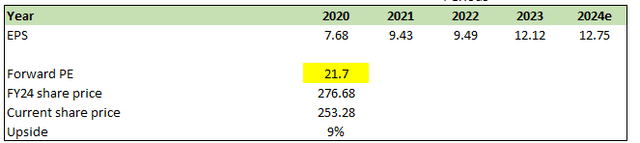
Again, even if that happens, assuming valuation sees a mean reversion to 21.7x forward P/E, the upside is 9% from here. I just don’t see how this return profile is attractive, considering the likelihood of a guidance miss.
Final Thoughts
In summary, I maintain a hold rating for Rockwell Automation, Inc. due to concerns about the potential miss in FY24 guidance. Management’s maintenance of 2024 guidance relies on an implied acceleration in order growth, posing high risks given the lack of visibility for 2H24. My analysis suggests an 18% organic order growth is required for FY24, which I think is hard to achieve as it implies major acceleration that seems unlikely given the current trend. Even if Rockwell Automation, Inc. meets guidance, the stock upside is limited. As such, I am staying with my recommendation.
Credit: Source link