Large language models (LLMs) have become fundamental tools in natural language processing, significantly advancing tasks such as translation, summarization, and creative text generation. Their ability to generate coherent and contextually relevant text based on human instructions makes them valuable across various applications. These models leverage vast amounts of data to learn patterns and relationships in language, enabling them to perform tasks that require understanding context, syntax, and semantics.
Despite their success, LLMs face challenges consistently adhering to logical constraints during text generation. These constraints include avoiding certain words, maintaining coherence, or following specific logical sequences. The difficulty lies in conditioning LLMs to reliably incorporate these constraints without additional training or complex algorithms. The need for models to follow particular guidelines during generation remains critical, especially in sensitive applications where accuracy and adherence to instructions are paramount.
Current methods to impose constraints on LLMs include search-based decoding algorithms and auxiliary neural classifiers. These approaches either need to scale better with sequence length or require extensive training for each new constraint. The GeLaTo framework introduced tractable generative models to guide LLMs but was limited to specific types of constraints. These methods often need to be revised when dealing with complex or dynamic constraints, highlighting the need for a more flexible and scalable solution.
Researchers from UCLA have introduced Ctrl-G, an adaptable framework designed to enforce logical constraints on LLM outputs. This framework integrates any LLM with a Hidden Markov Model (HMM) and uses deterministic finite automata (DFA) to represent logical constraints. Ctrl-G’s ability to distill an HMM as a white-box model that approximates the LLM and guides it during inference. This ensures reliable adherence to constraints without requiring further training of the LLM or HMM, making Ctrl-G both scalable and flexible.
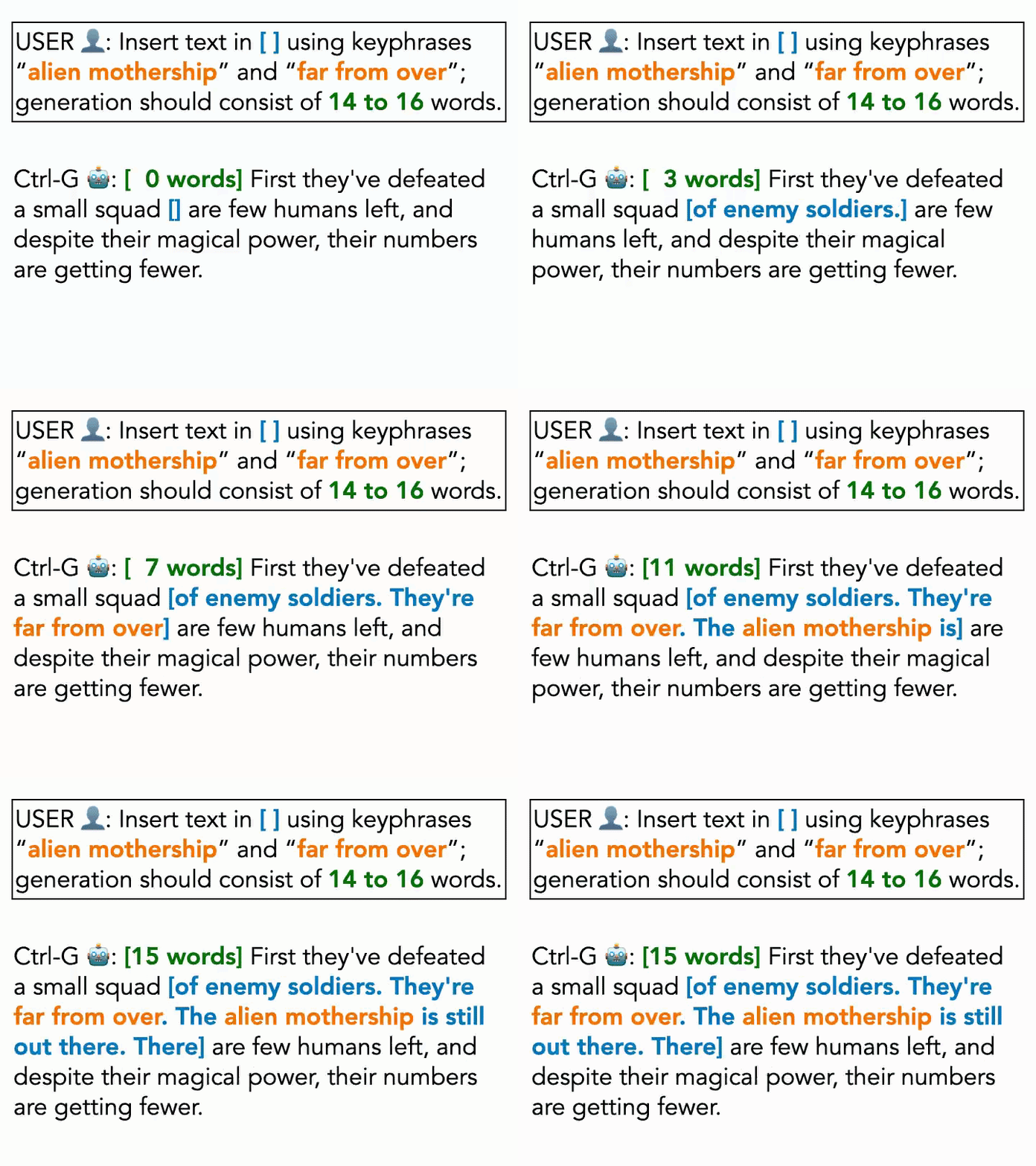
The Ctrl-G framework involves three steps:
- Distilling an HMM to approximate the LLM’s distribution.
- Specifying constraints as DFAs.
- Using the HMM to guide the LLM during inference.
This approach allows flexible and reliable enforcement of constraints without further training of the LLM or HMM, making it applicable to various logical constraints. The distillation process creates a white-box model that mimics the LLM’s behavior, enabling precise control over generated outputs. By representing constraints as DFAs, Ctrl-G can efficiently check and enforce these constraints during generation, ensuring outputs remain within specified guidelines.
In human evaluations, Ctrl-G outperformed GPT-3.5 and GPT-4 in generating text that adheres to logical constraints, achieving over 30% higher satisfaction rates. Specifically, for tasks like interactive text editing, Ctrl-G demonstrated superior performance by consistently producing text that meets logical constraints. When applied to medium-sized models like GPT-2 large, Ctrl-G significantly improved constrained generation tasks, achieving a 100% constraint satisfaction rate. In one benchmark, Ctrl-G used the TULU2-7B model and achieved over 90% constraint satisfaction, substantially improving over existing methods.
The research team also explored the adaptability of Ctrl-G on various benchmarks. For example, in the Grade School Math benchmark, Ctrl-G improved the reasoning abilities of LLMs by providing logical constraints during the reasoning process. This application highlighted Ctrl-G’s potential beyond traditional text generation tasks, suggesting its utility in enhancing the performance of LLMs in diverse domains. By conditioning LLMs on logical constraints, Ctrl-G demonstrated its ability to improve model performance in generating coherent and contextually accurate outputs.
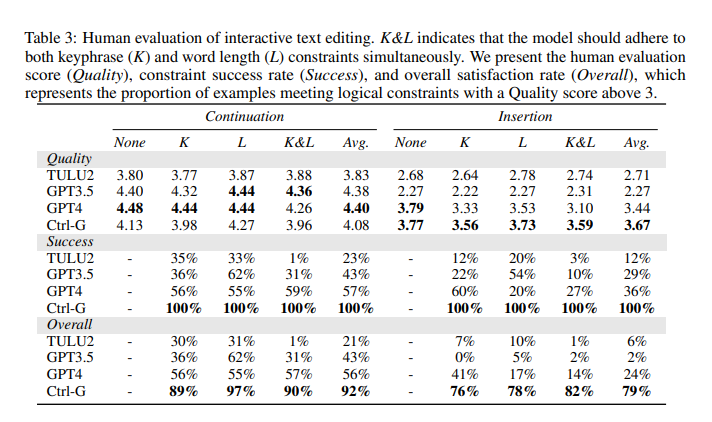
The research highlights Ctrl-G’s ability to enhance LLMs’ adherence to logical constraints, making it a versatile and powerful tool for controlled text generation. By addressing the limitations of previous methods, Ctrl-G offers a scalable and reliable solution for applications requiring fine-grained control over LLM outputs. The framework’s adaptability and performance improvements make it a valuable contribution to natural language processing.
Overall, the introduction of Ctrl-G marks a significant advancement in the control and flexibility of LLMs, paving the way for more reliable and contextually accurate text generation. This research underscores the importance of continued innovation in developing methods that enhance the capabilities of language models, ensuring they can meet the demands of various applications and adhere to complex constraints with high accuracy.
Check out the Paper. All credit for this research goes to the researchers of this project. Also, don’t forget to follow us on Twitter.
Join our Telegram Channel and LinkedIn Group.
If you like our work, you will love our newsletter..
Don’t Forget to join our 45k+ ML SubReddit

Nikhil is an intern consultant at Marktechpost. He is pursuing an integrated dual degree in Materials at the Indian Institute of Technology, Kharagpur. Nikhil is an AI/ML enthusiast who is always researching applications in fields like biomaterials and biomedical science. With a strong background in Material Science, he is exploring new advancements and creating opportunities to contribute.
Credit: Source link